I'm currently visiting South Korea and have some family (grandfather, great-uncles and aunts, etc.) that fled from the North to the South after the war started. I visited a cemetery specific to North Koreans and was surprised by the huge number of people in the 1950s who fled from North Korea to South Korea. It's surprising to me because my understanding is the South had a very low standard of living compared to the North at the time, and both of them were headed for military dictatorships, so it wouldn't have been clear at the time which side would end up being the better side to live on. I have a couple questions around this:
In Barbara Demick's book "Nothing To Envy", which engages in several case studies of modern North Korean defection, she notes that most young, able-bodied men in South Korea were apolitical at the time of the war. Traditional Korean rivalries were generally between the eastern (Japanese oriented) and western (Chinese oriented) halves of the peninsula, rather than the North-South demarcation made between the US and USSR. She does note that some South Korean rice farmers were sympathetic to the North due to a rumor that the Communist government would give out free land, but it is unclear that many of them would flee north because the majority of good arable land is located in the south.
She also discusses general migration trends in the war years. Tens of thousands of Koreans living north of the 38th parallel, mostly businesmen, landlords, Christian clergy, and Japanese collaborators from WWII, fled south fearing Communist persecution, while "a smaller number" of Communist sympathizers moved north. Many others were simply moved around due to the back-and-forth battle lines during the Korean War.
As for whether they knew they would ever be able to return, Demick asserts that in the case of a South Korean conscript named Tae-Woo, who was captured by the Communists during the war, the deciding event that meant "never going home" for him and other POWs was the 1956 order issued by the North Korean cabinet that gave all South Korean POWs certificates of citizenship. Effectively, though, his life as a South Korean ended upon his earlier capture and forced labor in a coal mining camp compared to his life as a rice farmer in the South.
Another interesting migration pattern was that of ethnic Koreans living in Japan, who numbered about two (2) million. Although they represented many levels of Korean society (from elites to conscripts from WWII), they were generally all treated as an inferior minority. After the Korean war, many become North Korean nationalists and affiliated themselves with a group called Chosen Soren, the General Association of Korean Residents in Japan, seeing North Korea as more anti-Japanese and believing much of the North Korean propaganda regarding the strength of the economy. About 80,000 of these Koreans in Japan emigrated to the North post-war, most of them with superior wealth than native North Koreans, but occupied a low post in North Korean society due to their foreign ties as well as relatively independent wealth.
Barbara Demick, Nothing To Envy, Ch. 2, Tainted Blood (Spiegel & Grau Trade Paperbacks, New York) (2009).
First, let's talk about the differences between the north and south of Korea in 1945. The population of Korea at that time was 25 million with 9 million living in the north and 16 million living in the south. The south has always been more populous - it has fewer, less rugged mountains, and more, better farmland. It's also home to the former capitals of the Silla and Baekje kingdoms, as well as Hanyang/Seoul, capital of Joseon. While the northern part of Korea was more industrialized and there were more opportunities for jobs off of the farm, unless a person was living in Pyongyang, or, to a lesser extent, Hamheung or Wonsan, then life would have sucked. Northern Korea was home to all the major dams built by Japan and generated the vast majority of Korea's electricity, and it also had the majority of heavy industrial output. Southern Korea also had a cement factory, light industry (mainly textiles), and a car factory in Bupyeong (which is still, to this day, a car factory - GM Korea), and the areas around Seoul and Busan/Masan were industrial sites. One of the largest problems, however, was the that the north cut off electricity to the south in 1948. With no electricity, no Japanese supplies or markets, no Japanese technicians, the industrial capacity of the south dropped to 20% of it's 1945 capacity.
Your average Korean living in the countryside would probably be better off in the south when it comes to food, and would have more opportunities to get off the farm if they lived in the north. The other thing to remember is that until 1945, Japan was taking the lions share of the profits from Korea. Once WWII was over, Kim Il-sung and the communists began taking the profits in the north, so while the north might have been economically stronger than the south, the peasants would have only seen marginal improvements.
Also, your comment that
both of them were headed for military dictatorships
is completely false. The ROK government was elected in 1948. Park Chung-hee would not stage his coup until May of 1961.
The Interwar Period
Cho Man-sik, an anti-Japanese fighter, became the head of the Committee for the Preparation for Korean Independence, a group made up of 20 members, 2 of whom were communists. When the Soviets arrived, they kept Cho in place (he was a strong and popular leader) while appointing more communists to positions of authority. By November, Cho was out of the CPKI and formed a new party, the Korean Democratic Party. While all this was going on, the Soviets continued to bring in Soviet Koreans to take over, usurping control from the well known local leaders who had fought against the Japanese.
In the south, the United States brought in overseas Koreans as well, namely Syngman Rhee, but he was at least part of the Provisional government. While history hasn't been kind to him (for good reason), and while many people wanted Kim Gu or one of the other members of the Provisional government, Rhee was not an outsider like the Soviet Koreans were in the north. Further, the US commander in Korea, General Hodges, snubbed the Korean People's Republic (KPR), a broad coalition of Koreans who were looking to run the country. The result was that the moderates and conservatives left the party, leaving only the radical communists. Without others to temper them, they made the KPR seem crazy which further marginalized them and alienated them from the people of the south. Anyone in the south who was looking towards communism would have seen a Soviet puppet regime in the north and a party of crazies in the south.
How many people fled to the south?
From 1945-1953, 900,000 people left the north for the south. This represents 10% of the northern population. Reasons for fleeing would have been political as well as economic. If people had money in the north, they would not have been safe because they would have been either a) Japanese collaborators or b) landlords, both of whom were persecuted heavily by the northern regime.
Could they ever go home?
People could cross between northern and southern Korea until May of 1946. After then, people needed to obtain a permit to cross between the zones of occupation. Up until the war began, however, people could cross the border. The issue of going home really had to do with the political situation. Until the situation changed, no one would have gone back - that's why they left
A huge portion of people who left did so during the war. When the Korean War began, the North Korean military swept over South Korea in a few months. Anyone who stayed and was seen as a part of the ROK regime was murdered. When the US/UN forces counter attacked and conquered most of North Korea, the South Koreans found the communist collaborators in the south and murdered them. As the Chinese counter attack began in November of 1950 and the US/UN forces were pushed back, any North Korean who had helped the US/UN forces fled with them, knowing that to stay meant death. On December 21 1950, as the US Marines were being routed at the Chosin Resevoir, the SS Meredith Victory loaded up 14,000 North Korean refugees and took them down to Busan and Geoje Island. The boat was designed to carry about 60 people.
Your overall question - would the North or the South have been seen as a better place
The South was seen as better. 10% of the northern population moved there from 1945-1953. Also, the Zainichi (Koreans in Japan) that moved back to Korea generally went to the South, unless they were ideologically communist.
For more information on Korean economic output, check out Korean History in Maps. It has tables of economic output during the colonial and post-colonial eras. My other go-to books are Michael Seth's A History of Korea and Kyung Moon Hwang's A History of Korea (unique titles, I know!)
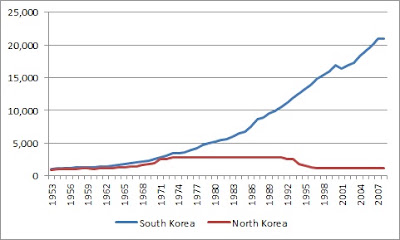
Regarding your statement that the South had a very low standard of living compared to the North at the time of the Korean war, that is not strictly true. Maddison estimated that at the time of separation, North and South had approximately the same income per capita. A graph made by Matias Vernengo that shows the approximate GDP per capita growth of both Koreas, using Maddison's data, is here.
Therefore, it would seem that any decisions at the time of the war would have been based around future prospects rather than current economic conditions.
Maddison, A. (2001). The World Economy: A Millenial Perspective. Development Centre of the OECD, Paris.
Because of the time period and the general governments of the Soviet and American controlled portions of Korea, accounts from the era are mostly anecdotal and oral. Kim Il-Sung's personal memoirs do not cover much of the pre-war period under Soviet rule, but instead covers most of his anti-Japanese actions in the region.
After the war, the Soviet leadership and the American leadership met to discuss Japanese colonies. The division was then agreed upon the 38th Parallel, almost exactly the division discussed in the Yamagata–Lobanov Agreement. The Soviets agreed with the terms quickly and without too much trouble. This split the country in 2 and left the South with approximately 16 million and the North with approx. 9 million.
At the time, the US Military swiftly enacted several major reversals of Japanese and wartime policies. At the time, most adult Koreans were illiterate and mass education was only recently established. The US enacted a swift policy of suppressing Leftists through South Korea, a policy that would continue for years under the Republic. Following the establishment of the First Republic, Syngman Rhee was elected as president. A staunch anti-communist, he established decrees to swiftly stomp out several leftist and communist groups in the South. The Jeju Uprising was one such incident, rebels that believed the one-sided elections would further divide the country revolted. At the end of the uprising, 30,000 had died.
After the establishment of the Provisional People's Committee for North Korea, Kim Il-Sung was selected as the leader. Following the establishment, the government enacted swift reforms to take back land from Japanese landowners and redistribute the land to the people. This, however, also caught Korean landowners as well, as their lands were also taken and redistributed.
The general distribution of the country had many of the industrial factories located in the North and much of the farm land in the South. As time went on the divide between the Soviets and the US continue to grow, leading the Soviets at times to cut off supplies of fertilizer and electricity from the South.
By 1950, both governments had been battling for legitimacy and the right to continue control of the peninsula. The South Koreans were aware of plans from the North to invade and requested troops and weapons from the US government, but were denied from a war weary US. Thus on June 25th, 1950, one year after the US had withdrawn and two years after the Soviets had withdrawn, North Korean forces invaded South Korea.
At the onset of the war, many North Koreans assumed the war would be temporary and fled south. Likewise, some South Koreans fled north as a means to avoid the war. Many on the border, such as those living in Seoul choose to flee as the North Koreans were targeting the rich and the land owners.
The general consensus was that as many as 900,000 North Koreans fled South at the onset of the war, mainly to avoid get caught in the war. Many at the time, were not aware of how the war would leave the country divided. Those that were rich or owned land, knew that the North Koreans would not accept their ownership and fled further South for safety.
In the post war period, both sides experience prosperous growth in the wake of rapid industrialization. Both sides aided in reconstruction by their allies from the Korean War.
I would like to know where you got the idea that the south was anything like the north, this sounds inaccurate, I would like someone to verify the south being a millitary dictatorship and having a low standard of living. It sounds like you have confused vietnam and korea.