Hi Folks,
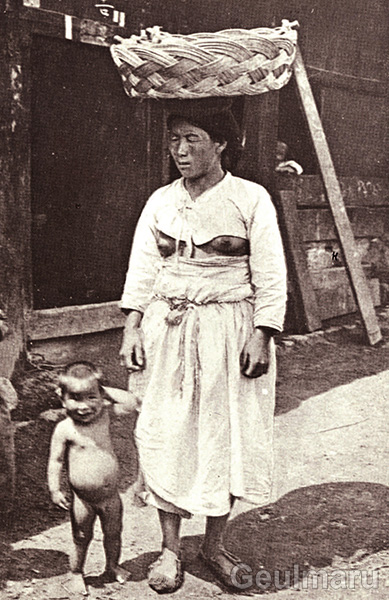
I was in /r/HistoryPorn and saw this picture: http://i.imgur.com/X5W63uV.png
What surprised me is that she indeed has her breast bare and I was wondering why this would be.
From what I can see in the picture, they could make clothes (although it does seem quite restrictive just above the breasts) so that can't be the reason.
It's stated that she just had a son, could it be to facilitate feeding the young one? If that's so, wouldn't there be easier ways?
Anyways, anyone know anything about this type of dress? Was it common in Korea at that time? Any explanation as to why she would run with her breasts bare?
Many thanks ;)
Yes, having clothing that bared the breasts was a thing that happened in the late Joseon Period and the practice died out around the time of the Korean War in the mid 20th century.
Baring your breast was not really considered to be inappropriate (however being completely nude absolutely was).
They definitely could make clothes haha. These were intentional baring of the breasts. There are several theories for this and it isn't clear when or how the fashion originally started.
The main interest in the practice came from, as one might expect, foreigners who visited Korea. For example, take this letter from Sept 2, 1897.
Scores of naked babies slept on their mothers' backs, or crawled about, or took lusty nourishment from bare breasts left uncovered between the skirt and the little jacket of the married woman's dress.
It should be noted that children being naked was very common in Korea, especially rural Korea, even well into the 20th century.
Western observer interest in casually bared breasts, especially in an otherwise incredibly sexually reserved and controlled society, is hardly surprising.
Many of photographic examples that we have today actually are photos taken for postcards (or are those postcards themselves), sent back home to shock and entertain as much as it was for records of posterity. (Really not much different from much Western interest in seeing nude tribal women photos today.)
The clothes did indeed signify the wearer was a mother, and more importantly, that her child was a son. In extremely Confucian Joseon Korea, having a son was much more desirable than having a daughter and mothers would proudly announce to their community when they bore a son. It is said that mothers would often bare their breasts in public in these clothes and breastfeed as a sign of pride.
It is not known if this is exactly how this fashion began but the reason was readily repeated by the Koreans themselves, so who knows.
While many of the photographs and postcards were staged and are a foreign lens into the fashion of baring breasts, there are also native art forms that depicted it such as paintings or even statues.
Let me know if you have more questions!
Hi, friends,
AskHistorians is a place to connect people with questions about history and those who have expert-level knowledge in the topic at hand. Our users happily expect that the answers they receive will be in-depth, comprehensive, and reflective of current academic scholarship on the topic.
Contrary to what your cleverly-named pub quiz trivia team might wish, expert-level knowledge does not include:
Please don't make those numbers out of date. You may consider this post your collective warning. Writing up a great answer can take some time for even (especially!) the best of historians. We ask your patience in the meanwhile.
Thanks!
Quick question. Is that a smoking pipe she's holding, and was it common for women to smoke at that time?
There are already great responses here and I just want to contribute to this thread with more information.
#Brief Photograph Information
The image above was released by Jung Sung Gil, honorary director of museum of Gemyung University in Korea. Director Jung dedicated forty years of his life collecting, restoring, and preserving Korean history. I wrote more about him down below because I did not want to digress too far from the original topic but do check it out because he is awesome.
#Why is it Controversial?
Korea has been known as 동방예의지국 (dong-bang-yeh-eui-ji-guk) which roughly translates to “Eastern Country of Courtesy”. This is because Korean society valued (and still values) respect, courtesy, morality, and etiquette very seriously.
As a result, when the picture above was released (because it looks scandalous), it caused lots of drama among the public as well as the scholars of history and culture.
#Different Opinions
Some researchers who studied traditional folk costumes/clothing argued that about 100 years ago wearing shorter juh-go-li (the jacket wore on top, more examples shown here and here) was a trend so it was easy for breasts to be exposed during labor. The photograph also enraged many due to portraying breast exposing Korean women as “a byproduct of Western Orientalism” as said by OP.
On the contrary, Director Jung (director of museum of Gemyung University) stated that this picture captures the extremely popular male-preference ideology during that time period. (Similar to the Western culture, sons were preferred over daughters in Korea, especially because Koreans really valued the idea of continuing the family name and legacy. Although earlier Korean history, for instance, during Shinla dynasty and Goryeo dynasty, shows fairly equal treatment of both women and men, when Joseon dynasty adapted Confucianism, the treatment of women in society changed because Confucianism ranks the “order of importance”, placing men over women.)
Therefore, according to Director Jung, it was not embarrassing (or necessarily seen as a bad thing) to expose breasts but was actually good to “show-off” that a woman gave birth to a boy.
The following are more photographs of breast-exposing women from Director Jung Sung Gil's collection. (Note that the titles are rough translations done by me so they are not official translations of the original Korean titles.)
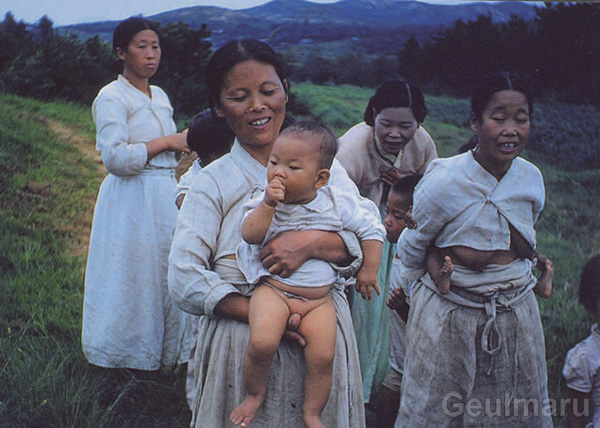
Title: 아들자랑 확인 (Confirmation of Son-Bragging)
Explanation: According to Director Jung, this photograph was taken by a foreign Associated Press photographer who came to Korea as a war correspondent during the Korean War. He went to a village as a volunteer and took this photo of a woman proudly showing off her son to other people.
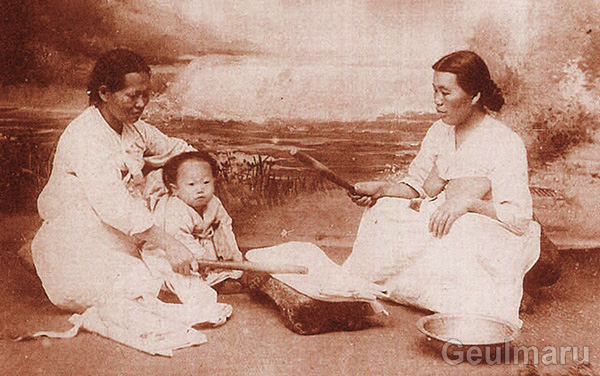
Title: 집안 아들자랑 (Showing off a Son in the Family)
Explanation: The women in the photograph are doing what is called 다듬이질 (da-deumi-jil) which is straightening of clothes. It is different from ironing because heat is not applied to clothes. They beat the laundry (wet with special kind of glue) until it becomes straight. More examples of da-deumi-jil here) Women purposely exposing breast to show off that she gave birth to a boy.
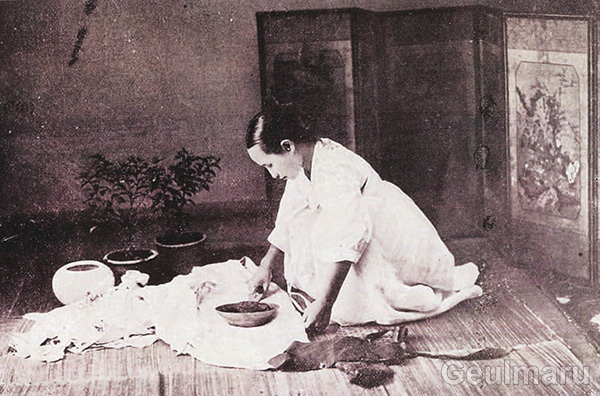
#Photograph 3.
Title: 젖가슴 의도적 노출 (Intentional Breast Exposure)
Explanation: The woman in the photograph is doing what is called 다림질 (da-lim-jil) which is same thing as ironing. Notice that unlike the previous picture 2, she is using a heated 다리미 (da-li-mi) or an clothing iron. One would place a hot coal in the bowl to heat the metal up to iron the clothes. Sometimes sparks from the coal would burn the clothes or skin.
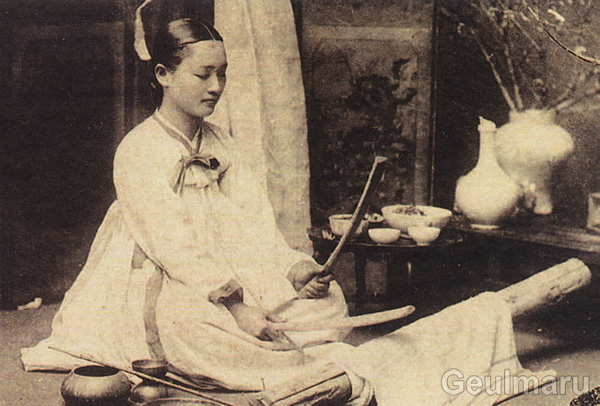
Title: 딸 낳은 여인의 저고리 (Ju-go-li of a woman who gave birth to a girl)
Explanation: This is a picture of a woman who gave birth to a girl so even though her ju-go-li (top jacket) is very short, her breast are not exposed.
Title: 같은 자세 다른 복장 (Same Pose Different Outfit)
Explanation: Three women are standing in a similar pose, carrying a basket on top of their heads. Two women are exposing breast but the woman on the far right is not. This disproves some opinions of folklorists and scholars of traditional folk costumes/clothing who argue that breast exposure was simply due to trendy shorter top/jacket designs (and therefore naturally exposing breasts).
Title: 아들과 함께 젖가슴 노출 (Exposing breast with Her Son)
Explanation: This woman who is also carrying a large basket on her head is exposing her breasts as well. Unlike the previous picture 5, her arms are down and she is standing straight. This further shows that breast exposure was not because of shorter ju-go-li designs but was actually symbol of pride of giving birth to a son. Also the boy in the picture is very cute.
#Further Notes:
This topic of breast-exposing women were also discussed and written in the dairy of Oliver R. Avison, who was a Canadian missionary/doctor living in Korea from June of 1892 to November of 1935. He served as the fourth director of Chejungwon (the very first western hospital in Korea by government of Joseon dynasty) and also the principal at the Severance Medical School.
He-won Shin Yoon Bok was a renowned Genre artist of the late Joseon dynasty (period from 1637 to 1897). He painted lots of day-to-day lives of ordinary Koreans (painting topics: pocking fun at the government officials, satirical paintings, romantic relationship between lovers, beauty of women, etc.) You can read more about the artist and his works here. One of his art works is the <아기 업은 여인> (roughly translates to “A Woman Piggybacking a Child”) A woman piggybacking a baby is painted with her breasts exposed. Her specific style of clothes indicate she is a 기생 (gi-seng), female artists who worked to entertain others such as 양반 (yangban) or noblemen and sometimes kings. More about them here if you are interested.
Gi-san Kim Joon Geun, another great Genre artist during the 19th century, painted <쌀 쓸난 모양> which portrays two women pounding grain in a mortar. One of the women is bearing her breasts. His other work <밭으로 점심 이고 가는 모양> (Carrying Lunch to the Field) also shows a breast-exposing woman (mother) with her son who is not wearing any pants. Another example of intentional breast exposure to show off birthing of sons. Similar to Shin Yoon Bok, Kim Joon Geun also painted many artworks portraying ordinary lives in Joseon dynasty so if you want to check them out, click here. Website is in Korean but you can still view the paintings. If you have any questions about any of them, please let me know and I would be more than happy to explain!)
#Sources:
Korea Times, 3 July 1985.
글마루 Geulmaru Magazine, 4th Anniversary Special Edition, written by Baek Eun Yung.
민중의 소리 Voice of the People Newspaper, November 2013, article written by Kim Han Su.