Credit to /u/delayT3 for this week's theme!
AskHistorians fields a lot of questions about wars--their causes and especially their operation. But what about the aftermath? How is "peace" brokered, and what kind of peace is created? Tell us a story from your era of expertise of a time of peace or "peace"!
Next up: Literal Skeletons (in the Metaphorical Closet) - archaeology experts, your turn!
This theme excited me enough to make me prepare in advance.
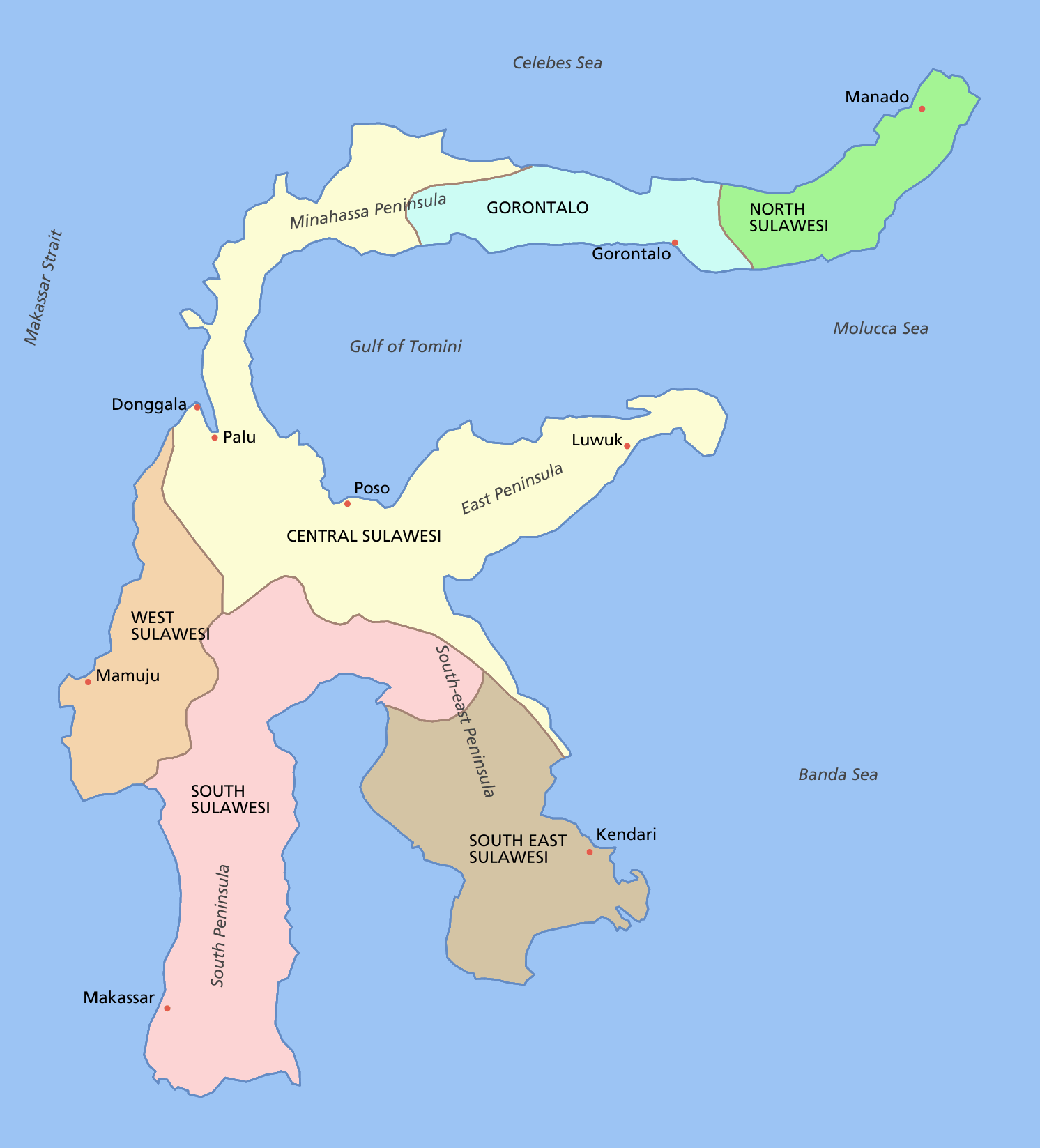
Map of Sulawesi. Confusingly South Sulawesi refers specifically to the southwest peninsula and some adjacent areas. The city marked 'Makassar' there was the capital of 17th-century Gowa, while major Bugis kingdoms are more east.
My main sources for this are works by Leonard Andaya: specifically the recent(ish) "Nature of War and Peace among the Bugis-Makassar People," but also his regrettably extremely dated article "Treaty conceptions and misconceptions: a case study from South Sulawesi." The sad thing about Southeast Asian scholarship (especially in English) is that there are so few academic sources that you end up having to rely on dated ones. As far as I know the most comprehensive Western-language source of the Java War remains a six-book series in Dutch written around 1900...
For there to be peace, there must be war. So I'll spend quite a lot of the first part of this comment talking about the perception of war.
The peoples of South Sulawesi (the Bugis and the Makassarese) have been famed and feared for their martial prowess throughout the lands below the winds, as some call the Southeast Asian archipelago. The Dutch called the powerful Makassarese empire of Gowa "the fighting cock of the east," while Bugis adventurers founded a royal dynasty in Aceh, 3,000 kilometers northwest of Bugis country. And when a Malay storyteller needs to show how great his hero is, he has the hero fight and defeat - of course - the peoples of South Sulawesi.^1
The Bugis and Makassarese themselves would probably have agreed. Warfare was a recurring event in South Sulawesi, and accordingly the region was quite militarized. Warfare had popular resonance, which is reflected in war songs (osong):
Sway, sway with the weapons, the clothing of the brave,
Let them shine, let them shine,
There beyond the endless mountain chains
On the marketplace of shields,
On the battlefield,
Where heroes like courageous fighting cocks clash.
But war in South Sulawesi was not simply fighting between men for practical reasons. Elite warriors (pabbarani) were so venerated that they were believed to have "white blood," a marker of divine descent.^2 It was also an opportunity for the relationship between the ruler and the ruled to be renewed through the oath of loyalty (mangngaruq), an oath that gave courage to the troops in the face of death. From a Bugis chronicle:
[The king, seeing his troops flee, said] "Are you not ashamed, my intrepid warriors, that you have let yourselves be put to flight? Do you not recall the unwavering oath and overstated words you uttered?"
Shame [the warriors] felt in their hearts, as they recalled the unwavering oath and overstated words which they uttered. They all wished to give their lives for the land of their birth. Together they attacked the [enemy] troops...
War among the Bugis and the Makassarese was also a war of supernatural forces. Banners and drums or the sacred weapons in a kingdom's palladium were all imbued with spiritual significance.^3 Troops meditated and studied magic before fighting, fortresses incorporated graveyards and sacred sites, and during a war against the Dutch in 1859, a Bugis leader called upon 40 organ-eating demons.
But what was the purpose of wars? There were wars of conquest, to be sure, but they did not involve creating a uniform administration. In Gowa's wars of expansion, the vanquished accepted Gowa's authority but retained their independence. Heck, even an alliance specifically created to defeat Gowa was allowed to function under Gowa hegemony! In South Sulawesi, kingdoms were conceived as people and interstate relations as relationships between individual humans (family relationships or a master-slave relationship). Wars were events by which a state could improve its position in the interstate hierarchy.
Peace, then, also had to be more than just a cessation of hostilities. Rather, it established personal, familial relationships between kingdoms by which the signatories could gain security.
Generally, there were no punitive indemnities the vanquished had to pay (the leniency of peace treaties is discussed in more depth in the next post). Rather, what was paid was a sebbu kati, a sort of fine embedded in the sacred number 3, such as three types of items or three of a specific item.
Once this had been paid, relationships were formally reestablished through a treaty, or the giving of words of honor (makkuluada or ma'ulukana). As I briefly noted earlier, the relationship between victor and vanquished was defined in terms of a familial relationship common in Austronesian societies: brother and brother, older and younger brother, parent and child, master and slave. These settlements defined the status of the signatories. The aim of kingdoms in South Sulawesi was "to maintain proper status differences" through which a kingdom could gain protection, just as a child could be protected by his parent. Treaties held power because they were accepted by all to be the way to preserve the harmony of society, just as family ties preserved the harmony of society on a smaller level. Indeed, the empire of Gowa, facing collapse before a Bugis-Dutch alliance in the Makassar War in the 1660s, had this to say to its vassal:
Go home and seek your own welfare because Gowa is hard-pressed and can no longer provide you the wings under which you can shelter.
The treaties of peace that Gowa had signed following its wars of conquest obligated the vassal to help its "father" and Gowa to provide for its "child." Gowa was no longer capable of meeting these obligations, and the power relationships of Gowa and its vassals were broken. Like this, family ties could also change depending on the geopolitical circumstances. After the Makassar War the Dutch replaced Gowa as the parent of the Bugis kingdoms, the children.
The strength of family ties in treaties is shown by the behavior of the kingdom of Soppeng in the late 16th century. Gowa was becoming far too powerful, and the three Bugis kingdoms of Bone, Wajoq, and Soppeng decided to ally. But Soppeng was so weak that it asked to enter a parent-child relationship with Bone and Wajoq. Bone and Wajoq each gave up some of their territory to Soppeng so that Soppeng could be the youngest brother and not a child. The conception of alliances as family members was so strong that it made Bone and Wajoq do things which would not make sense in realpolitik.
There is, however, a different type of peace. It is the ceppa or cappa, literally meaning "to take part in something." A ceppa is not an exchange of oaths (sitelli), a sworn word of honor (makkuluada), or even a promise (ma'janci). It is, very literally, something that the signatories participate in. This type of peace is rarely mentioned in the chronicles, but the most notable exception is the Treaty of Bungaya of 1667, which the Dutch and their allies forced on a vanquished Gowa. The extremely punitive treaty that the Dutch had enforced on Gowa was, perhaps, not a treaty that held the full range of ritual significance that words of honor had (I include the terms of Bungaya in my notes, it might be nice to contrast the lenient terms of normal peace treaties in South Sulawesi - explained in detail in the following section - with Bungaya).
October 2016. Juan Manuel Santos wins Nobel peace prize despite rejection of Farc peace deal.
FARC is a guerrilla movement involved in the continuing Colombian armed conflict since 1964.
1999–2002 FARC-EP-Government peace process.
After a series of high-profile guerrilla actions, including the hijacking of an aircraft, the attack on several small towns and cities, the arrest of the Irish Colombia Three (see below) and the alleged training of FARC-EP militants in bomb making by them, and the kidnapping of several political figures, Pastrana ended the peace talks on 21 February 2002 and ordered the armed forces to start retaking the FARC-EP controlled zone.
On June 23, 2016 a ceasefire accord was signed between the FARC Guerilla Army and the Colombian Government, in Havana, Cuba. Leaders of several Latin American countries which contributed to the deal, including Cuba and Venezuela, were present. A final peace accord will require a referendum to be approved. During the ceasefire there was a drought of blood.
On October 2, 2016 Colombians voted and rejected a peace-deal with FARC by 50.2% to 49.8%.
Questions:
a) What other peace treaties have been voted on by referendum?
b) If any, what have the results been?
c) How long did renegotiations take, if any were had.