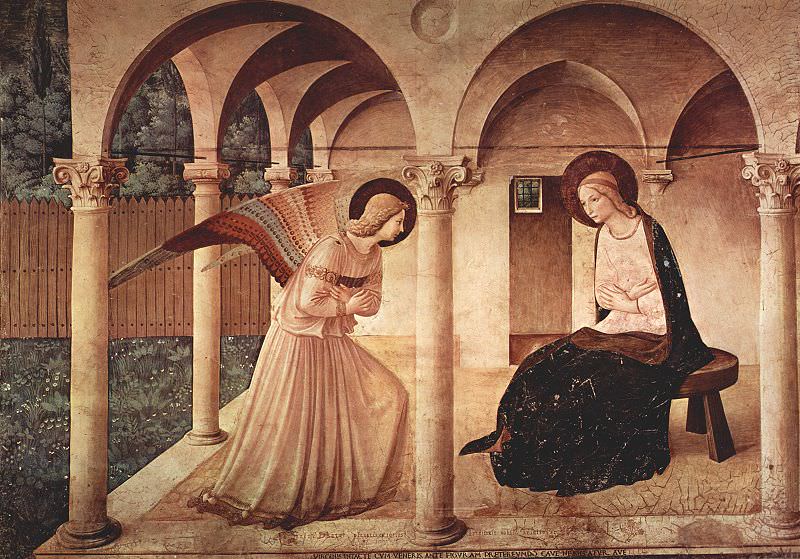
Perspective in old paintings is pretty screwed up a lot of the time, or exaggerated or just wonky. For example in medieval paintings things that are supposed to be behind something are generally painted above it. Why was it so hard for painters to figure out how to portray perspective?
Bonus: What were some of the big breakthroughs in perspective painting?
There was a thread (link below) few years back that had a similar subject, /u/MattJFarrell had a good answer that I think cover some of what you are asking.
https://www.reddit.com/r/AskHistorians/comments/199hmy/how_correct_is_the_view_that_we_lacked_the/
Another important aspect of art is the context, both in terms of when it was commissioned and in terms of who commissioned it. The concept of art mirroring society applied in 1200 CE just as much as it does today. If we look at Western Europe prior to the Italian Renaissance art was almost exclusively commissioned by and for the Church. The goal was not an accurate portrayal of the world, but rather ways to communicate ideas and themes from the faith to illiterate congregations. The focus was on the ethereal concepts of salvation and the afterlife, or as one professor summed it up "God was the measure of all things". The art of the time relied heavily on iconography to convey these ideas, simple images or poses to identify the subject.
With the rise of humanism (Italian Renaissance) this changed to "man is the measure of all things". The reason for this shift is pretty complex (and beyond my skills to encapsulate fully and succinctly), but the art of the time was once again a mirror of the times. A strong and booming merchant class following the plague meant that there were entities outside the church commissioning art with a lot of money, and with different tastes and requests. Religious themes were still prominent, but instead of a somewhat abstract depiction of an event conveyed through iconography the idea of conveying a specific moment with human emotions grew. A great example of this is the competition for the Baptistry doors in Florence, Italy in 1400. The challenge was to depict Abraham sacrificing Isaac. In Brunelleschi's submission you have everything crammed into the scene as though completing a checklist, the scene is somewhat static because it's more about representing the meaning of the story than the event itself. Ghiberti's submission, however, has a sense of movement to it, like we're just catching the climax of the scene and humanising it to relate to Abraham as a person as opposed to a concept. It's that shift in focus from God to man that led to the desire to have more realistic depictions of the world in art, and the emphasis on perspective was just one result of those changes.
Others have explained the way in which pre-renaissance art often is iconographic. Therefore, I will just say that your phrasing of your question implies that painting throughout history was an attempt to recreate realistic images. Which it was definitively not.
I will try and answer your bonus question. Because I see people have left that one in the middle. Bear in mind that I will mostly stick to textbook knowledge, so I'll support it with some general links. I would gladly deliver reading options for any subject that needs support.
The move to a more or less realistic painting style was influenced by a number of philosophical and societal developments in the late 14th and 15th centuries. Most important was the rediscovery of classical manuscripts, and the subsequent study and popularity of those ideas. After Medieval scholastic theology that was mostly based on Aristotelean philosophy, scholars in Europe (mainly, but not exclusive to Italians) started rediscovering classical works: Plato and in the case of painting, sculpture and architecture Vitruvius. That process of rediscovering was sometimes helped by exchange with Islamic scholars, but in the case of De Architectura by Vitruvius, which was a Roman engineer for Emperor Augustus, it was found in Switzerland and published in Florence in the early 15th century. Here it greatly influenced architects and artists, most notably Brunelleschi.
He started making linear perspective drawings during and after a study trip to Rome. Famous artists like Giotto and Fra Angelico were already trying to capture principles of perspective in their works (Angelico wasn't as publicly known). In art history you will always come across the Holy Trinity https://en.wikipedia.org/wiki/Holy_Trinity_(Masaccio) as a pioneering fresco in terms of its usage of perspective. It was created in between 1425-1427 and it is important to understand just how early that is. You can clearly see and appreciate how detailed and studied the use of architectural classical elements are in the fresco. Other Important figures were Pierro della Francesca, Fra Bartolomeo and later, of course, Leonardo Da Vinci; with his famous Vitruvian Man honoring its namesake.
With the rising economic power of Florence and other cities in Italy and the intellectual and artistic golden age that started, the classical style, later called Renaissance (French term) and its proponents quickly changed what was considered to be modern in Europe. By the 16th century, it had taken over all of it and many artists went for long study trips to Italy to learn how to work in the new style. All the while the position of the artist changed. His virtuosity had become important. His mastery of perspective, of realistic textures, the way in which he could encapsulate the ideal form and proportions were now 'iconographical' to a new era and its accompanying paradigm.
(In a side note I like to admit that I myself am more interested in the continuity through late gothic into Renaissance art and culture, but in text books on the history of art and in the view of many of the above mentioned actors, there was a definite breach between them)
EDIT: Fixed links