First off, Kamikaze is a reference to various Tokko (special attack forces) and only formally existed from mid-1944 to the end of the war. The planes involved in the Pearl Harbor attack were to return to their carriers; even the early scrapped plan to have the planes take off at the extreme limit of their range envisioned that some of the pilots would be saved by rendezvousing and ditching next to IJN submarines south of Hawaii. While a deliberate crash landing was up to the initiative of the pilot, the plans were for the pilots to return to fight another day.
The only IJN pilot to crash and survive was Shigenori Nishikaichi, who nursed his wounded A6M towards Niihau Island, a privately-owned and isolated island, where the IJN instructed pilots to crash land and be picked up by the submarine I-74. Nishikaichi persuaded some of the local Japanese community to help him, but tensions with the local Hawaiians- Nishikaichi was armed and tried by force to keep the islanders in the dark about the attack- led to the pilot's death on 13 December.
Nishikaichi's fate is a strong contrast to the midget submarine commander Kazuo Sakamaki. Unlike the planes, the IJN commanders did not expect the midget submarines to return from their attacks. What the IJN did not count on was the utter failure of the midget submarines to even reach their targets. The midgets were difficult to navigate and Sakamaki's boat ran itself aground off Oahu. Sakamaki and his crewmate Kiyoshi Inagaki tried in vain to get the submarine off the coral, and both became weakened and delirious from oxygen deprivation and the noxious fumes from the battery. Both he and Inagaki set the sub's scuttling charges, which failed to detonate, and made their way into the surf. Whether or not they intended to continue the war or surrender is unclear, as the exhaustion led to Inagaki's drowning and Sakimaki passing out on the beach, where he was soon captured.
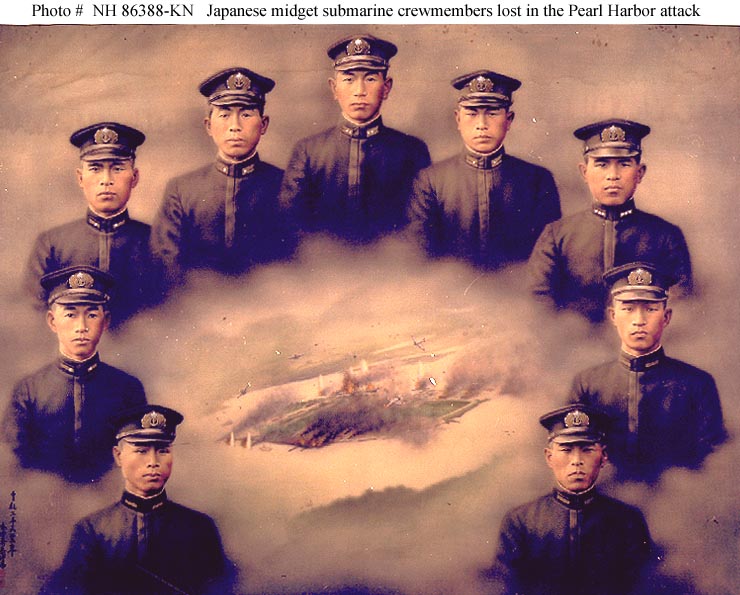
Sakimaki's ultimate fate illustrates what would have happened with other pilots and crewman captured: they would have been treated under the provisions of the Geneva Conventions. The Japanese government received official notice of his capture, as per the Geneva, and accordingly struck his name off the books in descriptions of the attack, such as this famous image of the midgets' commanders in which Sakimaki was absent.
Well, I think that you are operating under a misconception here. Japanese pilots were not synonymous with Kamikazes. At the time of Pearl Harbor, they were highly trained individuals who were conducting a "normal" aerial attack, that is to say using bombs, torpedos and strafing. The use of intentional suicide in planes packed with explosives, known as "Kamikaze" didn't begin properly until 1944. So I would ask if you could clarify which you are interested in here, as the answers would be very different, the capturing of downed pilots at Pearl Harbor, or incidents of Kamikaze pilots who failed in their mission?