The vast majority of people only arrived in a death camp once and the experience would differ whether a person was deported to Auschwitz-Birkenau or one of the other death camps of the Reinhard operation.
With the Reinhard Operation camps, Sobibor, Treblinka, and Belzec, as well as with Chelmno, the experiences differed slightly but remained the same in essence, though we have a really hard time reconstructing that in Belzec and especially Chelmno since there are so few survivors (seven still alive at the end of the war in Belzec, two of whom came forward and five at the end of the war from Chelmno, one of whom came forward to testify).
In Sobibor and Treblinka, it were mostly the uprisings there that left us with testimony what happened. Usually the experience of death and violence already began during the deportation in the trains. Done with freight and cattle cars, which could hold 60 to 70 people, the number of deportees in these train cars was usually double that. Forced to spend hours upon hours in these train cars, deprived of water, heat, and air, many did not survive the initial journey.
Ada Lichtman, who was deported to Sobibor, was selected to be one of the few working in the camp (at most 300 people around any given time) and later escaped to join the Partisans testified about the journey on the train:
We were packed into a closed cattle train. Inside the freight cars it was so dense that it was impossible to move. There was not enough air, many people fainted, others became hysterical ... In an isolated place, the train stopped. Soldiers entered the car and robbed us and even cut off fingers with rings. They claimed that we didn't need them any more. These soldiers, who wore German uniforms, spoke Ukrainian. We were disorientated by the long voyage, we thought we were in Ukraine. Days and nights passed. The air inside the car was poisoned by the smell of bodies and excrement. Nobody thought about food, only about water and air. Finally, we arrived in Sobibor.
After the arrival at the train stations, the deportees were allowed to leave these train cars. In order to maintain the appearance that they were in a "transit camp" they at first didn't see corpses or pits or the gas chambers. SS Unterscharführer Karl Alfred Schluch, who was in the Belzec camp described it as such:
The disembarkement from the freight cars was carried out by a group of Jewish prisoners under the command of their capos. Two or three Germans from the camp staff supervised this action. It was my obligation to carry out such supervisions. After the disembarkation, the Jews were taken to the assembly square. During the disembarkation, the Jews were told that they had come here for transfer and they should go to baths and disinfection. The announcement was made by Wirth [Christian Wirth, German police officer first involved in the T4 killing program and first commander of Belzec as well as inspector of the extermination camps of the Aktion Reinhard] and translated by a Jewish capo.
Kurt Franz, another officer who served in Belzec, described this as follows:
I heard with my own ears how Wirth in a quite convincing voice, explained to the Jews that they would be deported further and before that, for hygienic reasons, they must bathe themselves and their clothes would be disinfected. Inside the undressing barrack was a counter for the deposit of valuables. It was made clear to the Jews that after the bath their valuables would be returned to them. I can still hear, until today, how the Jews applauded Wirth after his speech. This behavior of the Jews convinced me that the Jews believed Wirth...
Another measure often described by survivors and Nazis alike was that when a new train load of deportees arrived to be killed, there would be a small orchestra of inmates playing music or in Sobibor where there was music played through speakers at first. Dov Freiberg, a Sobibor survivor described the scene:
We were separated there, men on the one side, women and children were taken away by the SS men. Where they were taken to, we did not know, but we could hear the screams and laughter of the SS men when they undressed. Afterwards we heard a mixture of noises, a running engine [the tank engine used for the gas chamber], the playing of an orchestra...
The musical selection consisted of a mix of German, Polish, and Ukrainian military marches though some also testified that they as prisoners were forced to sing anti-Semitic songs or that the Germans sang anti-Semitic songs and forced them to dance or to lie flat on the ground while they dance over them. In Sobibor, the orchestra was even forced to compose their own song about the camp with the refrain "our life is happy here/ we receive good food/ how happy we are in the green forest/ where I stay"
Abraham Kszepicki, selected from a transport to bury the bodies of those who didn't survive deportation after arriving in Treblinka testified:
As I stood near the "shower" at Treblinka, I discovered something new. For some time, I thought I heard music. I thought it was a radio receiver installed by the Germans so that – God forbid – they should not be removed from their native culture in this out-of-the-way-spot. Now I could ascertain that their concern for musical culture was even greater. Forty meters from the gas chambers, near the path where the Jews were led to the "showers", a small musical ensemble stood under a tree. Three Jews with yellow patches, three musicians from Stock, stood and played there on their instruments ... They played enthusiastically. It was difficult to make out their repertoire ... these were apparently the latest hit songs favored by Germans and Ukrainians.
As has been hinted above, after the gathering upon arrival, the vast majority of prisoners (usually all but 30 or so picked out for work) were separated between the sexes and lead to and undressing area. This is where the violence started, prisoners were hurried along and beaten and women made to undress in front of hooting SS men and also forced to have their hair cut.
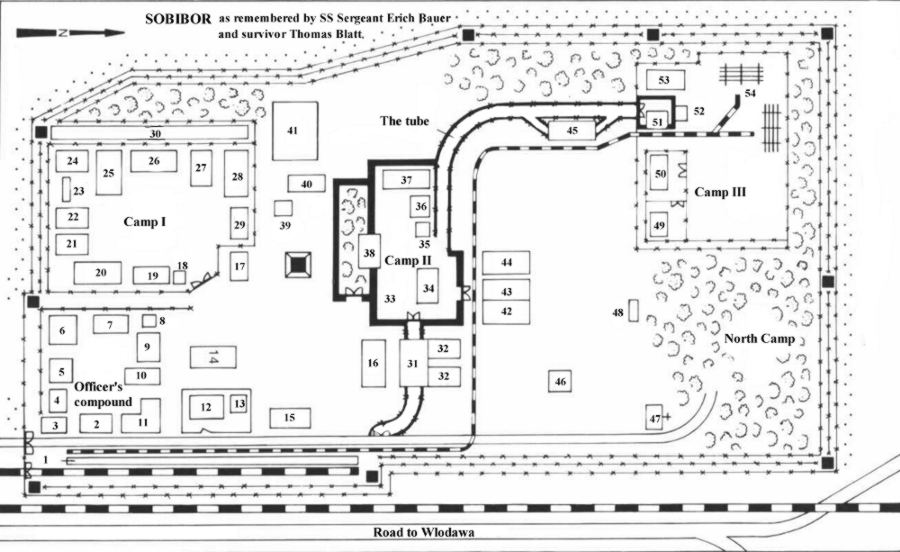
Then they were taken directly to the gas chamber, often first the men but sometimes also the women and children first. This procedure differed slightly in different camps. In Sobibor, the deportees were lead to Camp II to undress, get their hair cut and deliver their valuables and taken trough the "tube" a narrow passage fenced in with barbed wire to the gas chambers. In Belzec, there was no tube but rather a cordon of guards with dogs. In Treblinka a similar way to the "tube" existed.