Let's say I meet a random Italian - could I safely say he had an ancestor that lived in Italy during the Roman Empire?
Yes.
If you are of European ancestry, you could undoubtedly make the same claim as well.
Think about it this way. Assuming you are completely outbred (no inbreeding), you aren't, but a look at the numbers is helpful, you have 256 great-great-great-great-great-great-grandparents. That only covers the last couple centuries or so at the most, and it grows exponentially. Every one of those relatives had 256 great-great-great-great-great-great-grandparents and so on. Eventually you get to the point where you are related to every existing bloodline from cultures that interacted with each other. For instance, if you trace your lineage all the way back to Charlemagne, you would have over a trillion relatives in your family tree. Obviously this isn't possible without some inbreeding (to a minor degree anyway), but it should demonstrate that your family tree is absolutely enormous when you start talking about this much time passing.
So even if you think your entire family came from England, or the middle east, or wherever, there's an extremely high chance there was a Roman citizen somewhere that contributed to your gene pool.
Short Answer: Yes (if they are ethnic Italian that is), and in some localities also from other people.
Long Answer: Maybe it is better to begin from the very beginning: who were the Romans?
The Romans were an Indo-European people, a branch of agriculturist people who began spreading around the 4000BCE. We don't know if this spread was literal in the sense that they greatly outnumbered the by then native people and became the majority themselves or if they were a minority and heavily intermixed with the native people, but in either case we know that they quickly became the dominant group culture-wise and their language and its branches the main one in Western Europe no later than the 1000BCE.
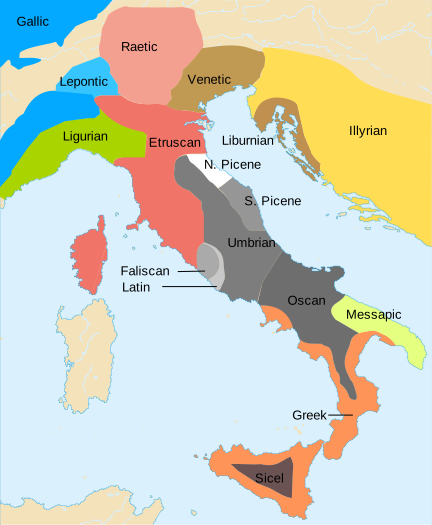
Then, the Romans spoke Latin, which first, it was part of a branch of Indo-European that we call today Italic, and frankly speaking we don't know when that split happened since writing was introduced far later in the region by influence of the Phoenicians (Afro-Asiatics) and Greeks (another Indo-European people) and we don't have a surviving archeological culture that was specially different to discern with that. What we know for sure is that most the people in Italia spoke languages from that branch by the middle of the Iron Ages (600BCE) in the region for surviving scriptures (by the way, the Etruscan and Raetian are not even Indo-European whereas Greek and Gallic are not Italic). Romans with their Latin was one of them, you can see them in the map, they are small!
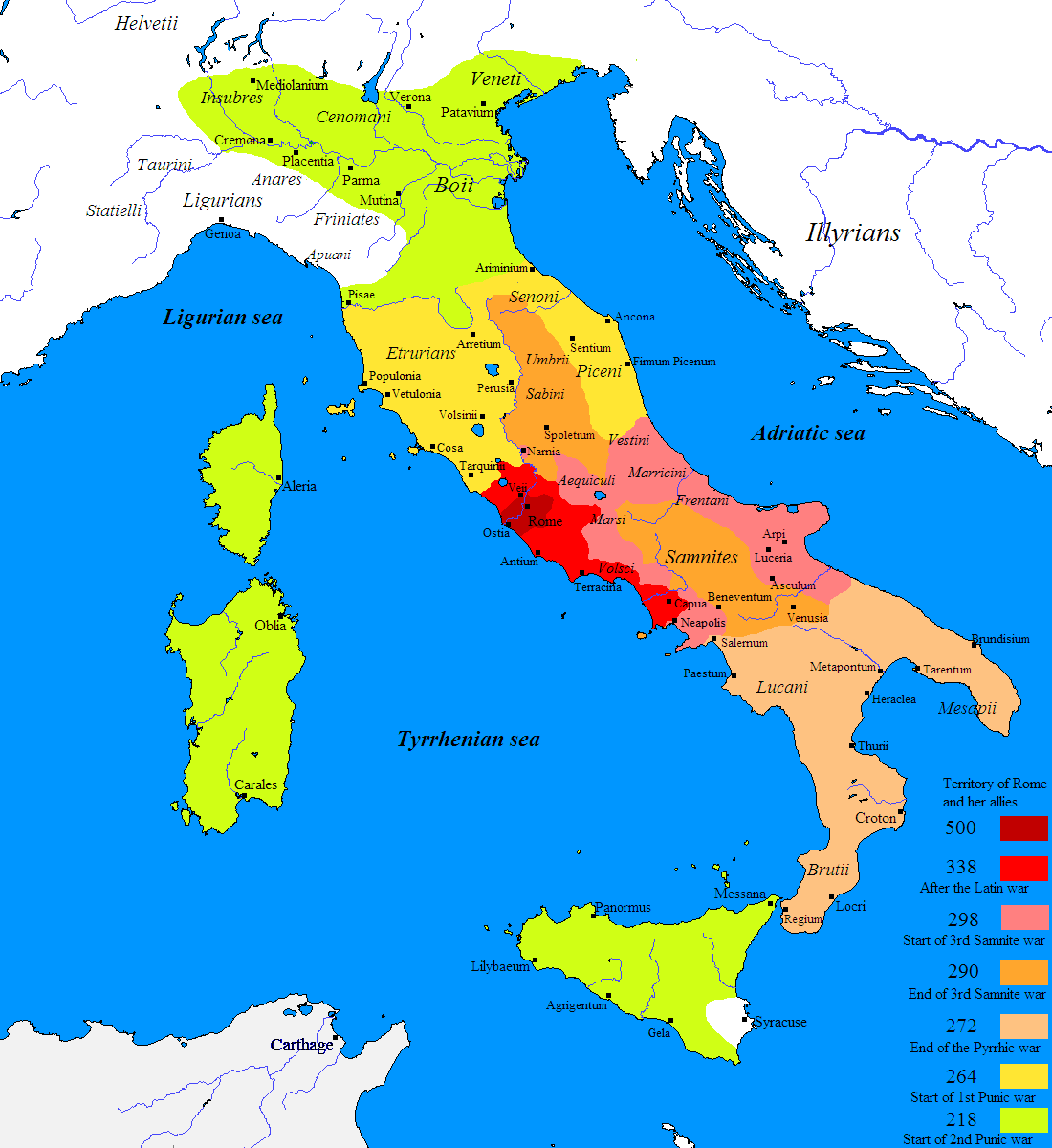
Rome began as a city-state kingdom around the 753BCE, or so says the legends, but that kingdom under unclear circumstances became a republic in 509BCE, the Roman Republic. For a time, this republic was just a minor actor in Italia, but using the Greek city-states as an example to follow and by developing a professional army they began to subdue and conquests the peninsula, beginning with the different Italic kingdoms. We can consider than more than outright converting them into Romans what they actually did was to unify the Italic people into a single state, and the nascent Roman Republic learned greatly from each kingdom and they made them part of themselves.
So from around the 272BCE we can consider that Roman and Italic are the same thing and that both can be considered Romans starting this point (though this process was consolidated gradually through two centuries more): Latin began to spread extremely quickly as well and after a century pretty much it was the universally spoke in the center of the peninsula. They later conquered the Etruscans which were strongly assimilated and became Romans themselves gradually through two centuries: the process was easy since the Etruscan got heavily influenced by the Italic peoples and the Italic peoples were heavily influenced by the Etruscans, so it wasn't an assimilation between strangers for sure. The same happened with the Raetians, though this might be more because they never were densely populated to start with.
Finally in the following decades they conquered the remaining Italic (and similar groups) domains in the rest of the peninsula, Mediterranean France (which they called Gallia) and Spain (which they called Hispania). And this, pretty much, can be considered the "Roman core". Rome did expand further, but it was those territories, those of the Etruscan, Raetian and Italics that would be wholly filled with Ethnic Romans.
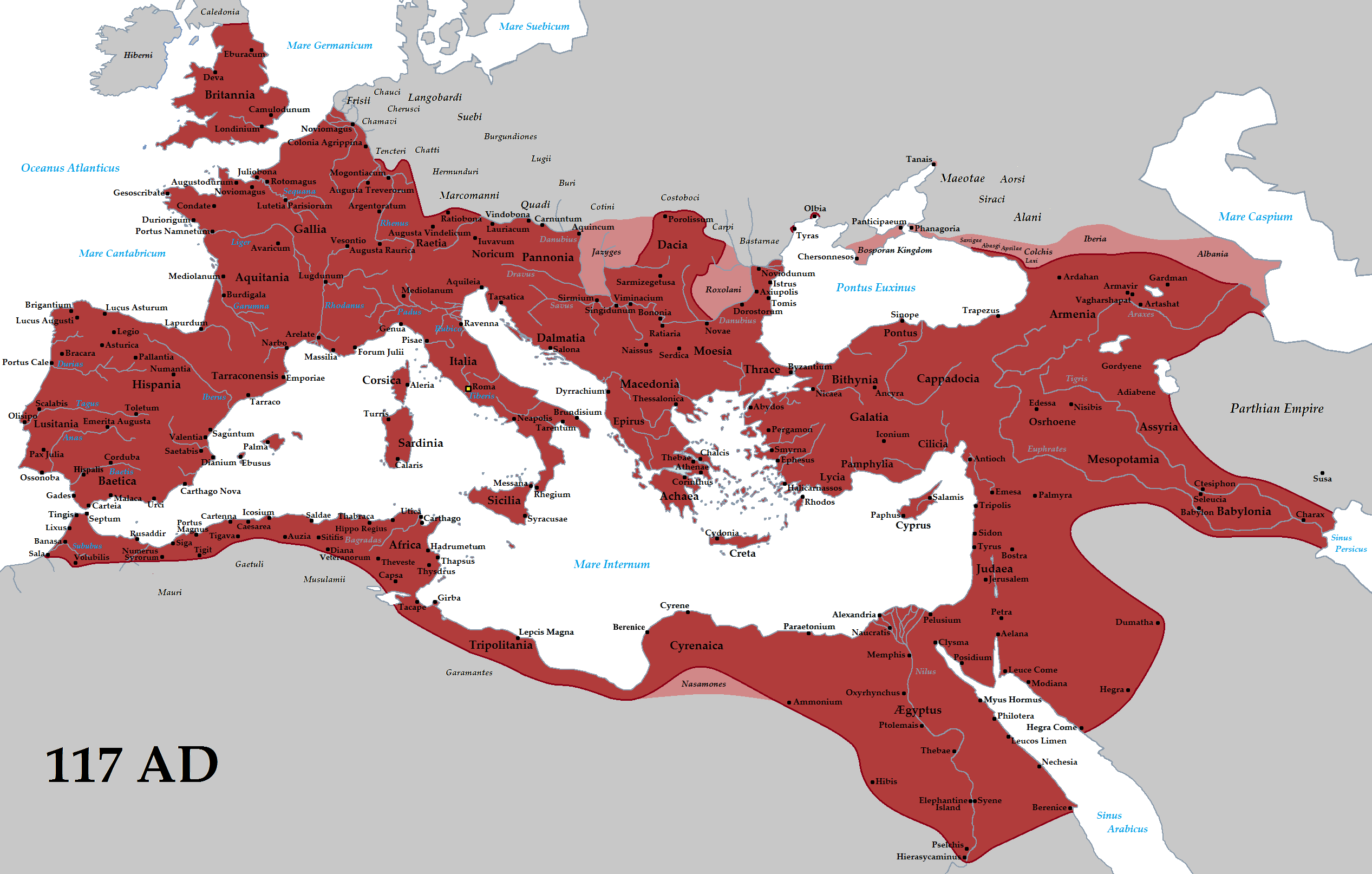
The Republic and later Empire would expand further, but the nature of such expansion were different. Outside the "Roman core" there lived mostly Afro-Asiatics peoples (specially Semitics) in Africa and the Mid East, Greeks (Hellenic) in the Eastern Mediterranean, Celts peoples in Britannia and Gallia and indigenous non Indo-European peoples such like the Basque in northern and center Hispania. They became "nominal" Romans once conquered, citizens of the Republic and later Empire, but they were not Ethnic Romans and the continued for the large part with their traditions and culture, now influenced with those of the Romans (but little more). The Bible's New Testament is a good popular portrait of that.
The "Romanization" would be largely limited to adjacent zones to where Ethnic Romans lived and in the places where they emigrated and began to populate: namely big parts of Gallia (now France) and some parts of Hispania (now Spain) and Britannia (now England). As they emigrated they intermixed with the local people and created syncretic (intermixed) cultures partly local, partly Roman, with a greatly varied and intermixed ancestry. At the same time some persons from those regions would emigrate in small numbers to the Roman core, but they ended up being assimilated and became Roman ethnics as well.
Well, understanding all this is important, because when the Roman Empire began its travel toward the end starting around 250CE, it constantly was pushed to broke part into ethnic blocks. The Afro-Asiatic began to revolt, the Galicians (those now intermixed folks I spoke a moment ago) began to revolt, the Greeks began to regain political control in the Eastern Mediterranean and outsiders began to invade everywhere. So it was of little doubt that all that remained shortly before the fall (that was in 476CE) was this same core.
Sorry if I went too long! But now I will start answering your question: modern day Italians are by large part direct successors from the Italian city-states that emerged during the Middle Ages (mostly 1000CE and onward), so to properly answer your question we need to bridge the period in which the Western Roman Empire fell and those medieval kingdoms and republics began to emerge back:
Italy was inhabited almost exclusively by Ethnic Romans by the time of its collapse unlike the other regions who fell prey to large-scale Germanic emigrations and from other groups decades earlier or since conception. Those Ethnic Romans began to slowly transmute into Ethnic Italians as feudalism began to be common in the region and with it a ton of new city states which began to distance from each other and develop different cultures such like the Venetians, Milanese, Genovese and so on. Their language slowly began to branch into a multitude of different languages as well, though the original Latin was never forgotten and continued being used in literature and religious work well into the Renaissance and even present day.
Those news people were sometimes joined by other people along those centuries and in the early times those outsiders had most the political control, but then they never emigrated in large enough numbers to make a big demographic change as they were absorbed into the different Italian cultures, though they also influenced back Italians a fair share before disappearing altogether. We can include there the germanic Goths, Vandals, Lombards, Franks, Austrians and Normans in Northern Italy, or the Greeks in Eastern Italy, or the semitic Jews, or Berbers and Arabs in Southern Italy into that mix.
By other hand Romans and afterwards Italians never really left in big scale the peninsula until the unification and war times during and after the Napoleonic Wars and later World Wars, where many fled to the new world.
Note: I never mentioned Dacia (modern day Romania) since I know very little about its history, I'm sorry!