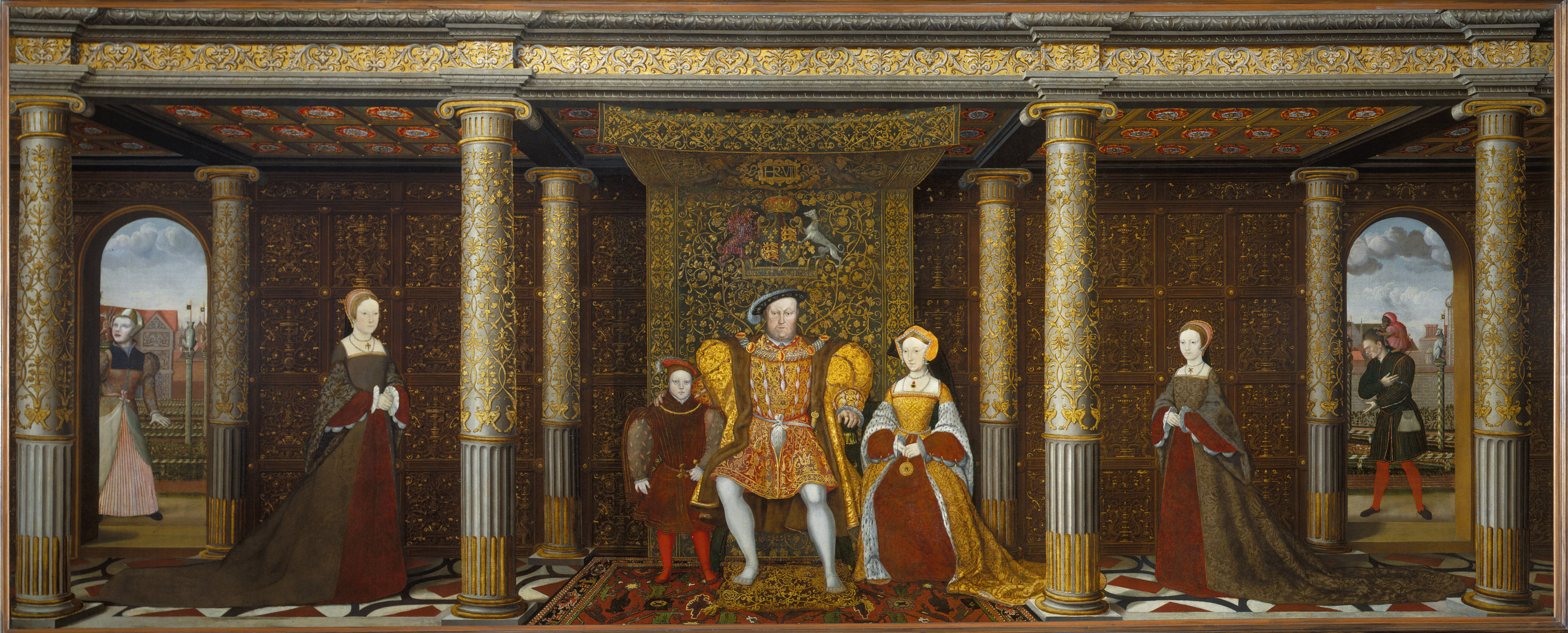
So the first item to look at is this portrait. It is "The Family of Henry VIII" painted c. 1545. This is a painting done while he was married to Katherine Parr, but features his deceased wife Jane Seymour as the mother of his heir Edward. However, both Mary and Elizabeth are present in this portrait. The two are presented at a distance from Henry, but they are still considered a part of his "family".
The first book I would recommend is John Guy's Children of Henry VIII, which is a recent group biography of Henry's three legitimate children and Henry Fitzroy, his illegitimate son. Edwards' biography of Mary (Mary I: England's Catholic Queen) is recent and thorough, but dry. Of the countless biographies of Elizabeth, the ones that would be best are J. Neale's Queen Elizabeth and W. MacCaffrey, Elizabeth I.
First, let's look at Mary, which is quite complicated due to her mother, Katherine of Aragon. So first thing to recognize is that Henry and Katherine did not get divorced, they had an annulment. The difference is important, because the former recognizes a legitimate marriage and ends it, while the latter declares the marriage to have never been valid. Since the marriage was annulled, Mary was considered by Henry to be illegitimate - born out of wedlock, and from a relationship that violated God's law (Scarisbrick, Henry VIII; Kelly, Matrimonial Trials of Henry VIII). Mary and her father's relationship was strained. What we do know is that after her mother's death (and Anne Boleyn's death), Mary acknowledged the Royal Supremacy of Henry, and admitted her own illegitimacy. Mary had been forbidden to visit her mother while she was alive, but tried to make peace with her father. When Henry visited Mary in 1536, it was with "much of his old affection, 'continually talking with her'. Jane [Seymour] presented her with a diamond, and Henry threw in a bag of gold and silver coins, 'telling her to have no anxiety about money, for she should have as much as she could wish." (Guy, Children, p. 95). Overall Mary and her father got along, so long as Mary was willing to accept her father's role as Supreme Head of the church, and admitted that she was an illegitimate daughter.
For Elizabeth, the relationship varied between extremes. During the first few years of her life, she was "Henry's favorite child" (Doran, Elizabeth I and Her Circle, p. 13). Once Anne Boleyn had been executed, Elizabeth's status changed to that of an illegitimate child, as pronounced by Thomas Cranmer and confirmed by Parliament (Doran, p. 14). During the 1540s, Elizabeth had few direct interactions with Henry, and the ones she did have were more formal than personal. Elizabeth was reported to have reacted with little emotion when she learned of Henry's death. In reality, Elizabeth was closer to her step mother Katherine Parr, as Katherine was the first of Henry's wives to really work at building a relationship with her step children and taking an interest in their education (Scarisbrick, pp. 456-457). Elizabeth wrote to Parr that she was upset that "Inimical Fortune...has deprived me for a whole year of your most illustrious presence." In the same letter she also mentions that she has not "dared" to write to her father (*Katherine Parr: Complete Works", p. 82). Whereas Mary had come to terms with Henry, Elizabeth does not seem to have forgiven her father in his lifetime for the treatment, trial and execution of her mother. During her reign, Elizabeth would proudly declare her descent from Henry, and championed his name, though Susan Doran argues that this may have as much to do with rumors of Elizabeth's illegitimacy (in the sense that Henry was not her father, rather than that the marriage was not legitimate) as with Elizabeth's attempts to use her father's popularity to her advantage.
The last item to consider is the will of Henry VIII. In his will, Henry tried to control the passing of the crown to his heirs in a way that had not been attempted before. His son, Edward, was only 9 when Henry's will was written, and his succession was not perfectly certain. In case Edward died childless, Henry stated that Mary should inherit the thrown after Edward (Ives, "Henry VIII's Will-A Forensic Conundrum", Historical Journal (1992) pp. 779-804). Should Mary predecease Edward or die childless, then the crown would pass to Elizabeth. So after a life of troubled relationships with his children, in the end Henry declared that his two illegitimate daughters were in the line of succession after Edward. The alternative, that the succession would follow Henry's sister's Mary's children - which would lead to the succession crisis of Lady Jane Grey in 1558 - was ruled out by Henry's will (Ives, Lady Jane Gray).
The end result was that Elizabeth and Henry probably had little love lost between them - Elizabeth only reminded Henry of her mother's betrayal, and Henry did not make life easy for Elizabeth. Mary and Henry got along better, though their relationship was strained. Mary had even been denied access to her mother when Katherine was on her death bed. It is important to recognize that Henry's poor relationships with his daughters was not necessarily because they were women - though that was apart of it. His relationships with them were strained because of their political status, their mother's marriages, Mary's devout Catholicism, and Henry's own prickly, stubborn and moody personality.