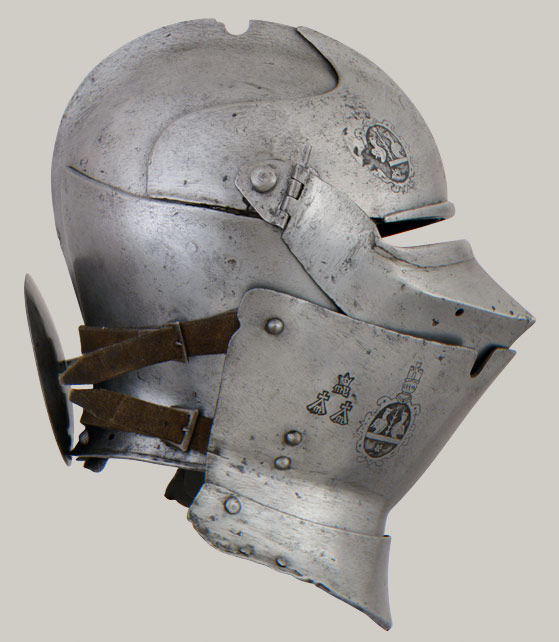
In a recent video Matt Easton talks about some of the downsides of fighting in an enclosed helmet and explains how many soldiers may have preferred to lift up the visor once they got into melee or even fight with the visor removed entirely. It seems like enclosed helmets (or at least helmets that restricted vision that much) were relatively uncommon both before and after the late medieval period. According to some sources, an open-faced burgonet will protect the face from arrows if the head is tilted forward, and this presumably applied to kettle helmets and certain other open faced helmets as well.
So is there any particular reason that enclosed helmets like the great helm or the pig-faced bascinet started to be seen as a necessity in the high-late middle ages?
First of all, fighting with the visor up seems to be a bit of a hobby-horse of Easton's. Not that he's wrong - there are decent arguments for fighting in close combat with a raised visor, and we see it in some illustrations, like in this edition of Talhoffer's Fechtbuch. Moreover, dedicated infantry often fought in open-faced helmets, such as archers (who obviously needed to see to shoot) and other infantry like pikemen and halberdiers (though some of these might wear bevors that covered their face, as in this 15th century Spanish example, or wear kettle hats like this one with coverings for at least the upper face. Moreover, in the 15th century in England men at arms fighting on foot (knights and those who fought as knights) wore full faced helmets like bascinets with visors, great bascinets, sallets (depending on the period and personal preference). Meanwhile armoured cavalry wears closed faced helmets (as the years go on, overwhelmingly so) from the 13th century onwards.
So after a very long introduction, why did -certain kinds- of soldiers opt for closed face helmets? The way they fought offers some explanation. First of all, mounted knights aren't necessarily going to be parrying blows as they charge with a lance - the forces involved are tremendous, and in any case a man at arm's hands are occupied with his own lance (if he is charging himself) and the reigns. So complete face protection is very important - we see this both in jousting helmets and in the war helmets of knights that fought more on horseback, IE the Italian men at arms. By the mid 15th century, they wore the more protective* armet and wore it with a wrapper, like so. This provided maximum protection against lances during cavalry-on-cavalry actions, as well as protecting against attacks from infantry, be they missile attacks of thrusts from pikes etc. In shock cavalry actions, protection was more important than some added visibility.
The other factor to consider is missle attacks. While it is possible that the brim of a burgonet could protect against missiles if you bowed your head, would you trust your life to that when confronted with thousands of English arrows at Agincourt or Towton or Tewkesbury? Apparently, English men at arms didn't think so either, since they covered every possible inch of their bodies in plate armour and wore visored helmets (great bascinets and bascinets and sallets) even as they fought on foot. Similarly the French at Agincourt seem to have worn visored helmets where possible, and they still bowed their heads due to the force of the arrows. Tobias Capwell has observed that French bascinet visorts have particulalry narrow eyeslits and pointed visors, perhaps to better protect against archery.
Finally, while there are indications that men at arms on foot fought with their visors up in close combat, there are many illustrations of them fighting with them down. For war the English preferred the great bascinet in the 15th century, which offers decent vision through the breath holes. Importantly, great bascinets (with the visors down) were the perferred helmet for foot combats with pollaxes into the 16th century (though keep in mind tournament armour was more 'safety conscious' than war armour, since it was less concerned with mobility).
So basically, soldiers wore closed-face helmets in no small part to protect against attacks they couldn't very well defend against - lance strikes, arrows, etc. And even then, there are indications that soldiers fought with visors down even in close combat on foot - the extra protection was worth it. I think it is easy to understate how important that extra protection is and overstate the disadvantages of fighting with a visor down. What visors gave soldiers was flexibility, to balance vision and protection as they needed to as the situation changed.
Sources: Tobias Capwell's Armour of the English Knight 1400-1450 does a beautiful job of explaining how armour was shaped by the 'way of war' of the men who fought in it.
*more protective since it has no potential gap in the middle of the face between the before and the visor, like the sallet does