If he is a member of a militia he might not need to. While wealthier citizens were generally encouraged to bring their own arms and armor, by this point many towns were collecting military equipment in public arsenals in order to equip soldiers in times of war. However these were still frequently under-supplied and what little equipment they did have was often low quality, old-fashioned, and ill-fitting.
The most likely scenario is that he wouldn't be wearing any armor at all. While the front ranks of a pike block needed to be well armored and would ideally be comprised of gentlemen who could afford to do so, many pikemen in the rear ranks would be completely unarmored and essentially just there to add more mass to the formation. Arquebusiers and musketeers during this period rarely wore any armor at all aside from sometimes a helmet. For them armor usually wasn't even recommended due to their need to serve as skirmishers and the fact that they already had to carry quite a bit of heavy equipment.
As far as options go if our peasant is dead set on acquiring himself some sort of armor. For the first half of the century padded jacks were extremely popular in the British isles. Jacks continued to be main armor used by English longbowmen and in Scotland even many noblemen reportedly preferred to wear thick jacks with a small wooden targe strapped to their left arm instead of a metal cuirass. Mail and brigandine armors were still present during this period, however they were being increasingly seen as old fashioned and not nearly as protective as plate armor. So it might be possible to acquire a used suit for relatively cheap. The most common armor during the period were low-quality, mass-produced munition breastplates and helmets. In times of warit might be possible to acquire equipment that had been looted from soldiers either killed in battle or by disease. Or equipment might be purchased from deserters or simply from soldiers who were tired of carrying it around and wanted a bit of extra pocket change (at various times the English army tended to have a problem with large amounts of equipment that went "missing").
Elizabethan Military Science
Certain Discourses Militarie With introduction by John Rigby Hale
The art of war in Italy, 1494-1529
Weapons and Warfare in Renaissance Europe
Follow up question: would anyone who wasn't a knight have need for armour, or how would they deal with personal threats?
Swedish peasant militia were by law required to own armour and weapons and train with them before 1280. They still retained arms and armour after that, although they were no longer required by law to do so.
The county laws that specified the armour they needed to own differed, and historians argue wether the laws represented a de facto state of ownership or a lofty goal that few could reach. Chainmail or plate (probably referring to coat of plates) and coif, helmet or iron hat were the usual requirements.
The constant fighting during the clusterfuck that was the Kalmar Union saw the Swedish peasant militia victorious several times, and it was commonplace to loot the battlefield for armour and weapons. Thus it was common to see them in armour one or two generations older than top of the line German landsknecht armour, taken on the battlefield from the ancestors of that same German landsknechts, as the Danish Kings trying to enforce the Kalmar Union had a reliable source of real coin in the Sound toll and thus could hire some of the best Frisian and Low German mercenaries for their campaigns to augment their Danish knights and squires and the retainers and possibly loyal peasant militia of the Swedish noblemen on their side.
The Gotlander peasants (nominally under the Swedish King, but owing no taxes or service and thus their own Peasants' Republic) defeated at Visby 1361 mostly wore coat of plates and coif and were buried with them on, while their helmets, shields and weapons were looted.
Here you can see the smiths of the Hoas family's reconstructions of the armour in the mass graves that have been excavated so far. This includes a lot of various types of coat of plates, but also obselete chainmail and even a lamellar armour (that had been modified to look like a coat of plate by adding leather on the outside).
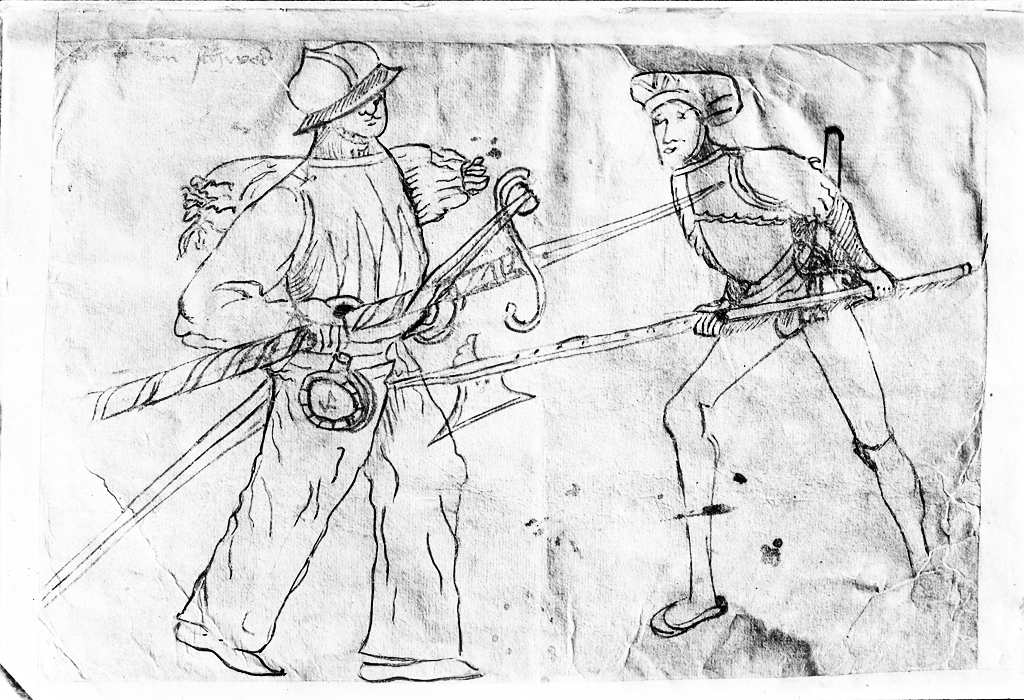
Another source to look at is the drawings of Paul Dolnstein, a Low German mercenary engineer in service of King Hans in his campaign to force Sweden into the Kalmar Union yet again 1501-1503.
Here you can see his drawing of Swedish peasant militia fighting a formation of Landsknecht pikemen. The Swedish peasant militia seem to be wearing either plate cuirasses or coat of plates armour.
Another of Dolnstein's drawings show a Swedish peasant militiaman fighting a German Landsknecht (and losing his family jewels in the process).
One can probably draw the conculsion from the fidings at Visby and Dolnstein's drawings that coat of plates would be common, unless the peasant was rich or had the fortune of looting a battlefield, which should let him have a plate cuirass. Commonplace is a lack of armour for the legs and arms - which would be heavy and cumbersome, and probably was far less likely to be lootable on the battlefield. Many of the dead at Visby showed wounds to the arms and legs and that the killing blow came when they were lying on the ground, often by removing their helmet and striking at their exposed head, which tells of the effectiveness of the coat of plates they wore.
Sweden has always been relatively rich in iron, and a majority of the Swedish peasants were self-owning farmers with enough surplus to invest in arms and armour, so the situation might not be immediately transferable to other peasants in other countries.