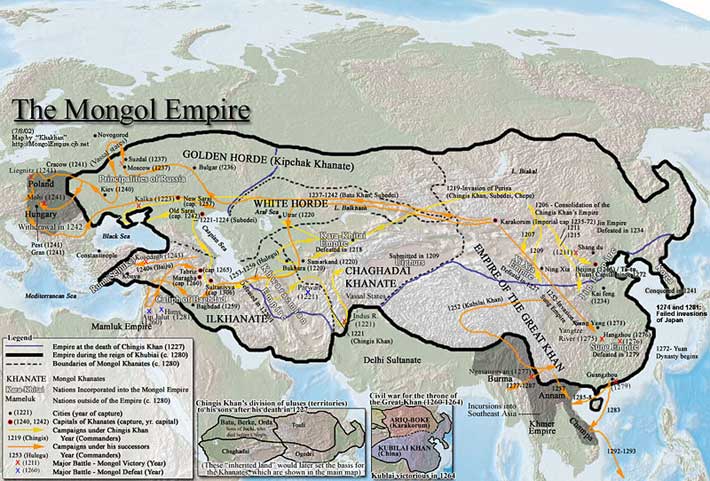
My understanding of Russian history has a pretty big gap between the early shifting of regional hegemony from Novgorod to Kiev to Muscovy (and even then, quite a pedestrian one at that) to eventual Mongol subjugation, and when they ended up taking over everything they have now. We're they actively sending out explorers and military missions in the 1600's to go subjugate people like the Kazakhs, Siberians, and Mongolians?
I think that the question that you are asking is inherently flawed because it's somewhat vague.
Saying that someone "has" a certain territory, in the modern meaning, implies that it belongs to a certain state or government. So Russia "has" Siberia now. Who had it before? Well, in a sense, no one. Prior to the expansion of the Russian state in the middle ages, vast swaths of Siberia were, and still are populated by nomadic tribes such as the Chuckchis, Yakuts, etc. These tribes had a very different society and culture than those of the West, and they did not create governments which asserted to other nations and peoples that they were exerting control over territory. Even the Mongols did not expand very far north into the Tundra during their conquests, so much of the territory we now know as Russia (especially the north east) was ignored or unknown until the modern area. This is largely due to the harsh nature and inaccessibility of the terrain, which remains to this day the reason that most of the surface area of Russia is uninhabited wilderness. Here is a population density map of the USSR which illustrates this.
There were, of course, many established states that previously existed within the modern borders of Russia. Some, such as the Khanate of Siber were subjugated in the middle ages, others such as Tuva were annexed by the Russian state as recently as WWII, and yet other regions in the Caucuses and Ukraine remain disputed territory today.
But to get to the core of your question, I think you want to know why Russia looked so small on medieval maps and why it looks so big on maps today. In short, Russia did battle and conquer many other nations as it expanded, but most of these were situated to the West of the Urals or the country's southern border. The vast majority of Russian territory as we know it today is this vast Siberian tundra in the north east that was unexplored by Westerners, Mongols, or anyone but the people who lived there, and thus also not claimed by any nation-states before the Russians got there. The Russians claimed the tundra and the north east of Asia, which is why the country looks so big on a map even though much of this space is uninhabited.
Were they actively sending out explorers and military missions in the 1600's to go subjugate people?
Yes, they certainly were. (Here is a great book on that process, btw) The Cossacks, working on behalf of the Tsar, were largely responsible for exploring the northeast of Russia, and even Alaska, and claiming these regions as territories subject to the authority of the Russian State. And just as you guessed, this largely occurred in the 16th and 17th centuries.
(To the editor: I know that I've included wikipedia links here and you guys hate that, but I feel that sometimes when one is looking into obscure parts of history, it is useful to share links like this which the OP would probably not have found on his own, because they are concise summaries of these obscure topics that one can read within the context of this reply without excessive distraction, and that they also provide useful lists of relevant sources. So I am aware of and stand by my choices, crucify me if you must.)