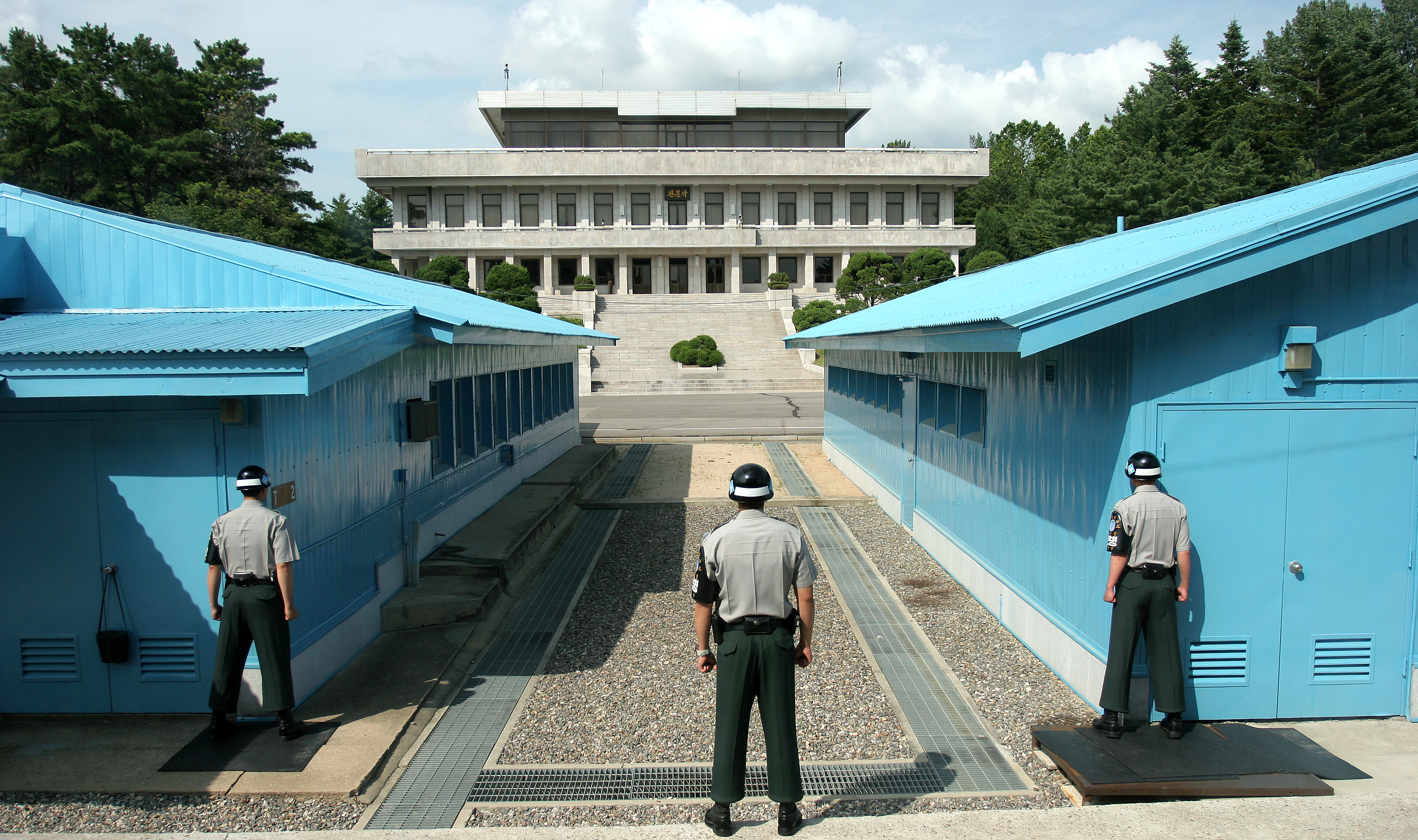
First, there is no "door" to North Korea. I'll assume you're talking about the doors on the huts that sit on the border in the Joint Security Area. This photo shows three guards, one in the middle and one halfway out from behind each hut. The two that are hiding behind the huts are doing it to present a smaller target if gunfire were to break out.
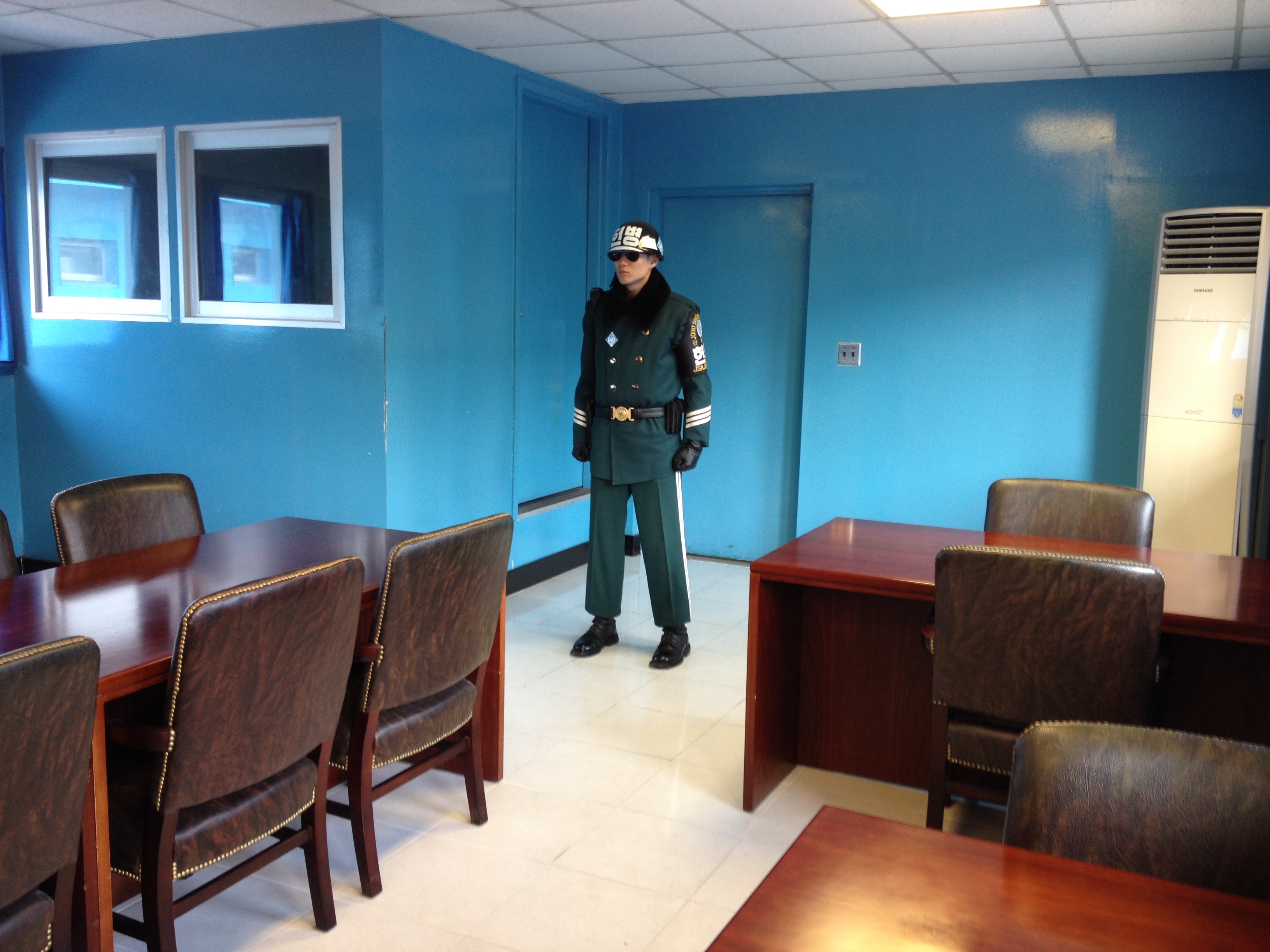
This photo shows an ROK soldier standing in front of the door that leads to North Korea. As you can see, he's standing there with his back to the door and there is no one near him. If a NorK soldier wanted to open the door and kidnap him, it'd be pretty easy, as long as he was a larger than average NorK since the ROK has height and weight minimums for serving at Panmunjeom. I've personally been to the JSA twice - in 2009 and 2014 - and both times it was fairly routine.
As far as the history of pulling people across the border....
Panmunjeom was originally set up as the meeting point between the UNC and the North Koreans and it was designed to be a place where both sides could go wherever they wanted. Here is a drawing of the Joint Security Area from August 18, 1976, the day of the Axe Murder Incident. Before that day, UNC and North Korean soldiers could go anywhere within the JSA, on either side of the Military Demarcation Line (MDL). As you can see in this graphic, the Korean People's Army (KPA) built guard posts on BOTH sides of the MDL, while the United Nations Command (UNC) built only on the southern side.
As you can also see, UNC Checkpoint 3 sits a stones throw from the MDL and in between KPA 4 and KPA 8. Checkpoint 3 was known as "the loneliest outpost in the world" because of it's location and the fact that a poplar tree blocked the view from Observation Post 5 up the hill. The KPA DID try on many occasions to grab UNC personnel from CP3, but they never succeeded. As far as those "many occasions" go, the two books I've looked in don't mention any specifics other than the North tried to do it.
After the Axe Murder Incident, the North Koreans were forced north of the MDL and their guard posts south of the MDL were dismantled and neither side crosses the MDL now.
Speaking of people crossing the MDL, in 1984 a Soviet citizen on a tour of the DMZ defected by running across one of the blue huts. The North Koreans opened fire and in the end, 6 people were killed but the defector stayed in the south.
So no, getting pulled across the MDL isn't really a concern. The more interesting issues are the Second Korean War/the DMZ crisis of 1966-1969. During that time, North Korean soldiers came into the south and set land mines, ambushes, and attempts at indoctrination of the southern populace. They set a bomb in a US barracks, they machine gunned a supply convoy, and they murdered a whole squad of US soldiers returning from patrol. The worst point was the Blue House Raid where 31 commandos got within a few hundred meters of the Blue House in an attempt to assassinate the president, Park Chung-hee. Since then, there have been other cases of North Korean incursions into the south - sniper teams, sappers, and just regular soldiers to harass the south. It even continues to this day with North Korean landmines maiming two soldiers just last year.
If you're interested in the DMZ and the border skirmishes, the two books I'd recommend are:
Scenes from an Unfinished War: Low-Intensity Conflict in Korea, 1966-1969 which is handily available online (which is great because I can't find my hard copy....)
North Korea's Military-Diplomatic Campaigns, 1966-2008, by Narushige Michishita. He has some great analysis of how the North Koreans are crazy... like a fox. Their behaviors are all calculated quite well and he explains it very nicely. There is also a great chapter on the Axe Murder Incident. In it, Michishita mentions that Park Chung-hee
"secretly ordered the ROK First Special Brigade to 'retaliate thoroughly against attacking enemies' if they attacked the South Korean forces in the JSA. In order to execute this mission, the comander of the Special Brigade decided to secretly bring grenades, pistols, and M-16 rifles into the JSA."
This is huge because it's a direct violation of the rules pertaining to the JSA AND because 2012 South Korean presidential candidate Moon Jae-in was one of those Special Forces soldiers. Just a really good book on the subject AND a cool link between the Axe Murder Incident, North-South relations, and ROK politics.