This came to me as a shower thought. Looking through the subreddit, I noted various discussion on the veracity and intent of The Jungle, but something else has been bugging me.
You're almost guaranteed to hear about The Jungle and the huge impact it had on both public perception and legislative policy in your high school US History or Civics course. It's odd to me, however, that there doesn't appear to be any other work in the century since that's had the same amount of impact. The only works that come to mind are perhaps the wave of fast food industry exposes we got (Fast Food Nation, Food Inc., etc.), and maybe Blackfish. As far as I'm aware, those didn't bring in the sweeping changes that The Jungle apparently singlehandedly ushered.
So the question(s): how come no single expose's ever caused as much change as The Jungle? Do we know why not? Is there simply less to expose nowadays? Do we care less?
Furthermore, I could be completely wrong about The Jungle's impact comparative to other works. In that case, corrections are welcome!
Silent Spring, by Rachel Carson comes to mind as an extremely influential work, though we could debate whether it was a work of journalism or a work of science, or perhaps both. In any event, it was extremely important. Not only did Carson's book lead to bans on the use of the pesticide DDT, it helped jump start the modern environmental movement.
Another example was the Watergate reporting by Woodward and Bernstein, although that did not become a book until deep into the scandal. But as far as investigative reporting goes, bringing down a President is pretty damn impactful.
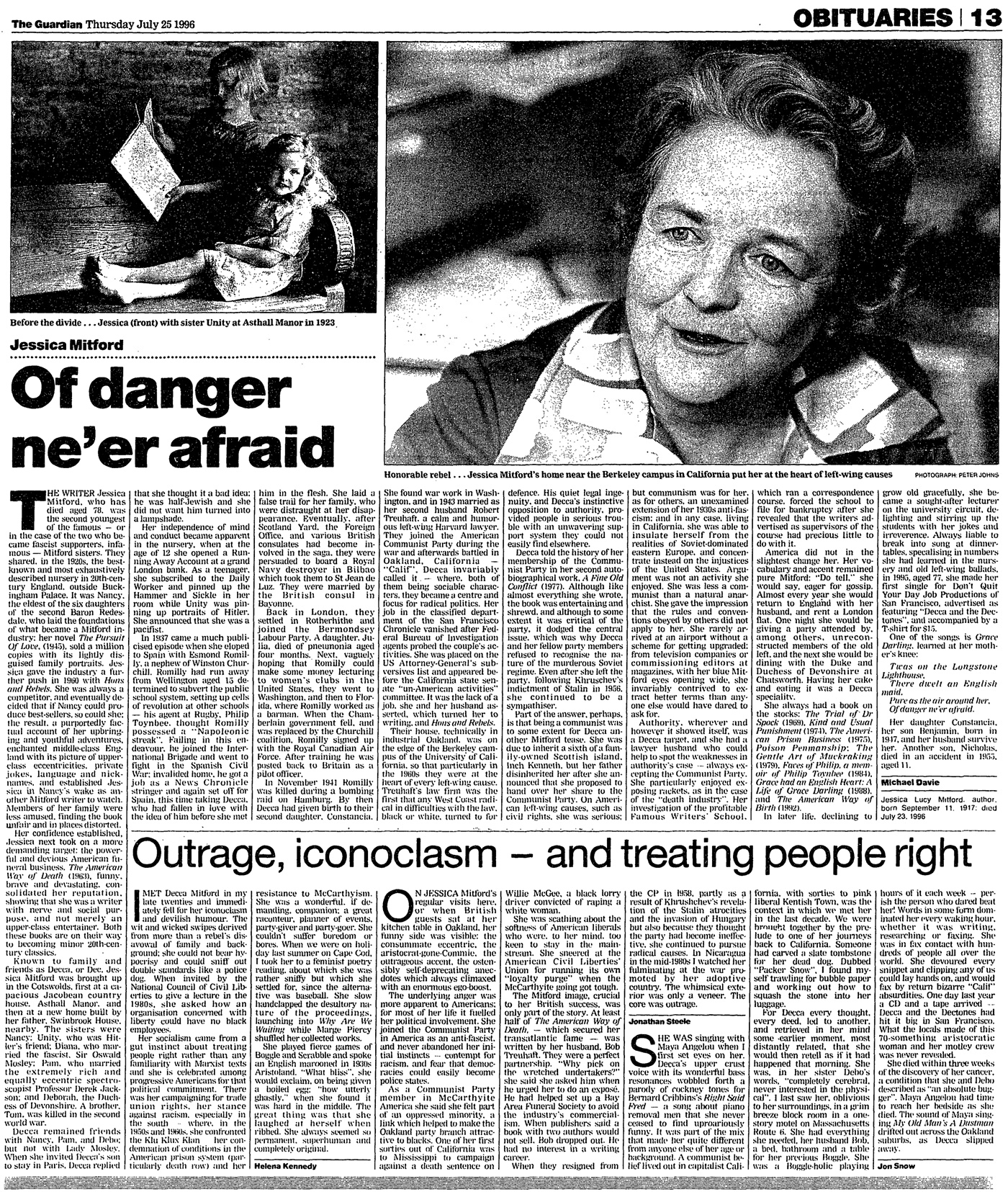
One often overlooked mover-and-shaker in this category is Jessica Mitford's muckracking exposé of the funeral business, The American Way of Death, which appeared in 1963 and exposed the ways in which funeral directors gouged grieving families when they were at their most vulnerable – persuading them to purchase expensive caskets, go to the cost of embalming, pay for hundreds of dollars' worth of flowers, vaults, and so on.
As Mitford pointed out, a full scale American funeral was often the third most expensive cost a typical family ever met, after the cost of a house and a car; at the time she published, the total cost could amount to a fifth of a typical American annual income. Fleshing out her investigation with some revealing interviews (she prided herself on her ability to lull interviewees into a false sense of security before pouncing, Columbo-style, at the very end of the discussion, with some things her subjects didn't know she knew) but also detailed readings of funeral industry house journals (she was a great believer in getting at the sort of "private" communications an industry had with itself when it thought no outsiders were listening, and was a long-time subscriber to Concept: The Journal of Creative Ideas for Cemeteries, Casket & Sunnyside and Mortuary Management), Mitford's exposé was not only a bestseller at the time, but led to Congressional hearings into what she had labelled a “huge, macabre, and expensive practical joke on the American public.” The overall result was new consumer protection laws, a sharp rise in the proportion of cheaper cremation ceremonies, and a fall of up to 30% in the cost of funerals.
The American Way of Death is also very well written and in places it's an extremely funny book, still well worth reading, like much of Mitford's stuff; I can also highly recommend her exposés of the fat farm industry and, especially, the Famous Writers' School, a well known correspondence course operation, fronted by some very big names, which exploited thousands of would-be writers – the latter of which effectively destroyed its target. Scourging, clever, and hilarious, it can be read in full here.