Glaives have always interested me quite a lot, because of all the various polearms of medieval and rennaissance warfare, they seem (to a layman observer such as myself) overall less focused on doing what polearms are generally good at, which is stopping cavalry. They seem more apt for cutting than stabbing.
And yet, Wikipedia seems to claim that the naginata, a japanese bladed polearm very similar to a glaive, specifically came into extensive usage because cavalry became more important; the site even puts forth an analogy to the European pike.
Which makes me wonder if my initial assumptions about glaive-like weapons' efficacy against mounted opponents hold water, and thus I turn to you folks here at AskHistorians:
Just how effective were glaives against cavalry? Were they even intended to be used as an anti-cavalry weapon in the first place?
Like European warfare, Japanese warfare has had many periods of change, due to changing military doctrine, technology, cultural influences, etc. Regarding the naginata specifically, it rose to prominence during the Genpei war of the late 12th century, seen as a good way to knock other riders of horses. The Genpei war is famously remembered as the period between the transition from the Heian period to the Kamakura shogunate, however of equal importance is that during this period of time it brought significant reworks to existing military ideology. I'd quickly plug in my older response on the relationship between shogun and emperor and so on here, because I think it's important to understand this to fully comprehend the significance of the Minamoto-Taira conflict during the Genpei. Arguably the most influential factor of change was that army sizes were becoming larger and larger - I'll link my other comment which tangentially talks about this here, and the relevant portion:
The end of the Heian period (~11th to the late 12th century, 1185), or the start of the Kamakura period, was when the concept of "samurai" came about, which also was a marker in that most of warfare conducted was on horseback. Small, elite units engaged in battles, unlike the huge numbers seen later on during the Sengoku period. Throughout these few centuries (the 11th to the 16th centuries), there was a gradual power shift in that local lords, or daimyo, had more of a say in their own personal armies. The shift into civil war and chaos that was the Sengoku period facilitated the change many daimyo implemented in their armies, in that peasant conscripts became more and more of a staple - huge numbers of peasants were conscripted into the ranks of the army, and most of these conscripts used the yari. No need for shields there. Samurai themselves, for the exact same reasons, had no need to use shields.
Also I remembered I do go more into detail of the evolution of Japanese military ideology here - I covered more than just this period. It's not necessary to read this, but I personally believe that a basic understanding of the shifting contextual elements is crucial to recognising why and how the naginata, and other weapons, were effective at their purpose.
Essentially, a mini TLDR of the above - before the Genpei, armies were <1,000. After, became bigger, fielding 10,000 or more at a time. A focus on cavalry also returned, and so you'd need weapons to deal with that on a larger scale.
So, it is during this period that the naginata emerged as a way to easily dismount cavalry, and to even the playing field. Thus, to answer your question
Just how effective were glaives against cavalry? Were they even intended to be used as an anti-cavalry weapon in the first place?
Yes, glaives (or more specifically, naginata) were effective, and were intended to be used as an anti-cavalry weapon. Prior to the Genpei, the general idea was that if you wanted to dismount a rider, simply shoot enough arrows at him or his horse. Now it was more similar to getting several footsoldiers equipped with swords on sticks to get the rider off, which is considerably easier (both in terms of training and general usage).
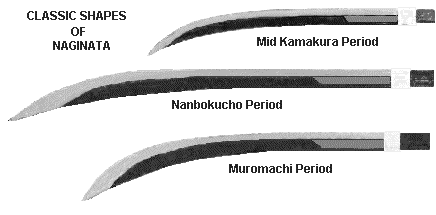
However, during the later Nanboku-cho period, these large armies started to become organised - during this period, the spear, or yari, became popular due to its ability to be effectively used (as you'd imagine a spear would be). From this point onwards use of the naginata declined, because the yari was more effective than the polearm at fulfilling not only the role of an anti-cavalry weapon but also as a general tool for combat in the large masses that we see composing armies throughout the Sengoku period. Have a look as well at this cool image which shows the general evolution in shape of the naginata blade throughout.
A larger reason why the yari replaced the naginata is because of the style and design of the polearm. The naginata is versatile for sure, as you can both cut and thrust, however it requires much more space to use effectively. Borrowing from Friday's "Samurai, Warfare, and the State in Early Medieval Japan":
For examples of warriors twirling naginata, see Heike monogatari (Engyōbon) 4. 18, p. 376, which depicts a warrior dubbed “Yagiri Tajima Myōzen” (“Arrow-cutting Myōzen of Tajima”) “spinning his naginata like a water wheel, striking arrows and scattering them to the four directions”; or Taiheiki (Keichōbon) 2.8 (“Morokata tōsan no koto, tsuketari Karasaki-hama no kassen”), which tells of a monk named Kaijitsu “whirling his short naginata like a water wheel” as he attacks an enemy swordsman. An illustration of a warrior twirling a naginata appears in Ishiyama-dera engi, p. 16.
This is why I linked the previous comments on the evolution of warfare - during the Genpei and successive conflicts, warfare in Japan shifted from a very personal combat to a more 'en masse' style warfare. Because of this, the naginata was unable to be used as effectively as a yari for the purposes of larger armies, and so was ditched in favour of the latter.
As a follow up how did the Naginata compare in general combat vs the Yari, including vs cav.
As a follow-up, Has the standard "DnD" nomenclature and categorization for this family of weapons influenced academia at all? I know there has to be a bunch of nerds like me who know enough to think themselves expert but not enough to realize they are far from that.
Glaive, Guisarme, Ranseur, Halbred, Glaive-Guisarme. These are the main types that are deemed different enough to have different rules applied to them. All of these are polearms that are more complicated than spears.