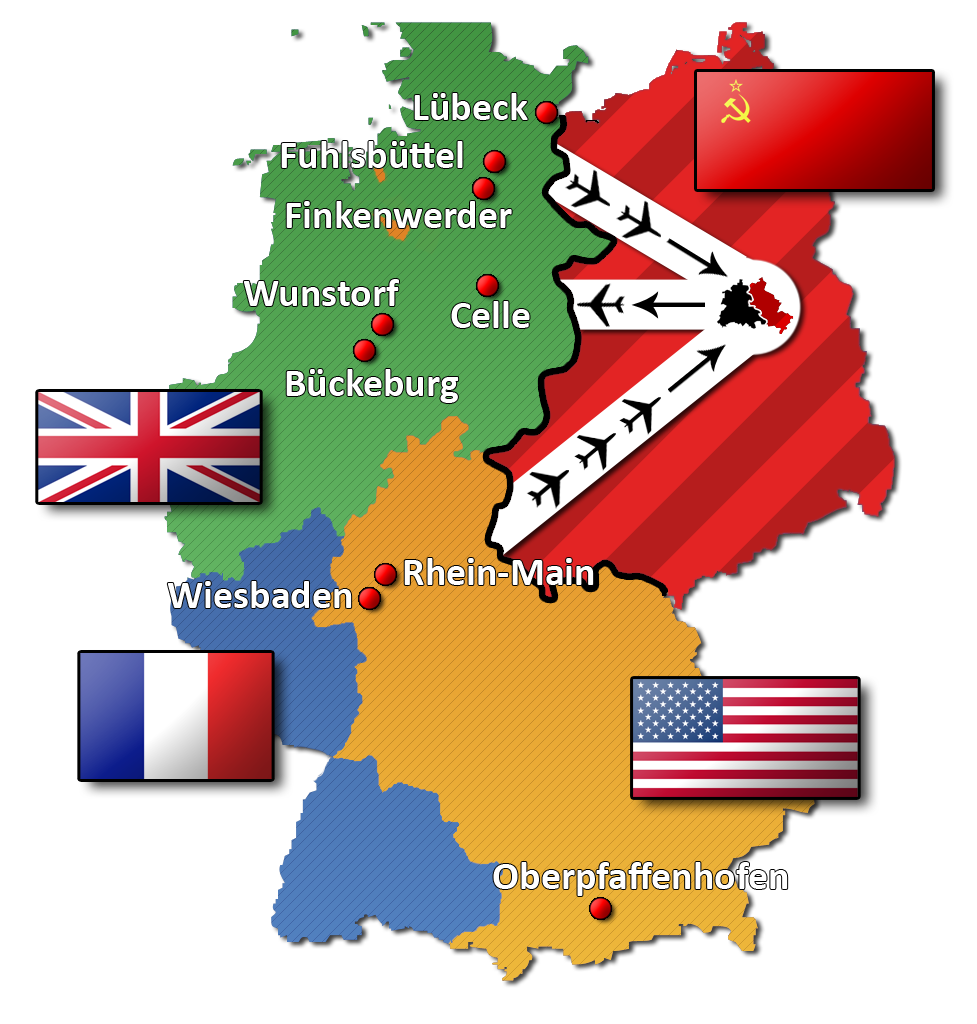
both pre and post Berlin airlift
You may wish to check this earlier answer here.
https://m.reddit.com/r/AskHistorians/comments/4s2g7h/during_the_cold_war_how_freely_were_military/
The bottom line is that there were about four rail crossing points, and a half-dozen road crossing points for corridors to West Berlin. Access was agreed to after the war before things got hot, and the Soviets/East Germans generally kept to the agreement.
Highways, railways, air corridors, and waterways. Although there was no initial formal agreement on Western access to Berlin via non-air routes, the Soviets did not prevent the Western Allies from sending supplies via non-air transport until the Berlin Blockade and then allowed it again after the blockade's failure (thanks to the Berlin Airlift). Air routes, on the other hand, were formally agreed to already in 1945 with two inbound (one heading north from the American zone in the south, the other southeast from the British zone in the Northwest) and one outbound (heading dead west from Berlin). This was necessary because of all of the air traffic going into and out of Berlin.
Fun Fact: Air cargo transport from the western zones of Germany began some months before the actual Berlin Blockade and continued right on through to at least the end of the blockade (maybe longer, I stopped looking - sorry). Already in April, 1948 some 80 tons of cargo were reaching Berlin via air transport on a daily basis (this compared to an average daily haul over over 5000 tons and a maximum haul of almost 9000 tons daily during the Berlin Airlift). This "little lift" was a result of Soviet harassment in rail traffic - prior to April, the Soviets had not interfered with rail traffic, but from for the first ten days of April, they demanded inspections of Western freight. Clay had two ideas on how to respond to this harassment. The first was to deny inspections and shoot any Soviets who attempted to gain access. American leaders in Washington thought this a bit drastic, but let him test the restrictions. The Americans sent a train across the border, and refused Soviet entry for inspection, so it ended up just sitting there, with neither side willing to force the other's hand. A few days later, Clay ordered the train to reverse course out of the Soviet zone. Importantly, the "little lift" as it's know was a sort of "proof-of-concept" as the Western Allies were not by any means certain that such a gargantuan task as completely supplying West Berlin by air could be accomplished. The little lift proved it was possible.