I have read how Vikings buried their dead mostly. Do we know anything about their traditions or customs reguarding death? Does it depend on the era in which it would have occurred? In what time period did "traditional vikings" occur and can the Normans be counted?
Thank you in advance for any information given.
I can't answer all of your questions but I can give a brief description of what Viking funerals were like in the mid 10th century. The reason for the specificity of date is that there is actually a first hand account of such a funeral written by Ahmad ibn Fadlan.
Ahmad ibn Fadlan was an Arab who traveled fairly extensively, especially in north-eastern Europe. While traveling, ibn Fadlan kept a journal documenting pretty much everything he and the group he was with came across. This group he was traveling with were sent from Baghdad to meet the king of the Bulgars. While they were camped with the Bulgars, another group of travelers came up a nearby river and set up camp. ibn Fadlan calls this group the " Rusiyyah." The Rus as a whole are generally considered to be Vikings who traveled from Scandinavia and settled in North-Eastern Europe but as far as I know there is still ongoing debate on which specific ethnic group ibn Fadlan actually saw.
Now, onto the funeral. While the Rus were camped near the Bulgars one of their chieftains died. The chieftain was buried in a temporary grave while preparations were made for the funeral ceremony. Grave goods were assembled (these would have included weaponry and armor along with various food and drink) and a new outfit was made for him. In addition, one of his female thralls offered herself to join him in death and she got to spend the time of preparation drinking and singing. On the 10th day, his longship was pulled up onto the shore and placed on a platform of wood. The chieftain was disinterred and placed on a bed on the longship and was surrounded by his grave goods. This section of the ship had a tent set up over it. The Rus then sacrificed 2 horses, two cows and a cock and hen and threw all the meat onto the ship. While all of this was going on the thrall continued to be fed alcohol and was led from tent to tent to have sex with all of the chieftain's men ("Tell your master that I have done this purely out of love for you"). Afterwards, the thrall was led to a doorframe that the men had erected. She was lifted to peer over the doorframe three times and each time described what she saw (purpose of this ritual was potentially to see into the afterlife. Her visions were first seeing her father and mother, then all of her dead kin, and finally the chieftain seated in paradise). Finally, she was led onto the ship where she was given more to drink and allowed to say farewell. She was pulled into the tent. Some of the men began to drum on their shields while others entered the tent to have sex with the thrall again. After they were finished the thrall was laid on the bed with the chieftain and two men held her hands and 2 men held her feet and 2 more held a rope across her throat while the overseer of the funeral,a "crone" called the Angel of Death, plunged a knife multiple times into the thrall's chest. The Angel of Death and the men then left the ship and the ship was set ablaze ("Then the deceased’s next of kin approached and took hold of a piece of wood and set fire to it. He walked backwards, with the back of his neck to the ship, his face to the people, with the lighted piece of wood in one hand and the other hand on his anus, being completely naked. He ignited the wood that had been set up under the ship after they had placed the slave-girl whom they had killed beside her master. Then the people came forward with sticks and firewood. Each one carried a stick the end of which he had set fire to and which he threw on top of the wood"). After the fire had burned out, they then raised a barrow over the ashes.
An interesting quote concerning your comment about the Vikings usually burying their dead: "One of the Rusiyyah stood beside me and I heard him speaking to my interpreter. I quizzed him about what he had said, and he replied, “He said, ‘You Arabs are a foolish lot!’” So I said, “Why is that?” and he replied, “Because you purposely take those who are dearest to you and whom you hold in highest esteem and throw them under the earth, where they are eaten by the earth, by vermin and by worms, whereas we burn them in the fire there and then, so that they enter Paradise immediately.” This passage is from immediately after the account of the funeral as everyone is standing around watching the ship burn.
My summation is mostly from memory. Skimmed the account just to verify details and pull out a couple interesting quotes. The details of this come from Ahmad ibn Fadlan's travel journal. The most complete copy I believe is Ridawiya Library, MS 5229 (Sorry, don't know specific pages. Only read it in translation). There is a translation (along with some background and commentary) done by James Montgomery available at https://www.library.cornell.edu/colldev/mideast/montgo1.pdf
Hopefully you found that interesting. Obviously, ibn Fadlan's account is from before the Vikings had adopted Christianity so their funeral rituals would have drastically changed once that occurred. Sadly, I do not have any sources for descriptions of post Christianization funerals. Ideally, someone else will come along that can answer the rest of your questions in a manner acceptable to AskHistorians (if you want my opinions on the rest of your questions I'd be happy to provide them in a PM but I have no sources so will refrain from posting them in the thread).
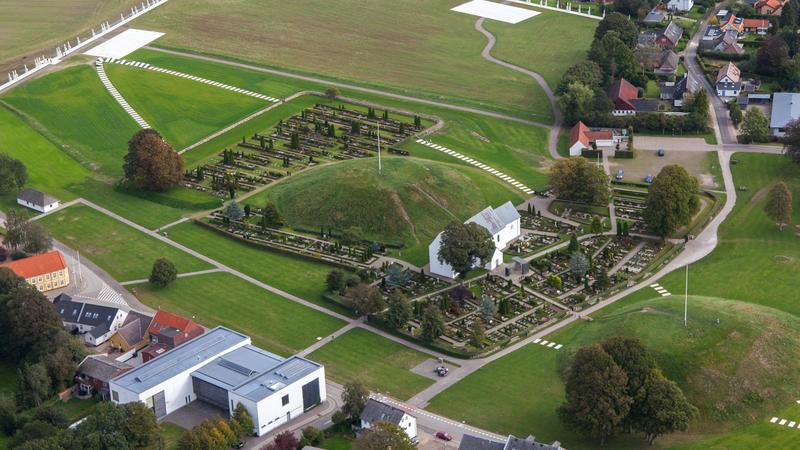
Well I can't tell you about the rituals. I don't know enough about Viking funerals for that, but I'll like to show you some of the Viking gravyards we have found.
The gravyard at Lindholmhøje is a collection of 682 graves and 150 stone ships. As you can see the stones have been raised in different formations. There are some round, triangle, square and ship formed. That is because the gravyard is used from 500 ac to 1000 ac and we have both men and woman buried here, so it shows a number of different customs.
This is a reconstruction of the biggest stone ship in Scandinavia. We know that the hill in the middle was build as a grave and we know that the other hill was build on the stoneship, but that no one was buried there. This is how we expect it to have looked before the church and the gravyards where build. Two big rune stones is raised betwen the two hills.