Follow up question: What is the oldest currency (coins or paper money) anywhere in the world that is still accepted as legal tender?
While various coins have dropped in and out of circulation, reflecting different mint milling standards, it's important to note that most of the currency changes in the UK did not necessarily make the older currency 'not legal'.
One of the few 'legal tender' changes was in 1696 where hammered coins were outlawed to prevent forgery, with new milled coins requiring 'Mintmarks' denoting where they were minted and the time they were made. In 1696 when the new coins were issued, temporary provincial mints had to be opened in Bristol, Chester, Exeter, York and Norwich, where the new silver currency was produced until 1698 when it was deemed the London mint was sufficient.
The L-S-D pre-decimal British coins give their etymological history to the Roman currency (librae, solidi and denarii), though it was King Offa in the 8th century who introduced the frankish coins to Britain under those names.
In the years prior to decimalisation though, the coins in use were the Half Crown, Florin, Shilling, Sixpence, Threepence, Penny and Halfpenny. The pound, notably, was actually a note until 1983. All of these, bar the Florin which was introduced in 1848, had been in mint and circulation since before 1696 in some shape or form.
In 1816, coins in Britain were revalued and fixed to the gold standard (Liverpool's Act), and silver coins could only be legalled used up to £2 (this is why when depositing coins at the bank there are maximum values accepted in coin bags), though I'm afraid I don't know if earlier minted coins were affected.
For more on the history of british coins: http://www.predecimal.com/p8milled.htm
Re-looking over the question, I see now that it's prrrrrobably only asking about British money. So this may well prove to be one of those answers that’s more answering the question it wishes was asked, rather than the one asked directly, but if you're game for an answer about old Chinese currencies, g'head and read on... here it goes anyway…
So first off, I could just throw out the concept of the sycee/yuanbao (細絲/元寶) – which was used as imperial currency from the Qin Dynasty (221 BC) all the way until the end of the Qing (1911). Nevertheless, since those are little more than just gold/silver ingots – and who doesn’t accept that?! – and also because they were not centrally minted, but just individually crafted by weight, that feels a little like cheating in terms of this question..
Though probably not the “oldest” or “longest serving, the silver and (primarily) copper coinage of the Ming and Qing Dynasties of China are nevertheless an interesting example of a form of currency that – at least in principle – proved to be quite durable and long-lived.
Now, to be sure, prior to – and even in the early stages of – the Ming (1368-1644) the Chinese Imperium had been undertaking a long-running experiment in the development and implementation of fiat currency in the form of paper money. This had been ongoing at least in part since the late Tang Dynasty and was first implemented by its Emperor Xianzong (r. 806-821) in response to a sovereign debt crisis that had spanned more than a century before that. Funnily enough this paper money was called feiqian, or “flying money” since it was so much lighter and easy to carry than the previous strings of metal coinage (Ederer, 1964). Nevertheless, paper money’s had been widely adopted by the succeeding Song Dynasty (960-1279), and then sole use (under penalty of death if found to be in contravention of the Khan’s law) during the Mongol rule of the Yuan Dynasty (1279-1368) (Mote 1999). Even though that system had faltered along with the Yuan Emperors’ power in the mid-14th century, the early Ming would nevertheless seek to once again emulate that paper currency with rather typical lack of longterm success.
But that’s not what we’re talking about, is it? No, we want the long-lasting currency here, so let’s get back to the Ming and Qing… With the failure of its own paper currency to maintain value, he Ming was at last forced in to admit that it held a hyper-inflated currency, and essentially give up the ghost.
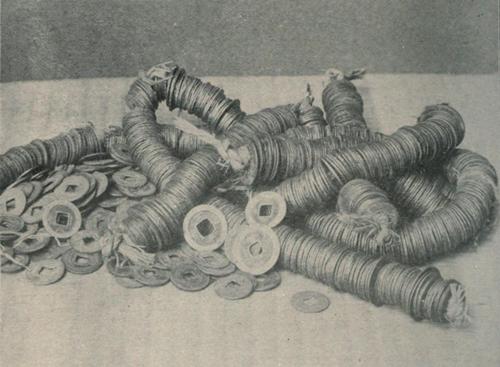
But it’s also interesting to note that even when paper currency was being issued as the de jure one-and-only-currency of the land, it was nevertheless still officially tied to a much older idea of tael coins (“tael” being a Malay loanword that literally refers to a weight of measurement, but was also used to signify the coin, also rendered as “cash coins”). The denomination was broken down as follows: 1 Da Ming Bao Chao (Precious Note of Great Ming) was to be worth the equivalent of 1 string of tael coins AKA 1000 copper coins. This was in turn pegged to the value of 1 oz. of silver, and that to ¼ oz. of gold (Gruen, 2004). In spite of this official “exchange” rate, the Ming government – like the Mongols before them - nevertheless expressly forbade the actual exchange from taking place. The paper cash would be by fiat only, and not redeemable for any actual bullion.
Nevertheless, and in spite of protection measure put into place, by the end of the 14th century, the Ming paper note was in its death-spiral, have devalued to some 1/35 of its initial value. That only accelerated in the next half century, and though in 1374 1 note = 1 oz. silver, by 1450 it took 1,000 notes to equal 1 oz. of silver (Mote, 1999). Thus by that year the government was forced to official re-recognize and sanction the use of copper and silver as direct means of trade, all but abandoning their by now nearly worthless paper currency. For the remainder of the Ming period, that system of 1,000 tael coins = 1 oz. silver = ¼ oz. gold would remain officially on the books as the official valuation of coinage. In fact these coins were so tied to the very idea of being "standard issue" that their very name, tongbao (通寶) simply means "general currency." To be fair, though, the actual market conditions would vary wildly and frequently, especially when Western empires began to supply the ever-more-insular Ming economy with large influxes of New World silver in exchange for their silks. From Gruen:
This massive influx of silver greatly increased the available money stock in the Chinese economy, which decreased silver’s value relative to goods and to copper cash. There were several economic effects from this market caused inflation. Various parts of the economy, especially the sector which manufactured goods for export, were stimulated, as the new silver mines gave foreigners greater purchasing power and thus greater ability to exercise their demand for these goods. However, this integration also made China vulnerable to fluctuations in the price and quantity of silver on the world market. This meant that China, once so self-sufficient and little affected by the small economies of its neighbors, was now subject to economic problems caused by factors utterly beyond its control.
By the mid-17th century, Ming edifices of the Ming were crumbling and in swept the Manchus under the auspices of the Great Qing Dynasty in 1644. Though they’d once again briefly try their hand at paper currency between 1651 and 1661, soon enough it’s be right back to the strings of copper coins at the 1000 -> 1 -> ¼ ratio of copper/silver/gold, respectively. This was a weight-based system, so as you can imagine the drive to counterfeit was high, and it was largely a system of caveat emptor in terms of individual transactions, since the Qing authority largely couldn’t be bothered, or as Einzing puts it: “the State abstained from interfering and left it entirely to local authorities and private trading interests to run their own monetary system. This system handicapped trade” (Einzig 1951).
The system of the tael coin-strings would die out a bit before the Qing itself, though. In 1889, the Qing – by this point rather desperate to play catch-up with the Western (and Japanese) powers that were pulling it this way and that, opened up its first Western-style mint in Guangdong, followed by its second in 1893 that issued silver-dollar notes. In 1897 the Imperial Bank of China (Zhongguo tongshang yinhang 中國通商銀行) was officially opened, and issued government paper currency, signaling the official end of the cash coin as an officially accepted imperial currency. Nevertheless, in the face of multiple various – and thoroughly confounding – systems of private paper monetary systems in print all at the same time, made all the worse by the Revolution, and then warlord era that followed it, it wouldn’t be until the formation of the Republic of China that it would truly centralize into a modern, centralized economic currency as the Yuan.
So there you go – a monetary system in pretty close to constant use at officiallly same rate of exchange from 1450 until 1897 (though in reality, El-Oh-El to that). And 4 and-a-half centuries is a pretty good run.
Citations
Einzig, Paul (1951). Primitive Money in its Ethnological, Historical, and Economic Aspects.
Gruen, Sarah (2004). The Chinese Monetary System: From Ancient Times to the Early Modern Period
Mote, F.W. (1999). Imperial China: 900-1800