I was wondering how different it was being in a warring country's navy in WW2 compared to WW1. Did newly developed technology make their lives safer or more dangerous?
Thanks you for providing insight into this topic.
The answer to this question is going to vary quite widely by navy since ship design, institutional cultures, and the position of the sailor in each society varied from country to country. For example, in terms of harshness of daily routine, the average daily routine of an IJN rating circa 1914 was not that much different than either his USN or RN contemporary. Discipline may have been more harsh in the IJN, but ships of this era were often rather cramped and dirty. However, the situation changed markedly by the interwar period, with the Japanese rating getting the short end of the stick. Attempts to sidestep the Washington and London Naval Treaties led IJN designers to cram too much weapons and armor onto narrow hulls, resulting in ships that were even more cramped and prone to heavy rolls in the open ocean. Innovations in habitability such as air-conditioning became more common on Western ships but were novelties in Japanese ones. The IJN design chiefs gave relatively little thought towards habitability and bunking methods remained those of the 1910s with a heavy reliance upon hammocks and rudimentary facilities on ship for a sailor off his watch. This Spartan mentality fed into existing cultures of naval petty officer disciplining and corporal punishment became much more the norm in the IJN than other services. Although the Jacks and Tars of the RN or the USN's sailors feared the wrath of a petty officer, interwar regulations on sailors' rights minimized the amount of physical punishment they could receive. With this in mind, it is important to realize that you can describe the changes only with a really broad brush.
Arguably, the biggest change in daily routine for most sailors between the wars was the switch over from coal to oil as a means of propulsion. Coaling ships was a routine fact of life for most sailors prior to WWI and as this image testifies to, coaling was dirty. backbreaking work. Ship bunkers required a considerable amount of coal and coaling was an effort that called for a good deal of a ship's company to participate. Counter-intuitive as it may sound, despite dangers of black-lung and other respiratory problems, a number of navy veterans saw coaling fondly as a period of camaraderie in which an entire company worked together. Coal dust reduced distinctions between ratings and officers, and as one RN salt put it in a postwar memory project, coaling:
was the only time everybody could swear at each other. An officer, if somebody ran over his ankles with a truck- it was dangerous- he could say "You bloody fool" or something like that. And you could turn round and say "who the hell are you talking to?" And you could call him just the same. And there was nothing ever done about it. Everybody was brought down to one level there. Everybody was as good as anybody else, because you could say what you like, you could do what you like.... The idea was that the officer was working just as hard as you were on the same job, so you were all equals there.
The transition over to oil-fired boilers, which began in the RN and KuK Marine shortly before WWI and pretty much became universal after 1918, ended this part of daily life. Refueling was now not only more intermittent, but also in the hands of specialists with specific training.
Increasing specialization and technical skills was also another facet of the career of a rating in the interwar period. The advent of new technologies like the airplane or the wireless radio spurred the development of satellite technologies needed either to make these new developments more efficient or counteract them in some way. Training in fire-control equipment became more widespread as not only were there directors for the main battery, but also directors for secondary armament and also for anti-aircraft barrage. This meant that the potential career path for a sailor became much more open in the interwar period than ever before. Specialist training usually meant higher pay and a step above traditional enlisted rating hierarchies, even if the actual ranks did not change. At the most extreme end of the scale, the advent of the airplane meant that enlisted pilots and aircrew could become an elite. Although many navies tried to restrict pilots to officers, expansion of naval airpower made this impractical. In navies with an incredibly strict divide between officers and enlisted men like the Japanese, enlisted pilots created a good deal of friction in these command hierarchies that sharpened during the war. In the case of the IJN's land-based units, enlisted pilots and aircrew often had substandard rations and facilities on the ground even when some of these pilots were much better in the air than their officer superiors.
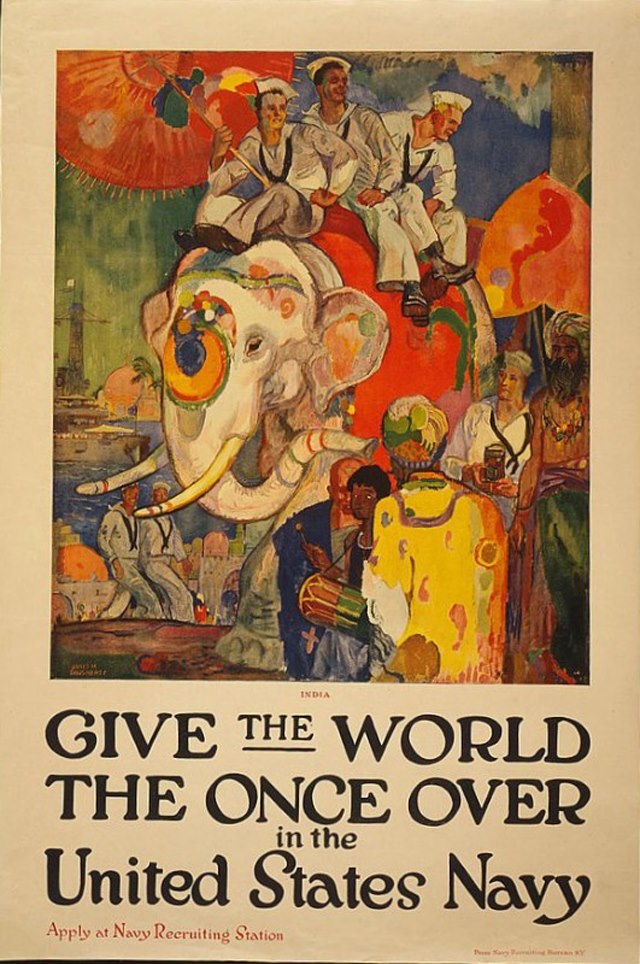
One of the major shifts in interwar navies was a shift in the class composition of its enlisted men. Even throughout the nineteenth century, naval manpower still largely drew from the fisheries and coastal communities. But the expansion of manpower needs and the wider occupational shifts in industrial economies meant that navies started to draw from other working-class sectors non-related to maritime industries. As early as the 1910s, naval recruitment was starting to appeal to non-maritime segments of the population, such as the USN's famous slogan "Join the Navy: See the World", as seen in this recruitment poster. This was a process that began in larger navies by the start of the First World War and became more of a reality in the interwar period. This class shift sideways into other sectors of the proletariat meant that a number of sailors enlisted for differing reasons than prior generations, and service for some was either a way to move up the socioeconomic ladder or make a living (and this was a key motive in the Depression). Naval service thus was not an end onto itself for many sailors, although "lifers" became a very visible minority, but rather as a means to a certain end, whether using naval social networks to open up a shop or tavern, or acquire specialist training, or to provide for a family during uncertain economic times.
The larger trajectories of technological development also had a darker component to it as well during wartime. For a sailor in the First World War, the primary enemy was another surface ship. Submarines and mines increased in effectiveness (WWI aircraft were only really dangerous to smaller surface craft) during the war, but fast, armored warships were difficult quarry. Therefore, the primary threat for a sailor at sea between 1914-18 was another ship that was more or less within visual range. As submarines and airplanes became more effective with interwar developments, the threat envelope expanded in three-dimensions. Death could come now not from a known enemy, but rather suddenly and without warning. The crews of surface ships operating without the benefit of air cover often became psychologically strained from the stress of prolonged operations, especially if the enemy did possess aircraft. The RN around Crete in 1941 recorded a number of cases of nervous exhaustion as German and Italian aircraft extracted their toll. The situation became so bad that Mediterranean Fleet commander Admiral Cunningham instructed his flag secretary to draw up warrants for hanging if a ship's company refused to sail back to the warzone. Although the RN muddled through the Crete campaign, it was quite harrowing for its officers and men as their only defense were their own AA barrages. The three-dimensional battlefield also meant a massive expansion of AA and ASW equipment, which in turn necessitated more ratings to man them. Ships' complements thus became even more cramped during wartime. The Japanese superbattleship Yamato had some several hundred excess crewman assigned to her to man the expansion of her AA suite, a development that necessitated hammocks sometimes being set up in hallways adjacent to nonessential areas like the ship's shrine. So not only as there greater fear of being killed against an enemy you could barely fight back against, but dealing with these threats cut into comfort and habitability.
As the above shows, new technology meant daily life was a mixed lot for many sailors. Routines like spit and polish and naval traditions like crossing the line remained in place, so naval service was not a complete break from the past. Yet what sailors expected and experienced when they joined the service definitely did change. Ratings became much more professionalized beyond manhandling weaponry and lugging coal and by the interwar period enlisted men were taking on specialized tasks that prior generations had reserved for officers. navies thus became more and less stratified in their ranks, as newer specializations eclipsed older hierarchies and in turn created new hierarchies in their place. New technology created unprecedented career opportunities for sailors, but it also unleashed the spectre of a sudden death from above or below that was difficult for some sailors to compartmentalize.
Sources
McKee, Christopher. Sober Men and True: Sailor Lives in the Royal Navy, 1900-1945. Cambridge, MA: Harvard University Press, 2002.
Spector, Ronald H. At War, at Sea: Sailors and Naval Combat in the Twentieth Century. New York: Viking, 2001.