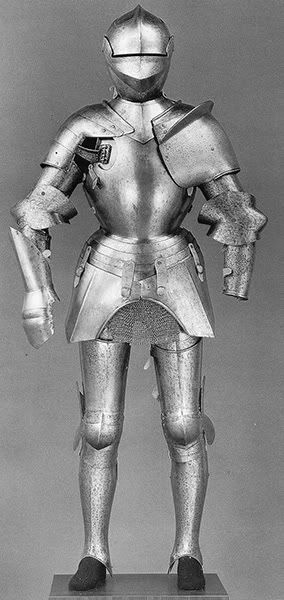
As far as I remember, plackarts appears to be essentially the lower half of a cuirass. was there a particular reason they were designed like that? and how did they compare with other pieces of armor (such as brigandine for example).
This is a good question! Plackarts seem to serve different purposes. They are always the lower part of a breastplate, but this can overlap more or less with the upper breastplate. Thos plackarts which overlap more would tend to reinforce the breastplate - those which overlap less simply serve as a lower breastplate. Both may offer some flexibility.
When the plackart first appears, it is small (extending less than halfway up the cuirass) and is used to hang the fauld (the front of the cuirass's skirt) off of. This is an early example from Northern Italy around 1420. In this case, the plackart is strapped to the upper part of the breastplate. which still extends most of the way down to the waist (so mostly the plackart overlaps with the upper breastplate). It is possible that hanging the fauld from a piece of armour that is strapped on rather than integral to the rest of the breastplate increases flexibility. With such a small overlapping area, the main purose of this plackart does not seem to be reinforcement. By the middle of the 15th century, the plackard has been extended upwards as you can see in the 'Avant' armour. This leaves most of the torso protected by a double layer of steel - as this armour would originally be worn, with the pauldrons and the gorget attached to the armet's wrapper, only a small part of each shoulder and the very bottom of the plackart would without a double layer of steel protection. This is the charactureristic arrangement in Italy in the middle part of the 15th century and probably in most of the rest of Europe (there are few surviving armours, so what happens under the plackard is hard to tell for sure when your main reference is a statue!) In the later 15th entury, Italian armours have plackarts that extend over almost all of the breastplate. Meanwhile in Northern Europe there are a number of depictions of breastplates without plackarts (starting in the low countries, then spreading to England, as far as I can tell) in the last quarter of the 15th century. In the 16th century, the plackart survives as a reinforcing piece for use in the tournament, or to help 'bullet proof' armour.
In later 15th century German 'Gothic' armours and in infantry breastplates (including those in Italy) we see a different form of plackart construction. In this case the plackard is attached with a sliding rivet (annowing some motion). Some of these overlap more than others. In those with the least overlap, the Plackart is shaped rougly like a triangle and the upper breastplate has a kind of chevron cut away in it. In these breastplates, the two-part construction and the sliding rivet may provide some other flexibility. In addition, this construction doesn't require as large a 'starting' piece of metal as a one-piece breastplate. This is important because it is easier to make smaller pieces of steel or iron than larger ones, and for cheaper breastplates (like those for infantry use) a two-part construction may save on materials, or allow the use of 'marginal' materials, because it can be made of smaller pieces of steel. Some other breastplate with rivetted-on plackards have a good deal overlap, so some of the purpose of these may be reinforcement.
The reinforcing plackart (which is also shown used over what are probably brigandines and other forms of less-rigid armour) is then (at least after the mid-15th century) another example of multiple sheets of thinner steel being layered to make the whole stroner - this includes the gardbrace over the pauldron and the brow reinforcement on helmets. Milanese armours especially seem to layer steel to create a more protective harness. If the wearer was wearing a non-rigid armour, a plackard would protect everything that was not under the ribcage, possibly defending against internal injuries from blunt trauma.
This still doesn't answer the question of why the 'mini' plackards of the early 15th century were used - they may offer some added flexibility.
In the end I have seen nothing that provides a definitive answer. What we can do is look at the construction of the armour and the mechanics of the body and infer the purpose of plackarts from there. Based on this, plackarts provided some added flexibility, and sometimes provided reinforcement or a way to make breastplates out of small pieces of metal.
For this answer I have consulted a number of pictures of the insides of original armours, originally compiled for Matthias Goll's 2014 PHD thesis, 'Iron Texts'. You can see an online collection of these images here. Particularly interesting are these images of two-part breastplates with a sever 'cut away' on the upper breastplate and very little overlap: Such as this infantry brestplate from the landesmuseum in Zurich. Contrast with this breastplate of finer quality. This breastplatehas a lot of overlap.
I also consulted Capwell's 'Armour of the English Knight 1400-1450' and used the excellent 'deconstructed' views of the 'Avant' armour in the Osprey Book 'English Knight 1400-1500' by Christopher Gravett (this is among the better Osprey titles - always be careful when using popular sources like this!!).
Edited for clarity