I'm reasonably familiar with the progression of naval arms races and the rough outlines of ship design over the 20th century - main gun caliber and armor belts, the like - but I haven't found many resources that indicate whether investment in a new battleship also meant better quarters or training. Would sailors aboard a pre-dreadnought have envied the lives of those aboard the latest battlecruiser?
Most of the information I've seen in regards to how personnel felt about other ships is based on ship class, e.g. "Tin Can Sailors" with cramped quarters bemoaning battleship sailors' access to ice cream machines, but I have found little regarding how (indeed, if) quality of life would differ between the same type of ships if one used newer technology to compete with other nations or was built to strict tonnage limits.
thanks!
Modified from an earlier answer of mine
The answer to this question is going to vary quite widely by navy since ship design, institutional cultures, and the position of the sailor in each society varied from country to country. For example, in terms of harshness of daily routine, the average daily routine of an IJN rating circa 1914 was not that much different than either his USN or RN contemporary. Discipline may have been more harsh in the IJN, but ships of this era were often rather cramped and dirty. However, the situation changed markedly by the interwar period, with the Japanese rating getting the short end of the stick. Attempts to sidestep the Washington and London Naval Treaties led IJN designers to cram too much weapons and armor onto narrow hulls, resulting in ships that were even more cramped and prone to heavy rolls in the open ocean. Innovations in habitability such as air-conditioning became more common on Western ships but were novelties in Japanese ones. The IJN design chiefs gave relatively little thought towards habitability and bunking methods remained those of the 1910s with a heavy reliance upon hammocks and rudimentary facilities on ship for a sailor off his watch. This Spartan mentality fed into existing cultures of naval petty officer disciplining and corporal punishment became much more the norm in the IJN than other services. Although the Jacks of the RN or the USN's sailors feared the wrath of a petty officer, interwar regulations on sailors' rights minimized the amount of physical punishment they could receive. With this in mind, it is important to realize that you can describe the changes only with a really broad brush.
Arguably, the biggest change in daily routine for most sailors between the wars was the switch over from coal to oil as a means of propulsion. Coaling ships was a routine fact of life for most sailors prior to WWI and as this image testifies to, coaling was dirty. backbreaking work. Ship bunkers required a considerable amount of coal and coaling was an effort that called for a good deal of a ship's company to participate. Counter-intuitive as it may sound, despite dangers of black-lung and other respiratory problems, a number of navy veterans saw coaling fondly as a period of camaraderie in which an entire company worked together. Coal dust reduced distinctions between ratings and officers, and as one RN salt put it in a postwar memory project, coaling:
was the only time everybody could swear at each other. An officer, if somebody ran over his ankles with a truck- it was dangerous- he could say "You bloody fool" or something like that. And you could turn round and say "who the hell are you talking to?" And you could call him just the same. And there was nothing ever done about it. Everybody was brought down to one level there. Everybody was as good as anybody else, because you could say what you like, you could do what you like.... The idea was that the officer was working just as hard as you were on the same job, so you were all equals there.
The transition over to oil-fired boilers, which began in the RN and KuK Marine shortly before WWI and pretty much became universal after 1918 in no small measure because of the Treaty system. The end of coaling ended this part of daily shipboard life. Refueling was now not only more intermittent, but also in the hands of specialists with specific training.
Increasing specialization and technical skills was also another facet of the career of a rating in the interwar period. The advent of new technologies like the airplane or the wireless radio spurred the development of satellite technologies needed either to make these new developments more efficient or counteract them in some way. Training in fire-control equipment became more widespread as not only were there directors for the main battery, but also directors for secondary armament and also for anti-aircraft barrage. This meant that the potential career path for a sailor became much more open in the interwar period than ever before. Specialist training usually meant higher pay and a step above traditional enlisted rating hierarchies, even if the actual ranks did not change. At the most extreme end of the scale, the advent of the airplane meant that enlisted pilots and aircrew could become an elite. Although many navies tried to restrict pilots to officers, expansion of naval airpower made this impractical. In the United States, the 1926 National Defense Act stipulated that 20% of the USAAC pilots and 30% of the USN pilots were to be enlisted men. Existing prejudices against enlisted men as well as fiscal retrenchment meant that these numbers were never achieved, but still some enlisted men were able to become pilots or aircrew. In navies with an incredibly strict divide between officers and enlisted men like the Japanese, the presence of enlisted pilots created a good deal of friction in these command hierarchies that only sharpened during the war. In the case of the IJN's land-based units, enlisted pilots and aircrew often had substandard rations and facilities on the ground even when some of these pilots were much better in the air than their officer superiors.
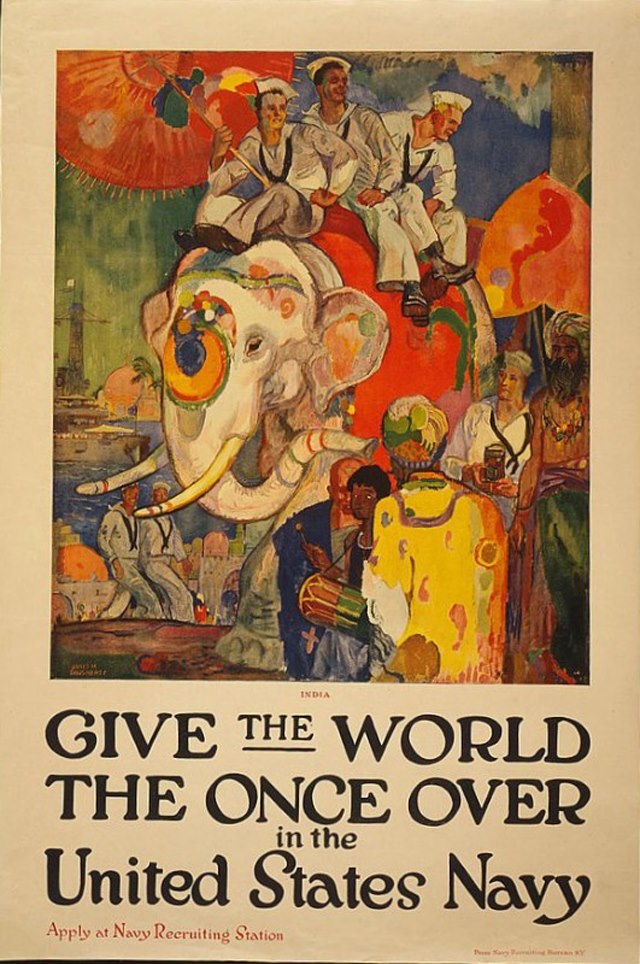
One of the major shifts in interwar navies was a shift in the class composition of its enlisted men. Even throughout the nineteenth century, naval manpower still largely drew from the fisheries and coastal communities. But the expansion of manpower needs and the wider occupational shifts in industrial economies meant that navies started to draw from other working-class sectors non-related to maritime industries. As early as the 1910s, naval recruitment was starting to appeal to non-maritime segments of the population, such as the USN's famous slogan "Join the Navy: See the World", as seen in this recruitment poster. This was a process that began in larger navies by the start of the First World War and became more of a reality in the interwar period. This class shift sideways into other sectors of the proletariat meant that a number of sailors enlisted for differing reasons than prior generations, and service for some was either a way to move up the socioeconomic ladder or make a living (and this was a key motive in the Depression). Naval service thus was not an end onto itself for many sailors, although "lifers" became a very visible minority, but rather as a means to a certain end, whether using naval social networks to open up a shop or tavern, or acquire specialist training, or to provide for a family during uncertain economic times.
In terms of ship habitability, the impact of the Treaty system was quite mixed. Modernized older construction often had to make do with inadequate galley, mess, and storage spaces. Things were better with newer construction, especially since the Treaty system forced some navies like the RN and the USN to think more globally with their ships. For instance, the RN began envisioning its ships operating in a variety of climates, ranging from the tropics to the arctic, and began development of evaporators and heaters to make the ships more livable. In the USN, experiments in air conditioning in the 1930s paid dividends later on during the ar, especially with the advent of the electronic battlefield in a world of vacuum tubes . In the USN submarine arm, 1920s tests with submarine cruises stressed that habitability was a major factor in crew performance leading to the first submarine air conditioning system on USS Cuttlefish in 1935. Sailors on smaller ships universally benefited from the growth in size of destroyers and other small craft from their often low-freeboard predecessors. But wartime experience showed that these interwar innovations were sometimes more apparent than real, especially as ship complements exceeded their designs. The Depression also gave little cause for innovation in this area; restricted naval budgets meant such innovations were often non-essential and most sailors were ill-inclined to complain.