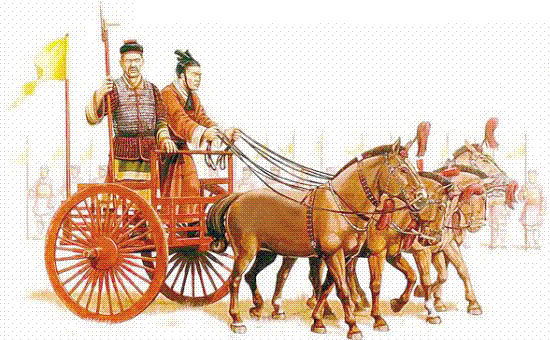
They did, but not in the medieval period, and in fact as a rule didn't have a "warrior caste" in the vein you're speaking - that is, a dedicated "combat-focused aristocracy" since roughly the Warring States Period of the 5th through 3rd centuries BCE. Up until that point, wars between the Chinese kingdoms/states of the Shang and Zhou are recorded as having been relatively small affairs (again, we're speaking relatively) with combat dominated by the movement of chariot-cavalry and chariot-archers - both of which were a staple of the early aristocracy (one does not simply give a peasant a horse chariot, after all!)
The duration, frequency, and intensity of those early internecine conflicts - ironically enough - depleted rather than strengthened or encouraged that "warrior-aristocrat"/equestrian class, and forced China to move away from the feudal-style methods of warfare (that of small, professional armies). By the end of the Warring State and its unification into the Qin Empire in 221 BCE, the State of Qin had definitively shown that the only successful strategy going forward was to embrace a truly "nationalized" - one might even say "modern" - style of warfare that placed total emphasis on mass mobilization of conscripted peasant armies.
That, in turn, was made possible in China due to an aspect that neither Japan nor Europe would achieve for another two millennia: mass-produceable, standardized, reliable, and easy-to-operate weaponry. For Europe and Japan both, that would come in the form of gunpowder weaponry, but for China by the formation of the Qin dynasty, the backbone of military tactics would be centered around the crossbow. That doesn't mean that it replaced the idea of the sword - or more accurately the dagger-axe-tipped-spear - but just like the musket and rifle would allow Napoleon in the 19th century CE to equip any and all dumb French or Bavarian farmers with effective killing power with minimal training, the crossbow did the same for mass armies in the 3rd century BCE for China - a kinda of super early levée en masse.
Not only did the weaponry of the era render the warrior-aristocrat obsolete, but so too did the formation of the state of Qin that would win the wars and unify China. The King of Qin had adopted the school of philosophy and governance known as Legalism - which in practice put all logistically important matters of state and war-craft... things like production of supplies and foodstuffs, its distribution, oversight of the war itself, tax collection, and the like... under centralized state authority, rather than depending on regional aristocratic families. This is a similar centralization as what we see in other massive empires such as the Romans - and conversely its opposite - the steep drop away from national-scale logistical control and standardization, and toward localized relationships of obligation that gave rise to the professional knights of Europe, or the Japanese samurai of the 15th-17th centuries.
This was further encouraged in the early Chinese empire by the slow-but-steady adoption of the Confucian idea of the scholar-official as the aristocratic ideal, vs. the warrior-official. That shouldn't be taken as though martial virtue did not still play a significant aspect of "manliness" throughout the Han Dynasty - it was in fact Ban Chao who "threw down the brush to pick up the sword," and the end of the Han and the 3 Kingdoms period was chock full of romantic ideals of martial virtue. But the drive toward aristocratic de-militarization would become all the more solidified after the second great period of civil war following the collapse of the Han Dynasty from 220-589 CE, with its reunification under the Sui and shortly thereafter the Tang. The Tang Dynasty especially embraced the idea that - ideally - the Chinese people should stay out of warfare themselves altogether, if at all possible. Instead they went with the military strategy of 以夷制夷 - "Use barbarians to deal with barbarians." Again, with both the aristocracy being fenced off from direct military power in favor of a centralized command, and the bend toward "outsourcing" one's fighting force to non-citizens, we can again draw parallels between early Imperial China and the late Roman Empire.
Increasingly over the course of the early and middle Tang regime, the armies were not only decentralized from the capital and into military governorships along the borderlands, but consisted largely (though certainly not entirely) of non-Han Chinese peoples, up to and even including their incredibly power regional commanders, known as 节度使 - the Jiedushi, or "Military Governors." These were professional, highly competent armies - or at least possessed corps of troopers essentially bred for battle - typically steppe riders. But that differs from the idea of the knight of the samurai because they were specifically kept as far away from the levers of political power as possible. Military commands afforded large power, yes, but not prestige - hence they were contracted out to/forced upon foreign commanders whenever possible. There was no glory in military posts, and no way to translate that into a positive career move into the actual scholar-gentry. It was an entirely separate career-path, and one the officialdom (and wanna be officialdom) kept as arm's length - quite literally only maintaining fighting forces along the physical border regions of the empire, and not near the capitals, if at all possible.
That would, in the end, turn around and bite the political structure of the Tang right in the ass when Governor Generals like An Lushan decided they'd had it playing second fiddle to the defenseless emperors, eunuchs, and officials and marched his army down from the north-east to assume personal control in the mid 750s. Though that would be staved off (and just barely), even the imperial court's realization that it did in fact require a centralized palace army to ensure their own safety wouldn't bring back the idea of such positions being virtuous or desirable. Command of the palace armies vacillated between mid-level political functionaries simply rotated through on a regular basis, or command of the force given to the one class who could never hope to hold direct political power, no matter what: the eunuch-officials (which is a whole other ball of wax). But by the Song Dynasty and beyond, at least in the national ethos the idea of military duty had been cleaved from the idea of masculine virtue. War was a destructive rather than creative affair, that obscured the better qualities of men - as exemplified in the Song era saying 好铁不打钉,好汉不当兵 - that is, "One does not waste good iron making nails, nor waste good men making soldiers."
So to sum up: China did have a professional "feudal-style" aristocratic military class, but very early on. Through a combination of early adoption of widely useable weaponry, the rise of centralized state authority over all aspects of war-necessary logistics, and the steady influence of philosophies like Confucianism, Daoism, and Buddhism that emphasized the idea that martial focus was un-gentlemanly, rather than the height of masculinity - that "Chinese samurai" class was phased out by the 3rd century BCE in favor of mass conscription of peasants and (later) foreigners.
Relevant Reads:
Bodde, Derk (2008). "The state and empire of Ch'in" in The Cambridge History of China, vol. 1
Chamney, Lee (2012). "The An Shi Rebellion and Rejection of the Other in Tang China, 618-763". University of Alberta.
Chen, Chiyun (2008). "Confucian, Legalist, and Taoist thought in Later Han" in The Cambridge History of China, vol. 1
Dalby, Michael T. (2008). "Court politics in late T'ang times" in The Cambridge History of China, vol. 3 pt. 1
de Crespigny, Rafe (2003). The Three Kingdoms and Western Jin A history of China in the Third Century AD.
Hsu, Cho-yun (1999). "The Spring and Autumn Period: Changes in state structure" in in *The Cambridge History of Ancient China.
Shaughnessy, Edward L. (1999). "Western Zhou History" in The Cambridge History of Ancient China
Weschler, Howard J. (2008). "The Founding of the T'ang dynasty: Kao-tsu (reign 618-26)" in The Cambridge History of China, vol 3. part 1.
Also, consider giving The History of China Podcast a listen ;)
Probably the most educational and pleasing reddit thread I've ever happened upon. Really loved it. Great answer and discussion. Gonna try to link to r/bestof. Amazing. Learned so much about a period of history I barely know but I love military history so this was better than porn.