In the Republic, the Romans wore them for the same reason basically everybody in the ancient world wore such decorations on their armour: because it made them look taller and more impressive (Goldsworthy, "Fall of Carthage", 47). Indeed, as Polybius points out of the feathers on the hastati in the mid 2nd Century BC:
"Finally they wear as an ornament a circle of feathers with three upright purple or black feathers about a cubit in height, the addition of which on the head surmounting their other arms is to make every man look twice his real height, and to give him a fine appearance, such as will strike terror into the enemy. " (Pol 6.23).
A cubit is 1.5 feet, so you can see how having these feathers on your helmet would make you taller, more colourful, more impressive, more intimidating. Such intimidation factor was essential in ancient battles where presenting an imposing spectacle to the enemy was an essential element of breaking their combat motivation and winning the fight. The emphasis the Romans (as others no doubt did also) placed on preparing their equipment to by shiny and impressive is evidenced in several accounts, one being the following, wherein the soldiers of Lucius Aemilius Paulus prepare to fight Perseus, King of Macedon, in 168 BC:
"...some were sharpening swords, others were polishing helmets and cheek-pieces, still others shields and coats of mail; some were fitting their armour to their bodies and trying the nimbleness of their bodies under arms, others were brandishing spears, other fencing with their swords and inspecting the point..." (Livy 44.34).
As you can see, not only do they sometimes wear elaborate headpieces, they go to a lot of effort to make sure their armour is well-polished, to make it brighter and more impressive. The effect of impressively-attired individuals is magnified when an entire army is dressed in such a manner. The impression a well-outfitted army can have is described by Livy, of Hannibal's veterans at Cannae in 216 BC:
"The shields of the Gauls and Spaniards were nearly of the same make; their swords were different, both in length and form; those of the Gauls being very long, and without points, those of the Spaniards, whose practice was rather to thrust at their enemy, than to strike, light and handy, and sharp at the point. The troops of these nations made a more terrible appearance than any of the rest, on account of the size of their bodies, and also of their figure. The Gauls were naked from their middle upward; the Spaniards clad in linen vests, of a surprising and dazzling whiteness, and bordered with purple. " (Livy 22.46).
Another example of the importance of appearances is Livy's description of a particularly well-dressed Samnite army that Lucius Papirius Cursor faced c. 309 BC:
"This body, from the covering of the enclosure wherein the nobility had been thus devoted, was called the linen legion. They were furnished with splendid armour, and plumed helmets, to distinguish them above the rest. They had another body of forces, amounting to somewhat more than twenty thousand, not inferior to the linen legion, either in personal appearance, or renown in war, or their equipment for service." (Livy 9.38).
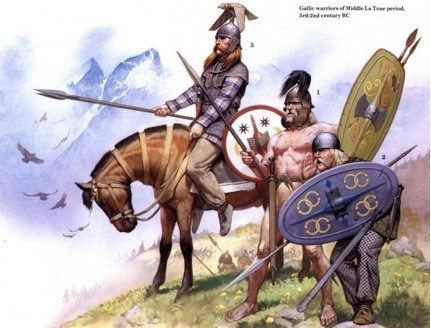
There are numerous other accounts of armies being described as impressive and intimidating because their armour was well-polished, their clothes were colourful, their soldiers were large, etc. As such, the feathers/brushes that Romans wore on their helmets served this same purpose, of making soldiers more impressive and intimidating the enemy. Such helmet decorations are peculiar not only to the Romans of course, and almost every ancient army tended to make a habit of putting something on their helmets or designing them in such a way as to make the soldier appear taller and more impressive. That it worked and continues to work is evident by the fact that soldiers continued to wear impressive but otherwise awkward helmets even in the modern day: observe the impressive headgear of, for instance, English dragoons or Napoleon's Imperial Guard. But going back to the ancient world, you can see similar practices by the Macedonians, the Gauls and pretty much everybody else to some extent.
As some others may point out, different helmet set-ups and plume-types could also signify rank and make the wearer more noticeable for the purposes of leadership, as is prominently the case with Roman centurions or tribunes/legates and standard-bearers (Caesar would also have had an elaborate Hellenistic-style helmet in battle). But for the majority of soldiers, the plumes were there primarily to make them look taller and more impressive in order to intimidate their enemies. That is not to say they were always worn of course: legionaries in the Late-Republic and Imperial period wore other designs such as the Montefortino or Imperial-Gallic helmet that are often depicted without crests, but it should be noted that attachments existed on most helmets to which plumes and crests could be attached (Bishop & Coulston, 102-3). Considering the psychological role of crests and tall helmets, I'm not sure why Roman soldiers seemed to have stopped wearing them as much, but I wouldn't be surprised if it had a bit to do with practicality in the field: in other regards developments in Roman helmets into the Imperial period such as increased neck and shoulder protection, the introduction of a browguard to defend against downward slashing attacks, and better ear and cheek-pieces seem to follow this pattern (101-2). However, somebody who knows more about equipment in particular could no doubt easily teach me a thing or two about why this occurred.
EDIT: It occurred to me after writing this post that the OP may have been mainly referring to the stereotypical depiction of Roman legionaries as wearing red crests, even in battle, in various visual media. For a start, red was not a colour as closely associated with the Romans as Hollywood has led us to assume, with soldiers wearing various coloured tunics, white perhaps being common, or blue/green for marines in the Later Empire, while the military cloak (shown always as red in shows such as Spartacus) also being of various colours, though generals often did wear red ones (Southern 154-5). As I said above, we know Roman helmets even in the Empire often had attachments for plumes or crests. But we flat out do not know if they wore them in battle, and we cannot too heavily on the idealised sculptural evidence (the detail we have lost without the paint notwithstanding) such as Trajan's Column (152-3) . Southern seems to summarise the matter (regarding soldiers in the Imperial period that is, we know in the Early to Mid Republic soldiers often fought with helmet plumes and feathers) in an eminently sensible manner:
"It is not certain whether the Romans went into battle wearing their crests and plumes. On Trajan's Column it seems that these were fitted only for parades and ceremonies, but Julius Caesar describes an occasion when fighting broke out unexpectedly, giving the soldiers no time to take off their shield covers, or to fit their plumes to their helmets. It may have been a case of fashionable practice at certain times, or perhaps it was left to the discretion of the general in command." (158)
For those interested, Southern is referring to this excerpt from Caesar's commentaries:
"Caesar gave the necessary commands, and then ran down in a chance direction to harangue the troops, and came to the Tenth Legion. His harangue to the troops was no more than a charge to bear in mind their ancient valour, to be free from alarm, and bravely to withstand the onslaught of the enemy; then, as the enemy were no farther off than the range of a missile, he gave the signal to engage. He started off among other things in the other direction to give like harangue, and found them fighting. The time was so short, the temper of the enemy so ready for conflict, that there was no space not only to fit badges in their places, but even to put on helmets and draw covers from shields. In whichever direction each man chanced to come in from the entrenching, whatever standard each first caught sight of, by that he stood, to lose no fighting time in seeking out his proper company." (Caesar BG 2.21)
To make it really complicated though, the word "badges" (or "emblems" in the Penguin translation) is a translation of, in this instance, the Latin insignia, which generally refers to a mark, a token, a signal, a proof, etc. It's not certain that insignia actually refers to, it's just an assumption that it's referring to helmet crests, but it could possibly refer to some other item that distinguished men or units.
So basically we don't know if legionaries wore those horse-hair plumes you see in movies a lot during battle, but we do know they wore plumes and similar things in the Mid-Republic, we know that their helmets could have crests or plumes attached to them even in later periods, and we know that crests, feathers, plumes and similar features of helmets were intended to make the soldier, in the context of battle, look taller, more impressive, and more intimidating.