I mean specifically outside of academia, when would the average person know about dinosaurs in roughly the same way we do now (not as biblical monsters or dragons etc.)
I have done a little research into this in the past, and while I can't speak for the average person worldwide, I can certainly give you some information focused on the US, and one very humorous source. The basic answer is 'sometime over the course of the second half of the 19th century.'
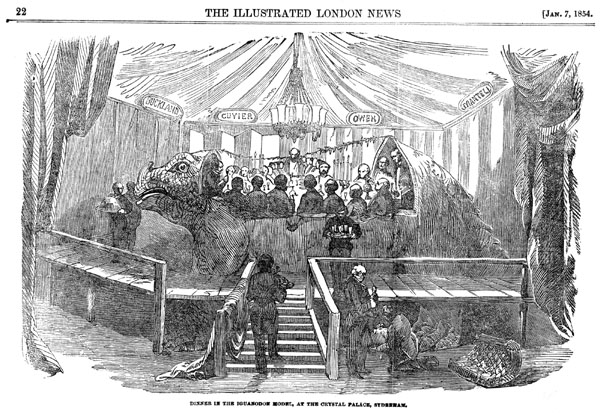
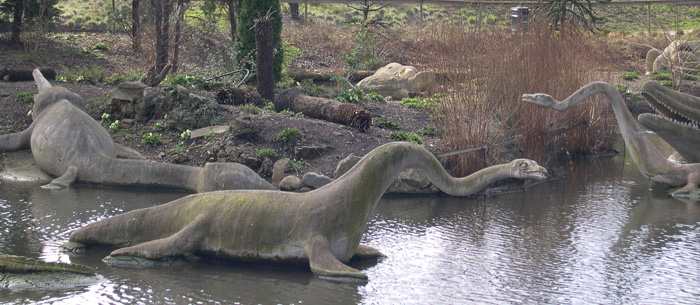
In 1854, Sir Richard Owen, who coined the term dinosaur, collaborated with a sculptor named Benjamin Waterhouse Hawkins to create several life-sized dinosaur (and other extinct animal) sculptures in London's Hyde Park, near the Crystal Palace. The focus was the new slew of giant extinct reptiles which had been discovered since the beginning of the 1800s. There's a great newspaper illustration of Owen hosting an 1854 dinner of all the contemporary leading academics/paleontolgists such as William Buckland and Georges Cuvier inside the mold of an iguanodon statue. So this would have been one of the big first times dinosaurs were thrust into the public eye. These remained pretty popular, and postcards and figurines of them were sold in the Victorian era.
By 1864 giant extinct reptilian creatures from the Mesozoic had appeared in [French] popular fiction, as this was the publication year of Jules Verne's Journey to the Center of the Earth, which features a battle between a plesiosaur and an ichthyosaur— two animals who had also appeared in Hawkins' Crystal Palace sculptures. (It wasn't published in English until 1871.)
That same Benjamin Waterhouse Hawkins traveled to America where he would put together the first mounted dinosaur skeleton on display for the public, in 1868, in collaboration with Joseph Leidy and Edward Drinker Cope. It was a Hadrosaurus, in Philadelphia's academy of natural sciences.
While modern-day websites claim the unveiling of the giant skeleton caused massive crowds and interest, the closest primary source news article I could find from an actual Philadelphia newspaper to the date of its actual opening is one that notes how the dinosaur's stance resembles a much-mocked posture trend in contemporary young women called the Grecian Bend, and spends the article making jokes, noting that it's "a great pity" that, with the Hadrosaurus putting on such a beautiful pose, "there were then no animals higher in the scale of creation than reptiles, to see and admire these highly gifted creatures. Let us hope their beauty was not wasted, but that cretaceous eyes and intellects were formed to appreciate the artistic more fully perhaps than crocodiles and alligators are capable of doing at the present day."
You'll note that while the whole thing is very tongue-in-cheek, the writer actually displays a solid understanding of the idea of geological eras and that not all animals (e.g. mammals in his example) had appeared yet during dinosaur times, even though Darwin's Origin of Species had only been published 9 years earlier. Did he expect his 1868 readership to already know the word Cretaceous? He certainly expects them to be able to infer its meaning. Though perhaps this was because newspapers had just recently used the term in writing about the Hadrosaur's unveiling a week or two before, and I just couldn't find those articles digitized. Here is a pdf of the page of the newspaper with the article, which is titled "The Grecian Bend."
So I think this kind of attitude along with Journey to the Center of the Earth are pretty fair evidence that in the 1870s even a non-academic person would have the idea that there was an antediluvian age where giant reptiles walked the earth before humans, even if they didn't think about geological time scales or the mechanism of evolution.
On the mechanisms of Evolution, Darwin-advocate Thomas Henry Huxley came to the US in 1876 to meet with paleontologist Othniel Charles Marsh to discuss dinosaurs, and Huxley gave a lecture series on evolution in which he explicitly showed diagrams comparing crocodile, dinosaur and bird fossils and anatomy, and publicly asserted birds were the descendants of dinosaurs. This lecture was transcribed and published in the New York Times, as well as collected into "Huxley in America," which is scanned and free on Google books. So while only academically-minded people might have attended his lectures in person, which I believe were held at universities, like I said the text of that book was also published in the New York Times. So by this point any New York Times reader would have seen illustrations of dinosaur skeletons.
Benjamin Waterhouse Hawkins planned to create a new display of dozens of life-sized prehistoric animals in New York, but his workshop sadly was burned down.
Then, and I'm not going to write a lot about this, those two paleontologists I mentioned, Marsh and Cope, got in a huge feud and constantly published smear articles about each other while competing to see who could discover the most dinosaurs as fast as possible, called the Bone Wars. The result was the well-publicized discovery of a lot of the most famous dinosaurs, like Tyrannosaurus, Triceratops, 'brontosaurus,' etc., with the bonus that now there were lots of enormous impressive specimens to become mounted centerpieces of the country's natural history museums in the 1890s and onward.
By the 1910s on dinosaurs were 100% common knowledge. You've got Conan Doyle's The Lost World, Windsor McCray's Gertie the Dinosaur on film, the Sinclair Oil Company picks a dinosaur as its mascot, and then from the 1920s on you get big dinosaur movies and everything else. And in these dinosaurs need no introduction or explanation.