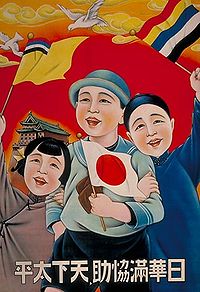
I found this post which only had a few comments. I doubt that there would be any armed resistance, but were there any major or minor groups, individuals, etc. opposed to the war, the imperial system, the bushido code, etc?
The idea of a conscientious objector might exist in the west, but were there any in Japan that we know of, even if the Japanese did not recognize the concept?
Please help with my curiosity.
Thanks
So you're asking two questions; first, was there opposition to the formation of the "Greater East Asian Co-Prosperity Sphere?" And second, would the idea of a conscientious objector have existed as a concept in Imperial Japan?
In terms of the first question: yes. There were elements of Japanese society opposed to the war effort. That leads to the second: no, they were largely not against it as "conscientious objectors.," but primarily as political actors. They had wholly different sets of motivations.
We can break these groups down roughly into three major categories: the Communists, the Anarchists, and then a guy off in his own corner named Saito Takao. Let's tackle them one at a time...
#Communists
Probably the most well-known was the Japanese Communist Party (日本共産党) which was formed in 1922, and more or less immediately suppressed by the Imperial government for fairly obvious reasons. In 1928 and 29, mass round-ups/arrests of its members were conducted. This in turn led to further backlash and radicalization from the JCP. From Beckman and Okubo's The Japanese Communist Party: 1922-1945:
During the election campaign [of 1930], the Communist Party yielded to pressure to utilize force. Within Zenkyo there were elements that wanted to transform strong words into armed action – to pit “red terror” against “white terror.” This tactical course had been proposed much earlier by Mitamura, who as head of the party’s union department before the April 16 [1929] arrests, had maintained that strikers should protect themselves against terrorism by organizing self-defense units. These were to be armed and given military training. Mitamura’s ultimate expectation was that the self-defense units would develop into a mass armed revolutionary organization based upon factories. In February 1930 the central committee approved the formation of “red self-defense bodies,” made up largely of Zenkyo members. In Tokyo, 15 squads of from three to five men, armed with knives and pistols, went into the streets to distribute handbills and hang posters, some of which called for “armed strikes, arson, and the destruction of factories,” to incite and intimidate workers and others, and to resist the police if necessary.
This tactic, of course, only further riled up the imperial government and led to further confrontation between the two groups. The violence between police and the Communists escalated over the course of early 1930, culminating with the arrival of May Day/International Workers' Day. This was, of course, highly planned. In a message leading up to the clash, Party Leader Zenkyo wrote a missive to his party members urging to engage in "the struggle" with all their might. He wrote:
At this difficult time, who is going to defend us – the workers – and literally fight to the death? Only the Communist Party. The Japanese Communist Party has come out into the open […] and is directing all struggles with the acclamation and overwhelming support of the masses of workers and peasants […] We will support it, join its struggles, and fight to the death at the head of the class war until a new day comes for the workers. […] Only a council of armed workers and peasants led by the death-defying Communist Party and only armed political mass strikes and great demonstrations can eliminate wage cuts, layoffs, and long work hours, and free the workers from a life of slavery.
In spite of the standard-issue over-the-top Communist rhetoric on full display, the May Day "March on the Diet" would prove to be a complete fiasco. The police were more than ready (they read the leaflets, who'd have thunk?), and they were quickly able to move in, arrest the leaders of the still-forming group, and disperse the rest. This would prove to be something of a double-defeat, since it showed to the Party's own members just how pitifully weak they were compared to the might of the imperial police, which at the same time it gave the police all the more ability to play up the violence and "danger" of the Communists. They're trying to march on the Diet! They must be stopped!
The following year would see the re-flaring up of Sino-Japanese tensions in the form of the Mukden/Manchurian Incident in Sept. 1931, in which the Imperial Army arranged for a quantity of dynamite to be detonated near one of the own railway lines in order to blame the Chinese of committing acts of terrorism against them - thus justifying an invasion. Rather funnily, they actually used so little dynamite that the resulting explosion didn't even manage destroy the tracks and derail the oncoming train. Nevertheless the IJA had its pretext and in less than 6 months had "liberated" Manchuria and brought it into the Greater East Asian Co-Prosperity Sphere as the puppet state Manchukuo. And they even gave the deposed last emperor of the Qin Dynasty back his crown and a chair to sit on. Isn't that nice.
The CPJ vigorously protested the imperial occupation of Manchuria and the rather transparently-false narrative justifying it. Both free members and those already imprisoned did as much as they could to make their voices heard against such aggression. They hijacked their own ongoing trials to loudly decry the imperialist nature of the conflict - which the presiding judge tried and failed to contain. They conversed and shouted in the prison to the point where they guards were regularly beating them up. One defendant showed up to trial following such a beating with a swollen and bruised face, allowing the Communist to have a PR victory and force the police to stop such tactics - lest the Communists threaten to once again to put such brutality on display in open court.
The Communist newspaper publication Shimbun Akahata (meaning Newspaper Red Flag) published:
The bourgeois newspapers and magazines unanimously find the “causes” of the present war in the “violence” and “scornful attitude toward Japan” of Chinese soldiers and in the partial deconstruction of the Manchurian railway. However, this is completely false. The real cause lies in the fact that the Japanese imperialists have been preparing for a war of territorial plunder in order to extricate themselves from the crisis with which they are confronted at home. The action that the Japanese military clique took under instructions from the financial bourgeoisie did not come about all at once. […] It is an act of imperialism and the beginning of armed intervention in the Soviet Union […] We must fight against bourgeois patriotism and chauvinism, which are rooted deeply among Japanese workers, and strive for the independence of colonies and semicolonies. We must transform the war of imperialism that will intensify the dictatorship of the bourgeoisie into a civil war in order to establish the dictatorship of the proletariat.
Nevertheless, the police's continual crackdown on the Communist group - and even supposedly "legal" Proletariat group in the Diet - had the intended effect. By 1935 the JCP had been effectively silenced and was forced to shut down its operations, retool, and reorganize... and process that would take it into the 1940s to achieve.
#Anarchists Another rather rag-tag group that assembled against the imperial aggression of the Japanese government and military in the 1930s were the various anarchists across the nation. The Black Youth, the Farming Village Youth, and the Zenkoku Jiren being some of the more famous examples. That last, Zenkoku Jiren was kind of the "flagbearer" of the Japanese anarchists at the time of the Manchurian Incident, since by the early 30s, the other anarchist movements had (wouldn't you know it) splintered and begun infighting. As such it was in the Esperanto-language version of the Jiyu Rengo Shinbun that the organization published on Nov. 19, 1931:
The true cause of mobilization to China is none other than the ambition of the Japanese capitalist class and military to conquer Manchuria. Japan has its own Monroe Doctrine. Japanese capitalism cannot develop, or even survive, without Manchuria. That is why its government has made up its mind to risk anything so as not to lose its many privileges in China [...] American capital has flowed into China in larger and larger amounts. This represents an enormous menace to the Japanese capitalist class. In other words, Japan is now forced to oppose American capital in China. The is, in fact, the direct cause of the mobilization.
Later on the article concludes:
Complete international unity of the anarchists would signal our victory, not only economically but in the war against war.
ANARCHIST GROUPS OF ALL COUNTRIES, UNITE! ABOLISH IMPERIALIST WAR!
Theirs would prove to be a similar fate as the communists: relentlessly hounded by the police force until they were effectually dissolved.
Character limit reached part 2 below