Hello there, this is my first but my very sought after answer. First of all, please bear over with me and my english as it is not my mother tongue.
short elaboration: So to start, my girlfriend came home and told me she learned that the ancient statues were painted and found some examples on the internet such as: https://mocochocodotcom.files.wordpress.com/2014/04/true-colors-of-greek-statues-1.jpg
I could not believe it and still cannot. I tried to look it up different places on the internet and it seems they haven't been able to find a clear answer yet, they seem to argue a bit? or am I wrong here? Maybe I were looking at older articles.
I've read they found color pigment on the statues. I was thinking this would mean they either colored them like she said and the picture shows or it could be to try it out with color.
So were the statues in fact painted, why would they paint them as most nowadays would think them as uglier than this pretty white marble?
Can anyone give me some insight, a clear answer and maybe some background stories and explanations?
Thanks in advance!
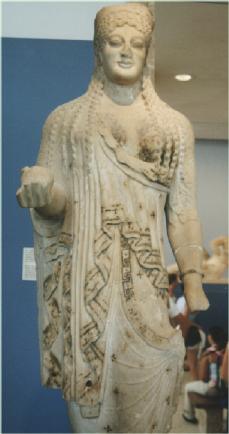
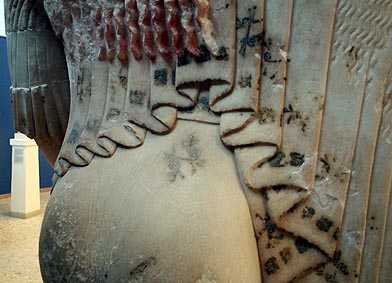
Yes, Greek statues were painted--see here. This is absolutely not up for questioning, we have abundant textual references as well as chemical traces of the pigments (in some cases much more than just traces--a quick trip to the Classical Athenian portion of the Met will show a number of gravestones that still preserve visible indications of encaustic pigment)--that Greek statuary was painted with encaustic is a certainty. No scholar has seriously denied this for nearly two hundred years, no matter the arguments of the Internet.
So were the statues in fact painted, why would they paint them as most nowadays would think them as uglier than this pretty white marble?
Your opinion may be that they're ugly like that, but there's no reason to suppose this would have been the general opinion of antiquity. Furthermore, the reconstructions that you're looking at are imperfect at best. In reality Greek painting, both encaustic for statuary and architecture and more "usual" (to us at least) wall painting, was quite sophisticated. A cursory look at surviving Greek and Roman frescoes will immediately show skillful use of shading and complex color theory. Similar techniques were employed on statuary--Pliny has a whole section on encaustic. Painted statuary would not have been as flat looking as most modern reconstructions, which simply take a surviving pigment and apply it to a whole surface. We are unable to accurately determine, due to age and weathering, the shading and subtle variations in pigment that existed in the encaustic of classical statuary, but we know from our texts that the painting of statuary was considered just as lifelike as its form--the Venus of Cnidus was prized not just for Praxiletes' skill with a chisel, but for the beautiful encaustic coat that was put on her, with a polished layer of beeswax to make her skin seem real and supple