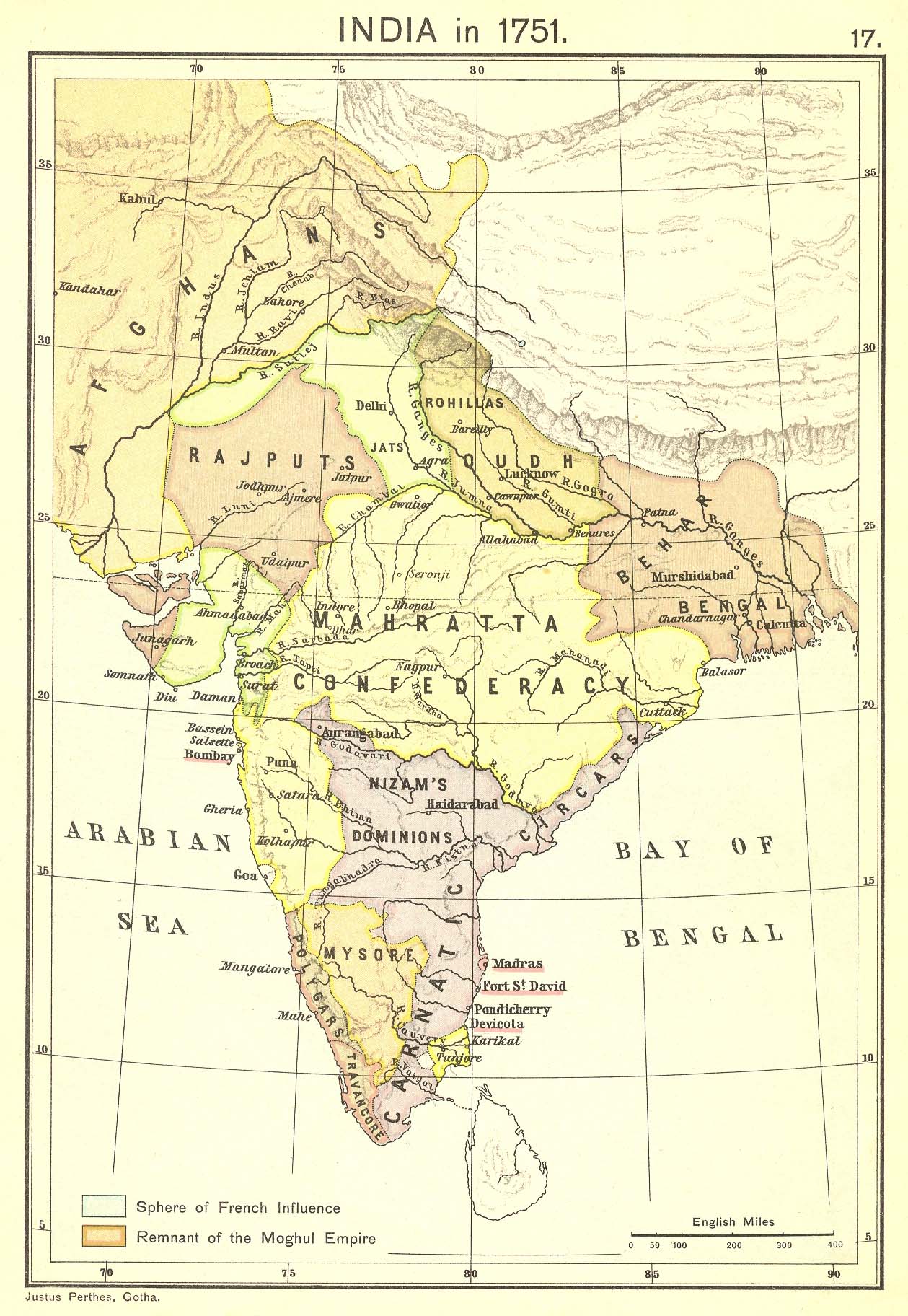
The parts of South Asia that Britain had direct and indirect authority over were not always under a single broad political authority. Today we of course have countries like India, Pakistan, and Bangladesh in British India's place, but even before the British, South Asia has been alternately ruled by different groups of people of different cultures and languages, coming from both outside and from within modern day India. The older Maurya and Gupta Empires were quite sizable, as were the more recent Delhi Sultanate and Mughal Empire at their heights in the ~14th and the early 18th centuries respectively. However we can also see smaller kingdoms, like in this map of South India through the 15th and 17th centuries, and during fragmentation of power away from the Mughal Empire in the mid 18th century. India as its territory exists today is just that- a reality that exists in present day, but was by no means always true or even present in the same way in the past.
In the scheme of things, while India as a political entity is relatively new, so too is the concept of being Indian. Today, it is possible for people from Punjab and Tamil Nadu (see the red arrows on the map of present-day Indian states) to both feel unity as countrymen and being Indian, while still identifying with the regional cultural things that distinguish them and make them Punjabi or Tamil. For most of the history of British India this was not possible; even before the British "got there," there was no larger identity that unified the people of South Asia.
As a consequence of this, the frequent revolts against the British were primarily done on local scales in protest of local issues up until the early 20th century, when a larger and sort of national identity began to grow and coalesce among the people. (This also coincides with the growth of a Muslim identity that would feed into the creation of Pakistan.) Some of the local rebellions were from people in places of authority, often landowners with tax-collecting rights, who felt that the British were unacceptably encroaching on and interfering with their rule and rights, as seen in the Poligar and Paik Rebellions of the early 19th century. There were also revolts over what was seen as the imposition of foreign cultural elements, like the short-lived 1806 Vellore Mutiny. In this instance, sepoys (Indian soldiers) were angry over new local East India Company military uniform rules which required them to remove caste and religious markings, and to wear helmets that they associated with Christianity. Aside from impositions of ruling authority or culture, people would also rebel in the face of local economic policies that caused them financial hardship, like high taxes or trouble with money lenders whom people had to deal with due to changes in things like land ownership and agricultural policy. As said above, these movements were quite local in character and did not call for large-scale things like mass unity or for the British to quit South Asia all together.
Even one of the largest and most famous revolts, the 1857 Sepoy Rebellion, 'failed' in part for its still too localized character. There were many areas where the military refused to participate in the rebellion or in some cases actually supported the British, as did certain local rulers who felt their position was good in Company rule and wanted it to continue. There was also a lack of support across the various swaths and social/economic classes of society. Despite the fact that native people also outnumbered Englishmen in the Company military in India, English soldiers maintained control over the majority of the artillery, a fact which prevented most of it from being used by rebelling forces. After the 1857 Rebellion, the British government dissolved the East India Company, and took over the job of ruling India. They also began taking direct steps to ensure their military dominance over British India, such as by recruiting native soldiers from areas and peoples who largely aided the British in 1857, like the Gurkhas from Nepal, and by almost completely removing artillery from the hands of the sepoys and refusing to train native artillery units. So at this point in history, the people of British India were still lacking in the amount of unity and national conscience that would later allow them to have greater success in gaining independence, (and militarily defeating the British was out.)
Just to illustrate the eventual change in character that these rebellions had, let's jump forward to the 1913 and take a quick look at the Ghadar Movement, which was mostly led by expat Punjabi Sikhs (but secular in nature) and sought to overthrow the British via a military rebellion. Since Punjab was an especially rich agricultural zone, it was subject to great policy re-working by the colonial government in order to further increase its productivity of food for export. Taxes and revenue due from the land were still high, though due to the greatly increased value of the land, moneylenders raised the amount of money they were willing to give to farmers. The lenders often took advantage of the peasants, most of whom were illiterate and otherwise powerless to do anything, and many fell into a cycle of indebtedness which continued for generations. Between 1872 and 1903, the amount of farmers who didn’t own the land they worked on increased by 360%, and by 1891, four million acres of land had passed from their ownership to that of the moneylenders. Taxes were not lowered during droughts or famines, and though agricultural output was high, poor management and the export of much of it took its toll. Craftsmen and artisans fell out of work, and many became farm workers as British-made goods flowed in and native industries suffered, or simply joined the British military. As you can see, the Punjabis who joined the Ghadar certainly had many reasons to want to see some major changes and improve the lot of Punjab, but they set their sights on a larger goal, wanting to remove the British from South Asia entirely. One of their figureheads, Lala Har Dayal, sought to be a bridge between the Punjabi workers, ex-soldiers, and intellectuals and students who joined the movement. Despite this, the movement was not actually able to successfully recruit civilians in Punjab or the rest of British India, but some intent was still there. In the first issue of a magazine published by Ghadar supporters, they listed fourteen points detailing the injustices and failings of British rule in not just Punjab, but over the rest of British India. Examples were draining the wealth of India (and failing to put anything back in or compensate the country), crippling of Indian arts and industries, causing rampant famines and plagues, enacting high land taxes, and attempting to sow discord between different groups and classes of Indian society.
Though the Ghadar Movement was unsuccessful, it came at a time where we start to see a growing number of people coming together under nationalism, advocating for their idea of "India" (or at least a much larger community) instead of simply advocating for their town or regiment or local ethnic group, and often asking for something beyond just some economic policy changes. Part of this advocacy involved the development of political leadership and organization that could represent the will for some amount of independence or complete self-rule; this didn't really exist in an effective way until the early 20th century, but had its beginnings in the latter part of the 19th century when the Indian National Congress formed in 1885.
I don't want to give you the impression that everybody in British India was totally united on what should or shouldn't be done about British rule, or that they were even in agreement on what an independent country should look like and how it should be achieved, or if there should even be a single new country as opposed to multiple ones. The important point is not necessarily that there were disagreements about these things, but that disagreements, a popular will for some sort of independence, and a growing national identity were around at all, because you wouldn't have seen that for most of the time leading up to the 20th century.