I just finished reading Tom Holland's "Rubicon" and while it filled in a lot of gaps in my knowledge, corrected many errors I'd learned in history class, and gave me some new small bits of interesting info (like Romans thinking it was barbaric to drink milk) - one of those tidbits that sticks with me most is that one of quirks the Romans thought odd of the Gauls is that they did not lay down to eat. I may have heard of Cato's public mourning of the republic via eating in a sitting up position prior to this reading, but didn't understand its magnitude then and still don't quite. Did all Romans of all classes eat laying down - for instance laborers, slaves or gladiators? Was this common in other civilizations outside Rome at the time as well?
I just finished reading Tom Holland's "Rubicon" and...it...corrected many errors I'd learned in history class
Lordie I hope it didn't, since Holland's absolutely full of errors and misunderstandings himself--it's really not a very good book.
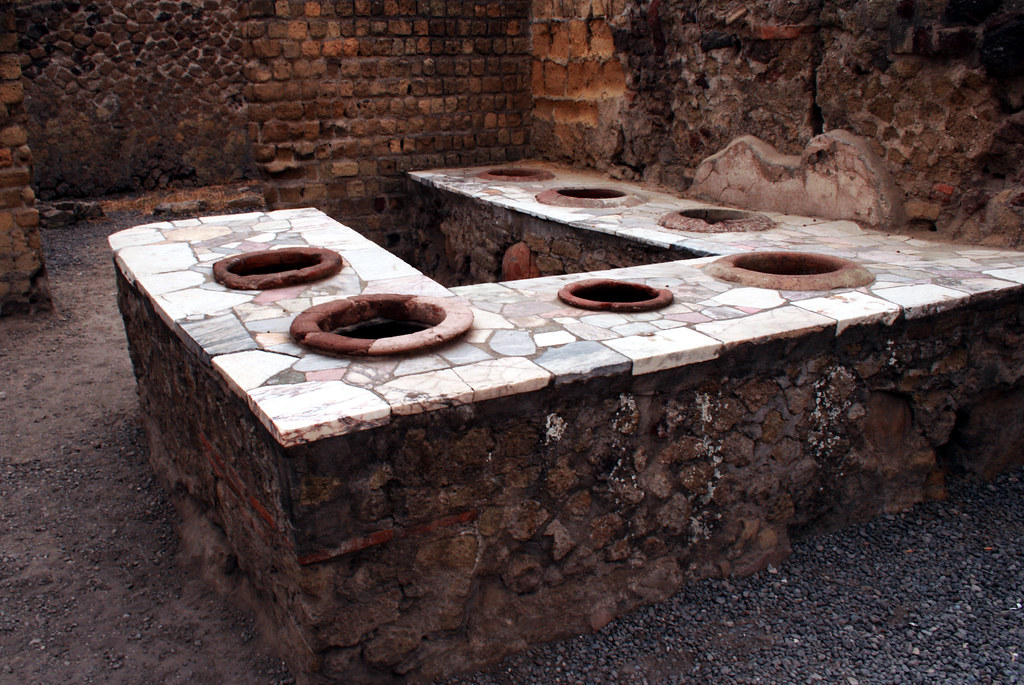
As I understand it your question is not about what the poor ate, but the actual manner in which they ate, correct? That's something of a pity, because we have decent information for the first question (the answer to which would be "not a whole lot") but very little for the second. It's simply not something that our surviving material dwells on. It should be noted that reclining at table was a decidedly social custom--one reclined in the company of others, at private or public banquets. Which meant that reclining at table was necessarily generally an aristocratic custom and one that would not generally be observable at the minor meals of the day (although the wealthy Roman often ate little besides the cena). The average urban Roman was a day-worker whose daily wage (if he even managed to find work that day) was only barely enough to provide him with the grain he needed to bake his bread. The situation was slightly different for the rural Italian peasantry who owned (or more likely rented) a iugerum or two, but for much of the urban plebs it's debatable whether we can even really refer to them as having meals in the first place--this is, of course, fraught with speculation since we don't have that information. For the slightly better-off the usual place of dining was to be found in the eateries of the city, most importantly the thermopolia. You may be familiar with these things from Pompeii--they're often mistranslated as "taverns," which they're not. The poor did not cook their meals in the city--even if they were lucky enough to have an insula provided with a hearth they could not risk fire to cook for themselves. The plebs media--shopkeepers, skilled workers, etc.--dined in these eating shops, but as you'll notice there's little room or provision for the couches on which the Roman elite reclined in their triclinia--the thermopolium customer sat on a stool at the counter.
However, a facet of Roman rural life was the regularity of public festivals, which frequently included public banquets, at which the rural plebs would also recline (the evidence for reclining, though, is probably stronger among the rural plebs, many of whom probably owned or rented their own small plots and had more leisure time for such things than their urban cousins). Public banquets are not really a feature of Roman urban life, however, unlike among the Greeks. For those among the urban plebs who had patrons there was the possibility of invitation to a patron's private cena every now and then. How often this happens is quite debatable--I would contend that it was exceptionally rare except in the case of very "high-profile" clients (relatively speaking, at least) and that the vast majority of the urban poor were, as unskilled semi-migratory laborers, more or less faceless and unconnected to a single patron, although many of these laborers might consider themselves the clients of their tribunes or other leaders who really had little (if any) personal affiliation with them. Low-class clients at a patron's cena might be treated very differently, however. If a large number of clients were invited at once (as was probably more usual) they might find themselves separated from the guests of honor (so to speak) and forced to make do with sitting at table, sometimes in a different room. Even when allowed to dine at the same table clients probably often had to sit, like the women, while their patron and his friends reclined by them. Besides the patron's own clients there was frequently the expectation that dinner guests would bring their own clients and dependents, the mysterious umbrae (shadows) mentioned sometimes in our sources--likely these guests were maintained in separate facilities. In other words, when given the opportunity to recline, everybody did--except of course slaves (although gladiators, frequently prized guests, might be allowed to recline) and sometimes women.
That reclining at table was an indication of leisure and sophistication is clear from its origins. The Romans adopted the practice from the Greeks, who in turn probably borrowed it from Near Eastern or Anatolian peoples. Pretty much immediately after its introduction in the Archaic Period (the heroes in Homer do not recline) reclining at table was a mark of sophistication, a custom practiced mainly by adult, landed males at their symposia and other commensal events. Among the Romans invitation to communal meals was somewhat freer, admitting women, the poor, and even slaves, and was somewhat less a public display of citizenship and sophistication. But even so, it seems fairly safe to say that the vast majority of the Roman population, for most of their meals at least, did not recline--though if given the chance they naturally took it, and reclining was always thought of as better than sitting, something only done by even the poor only when they had little choice (as was usual)