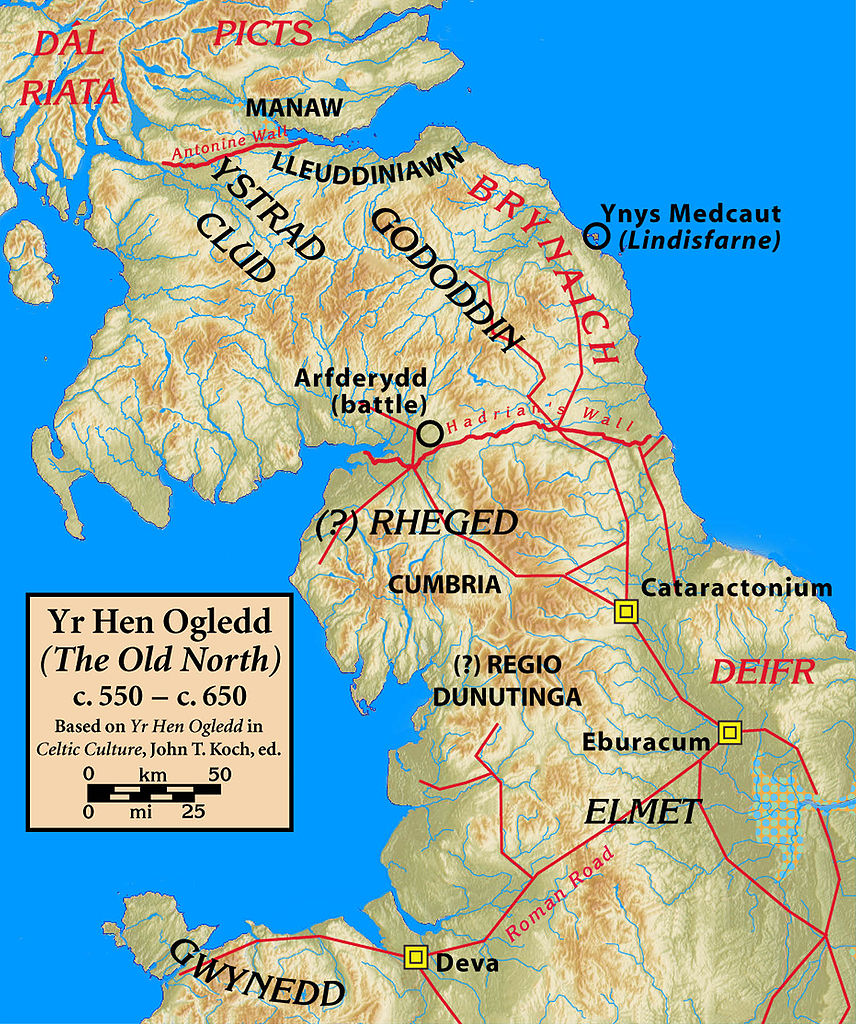
Historically for a long time, the mother tongue of the lowlanders was Scots, a Germanic language derived from Northumbrian Old English. Scottish (Gaelic) was the mother tongue of the highlanders not the lowlanders whereas Old English (and its derivative Scots) was the mother tongue of the lowlanders.
Prior to the Germanic & Gaelic invasions/migrations to Britain, the language spoken in the lowlands was Brythonic, a language related to Welsh. Whereas the language spoken in the highlands was Pictish. As can be seen on this map. I'm fairly confident that Scottish (Gaelic) was never spoken by the majority population in the lowlands. Lowland Scots also have significant genetic influence from the Anglo-Saxons and Vikings due to the occupation of that region by them.
So how come the Scottish Lowlands are part of Scotland and not England when they have more in common with England in terms of language/history/ancestry? Since England was historically much more powerful than Scotland, I find it interesting that the Scottish Lowlands are not considered part of Northern England. What are the reasons behind this?
Before the birth of the kingdom of Scotland in the 9th century, much of the Scottish Lowlands, known as well as the Midland Valley, was part of the kingdom of Northumbria and was indeed Anglian rather than Scots. Edinburgh itself was part of it. But back then, ethnic or linguistic realities had little to do with the demarcation of borders.
The Danelaw, the viking state in England, shattered old borders and Northumbria in particular, and left a power vacuum that the young Scottish kingdom took advantage of, in fact until the treaty of York in 1237 established definitely the border between England and Scotland, the latter made several attempts to push it's border southwards to include all of former Northumbria. Historically this was a defeat for Scotland because while they did retain the Lowlands, this actually fell short of their ambitions for the past three centuries.
York was a turning point in the sense that the extent of Scotland and England were no longer contested, further conflicts between the two would be about the crown of Scotland itself. England never tried to contest the boundaries of York, as it was preferable afterwards to gain all of Scotland if the opportunity arose rather than redraw borders. Repeated English attempts to rule both kingdoms led to the wars of Scottish independence in the 13th and 14th centuries but at no point did the English try to merely change the border demarcation, their kings wanted to rule the island, not merely a bit more of it. The Scots did try one last time to expand during the War of Roses by retaking Berwick and disputing the border, but the attempt failed and was followed by an English invasion that again was aimed at the entire Kingdom rather than part of it.
So to summarize it was always Scotland who marched to redraw borders in their favor, their war aims were merely territorial, while the English felt that taking all of Scotland was preferable and doable. Had London decided to fight for the Lowlands rather than Scotland as a whole they would have had multiple chances to build upon their gains at York in the next 300 years, but officially respecting Scotland's territorial integrity while trying to win it's crown by force seemed simply more advantageous.
Ultimately Scotland fought off military attempts to it's throne and it's a royal marriage between the King of Scots and the eldest daughter of the King of England in 1503 that would be the first stepping stone to the Union of Crowns. Though there was afterwards another war when France invoked the Auld Alliance a mere decade later, the dynastic bond was forged for good and later paid off. It's ultimately a Scottish king, James, who came to create in 1603 the personal union of the thrones of England, Scotland and Ireland that would a century later become the UK, realizing a fear that had been voiced in England often since 1503. The attempt to marry into the Scottish throne backfired a century later, but England knew it's demographic weight would ensure it remained the seat of power in the union and accepted the fact.
So Ive drifted a bit from the original question, but the short answer would be that between 1237 and 1603, the English were too focused on taking the Scottish throne for any of their wars to be merely about redrawing the border. The Scots were also not easy opponents to have, and won many military victories despite frequent numerical inferiority. Other factors would be the Auld Alliance with France that complicated all conflicts with Scotland and the Papal principle of the rights of Kings that, until the principle of sovereignty of nations superceded it post-Westphalia, made it preferable to seek to gain an enemy's title than merely try to get them to cede land.