The AskHistorians Podcast is a project that highlights the users and answers that have helped make /r/AskHistorians one of the largest history discussion forum on the internet. You can subscribe to us via iTunes, Stitcher, or RSS, and now on YouTube and Google Play. You can also catch the latest episodes on SoundCloud. If there is another index you'd like the cast listed on, let me know!
This Episode:
/u/CptBuck gives us the first of two episodes looking at WW1 in the Middle East, discussing the political intrigue and wrangling between the Ottomans, British, French, and Russians, among others. This episode focuses primarily on the Turkish area of the Ottoman Empire, and the various plans hatched both before and after Armistice to divvy up the Ottoman state. Along the way we talk about the Sykes-Picot, the Young Turks, the Greco-Turkish War, and Lawrence of Arabia. (59min)
Questions? Comments?
If you want more specific recommendations for sources or have any follow-up questions, feel free to ask them here! Also feel free to leave any feedback on the format and so on.
If you like the podcast, please rate and review us on iTunes.
Thanks all!
Previous Episodes and Discussion
Next Episode: /u/cptbuck continues the discussion on how WW1 shaped the borders of the modern Middle East, focusing on the Arab states.
Want to support the Podcast? Help keep history interesting through the AskHistorians Patreon.
Thanks /u/400-Rabbits!
Happy to take any questions, in the mean time some extra links, corrections and addenda. I also have some additional quotes that I had hopped to work in that I have in my notes back home as well as some good photographs which I'll post when I get back from work and can hopefully add to this as well.
Maps, maps, maps:
Google is failing me in finding in finding a great map of the Ottoman Empire in 1914, but this one is quite nice looking and is close enough although I believe there was a small Ottoman garrison in Qatar in 1914. Also just some context for what Europe looked like.
The Ottoman administrative divisions of Syria are confusing, this is probably the best one I've come across. NB: basically the colors here represent top-level provinces/states/wilayets, while the letters show the sub-level districts. The exceptions are Jerusalem and Lebanon, which were top-level and separate. Also as is shown on this map, the city of Beirut would have been part of the vilayet of Beirut despite being surrounded by the mutasarrifate of Lebanon.
For the Damascus Protocol, you can see the text of the Arab claim here which roughly corresponds to this entire territory, this map includes the British caveats in the Hussein McMahon correspondences, though as I discuss even those are disputable.
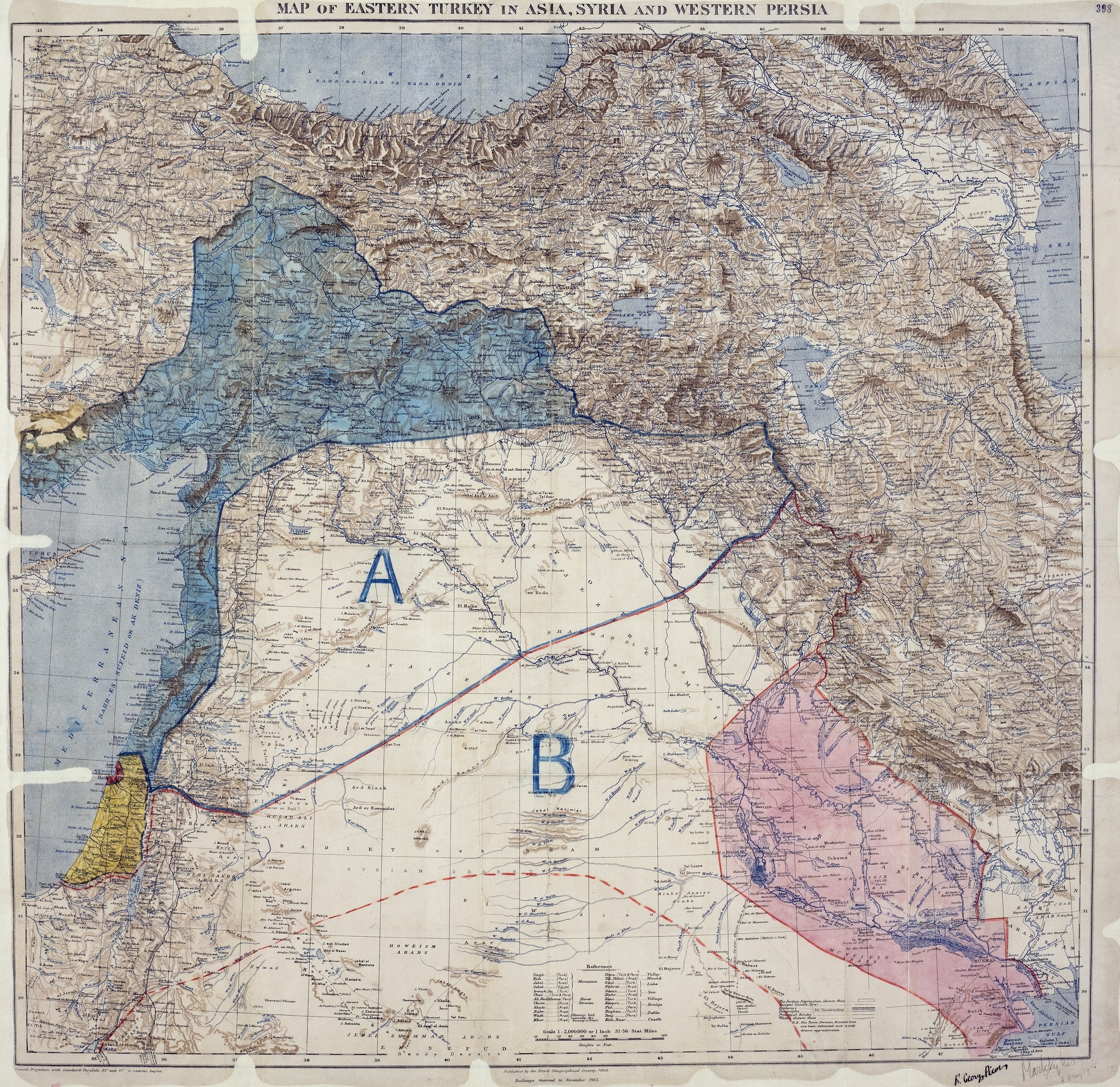
The original Sykes-Picot map can be seen here. The un-shaded A and B areas would be under each country's respective sphere of influence but would otherwise be nominally "independent." You can also see Sykes and Picot's signatures in the bottom right. Sykes signed in pencil. This is the finalized version that was actually agreed to in Russia in 1916, and which also shows the Russian claims, and is also why there are occasional references to Palestine being shaded "brown" despite the Sykes-Picot map being yellow. The Italian portions were included in the Treaty of London, which I didn't discuss because they were basically made irrelevant by the facts, but reinforces just how much they wanted to carve up this territory and would come back into play with Sevres.
Here are the divisions of Ottoman territory stipulated in the Treaty of Sevres.
Approximate map of Turkish National Pact.
Primary source materials
Corrections and Addenda
7:28 – Iskenderun, not Iskandria
12:12 -- capitulations, not concessions.
17:30 – Hussein became Sharif in 1908
21:35 – Henry McMahon was the British High Commissioner for Egypt.
23:20 – As predicted, I did mix them up, al-Fatat was the more literary society, al-Ahd was the Iraqi military society.
30:40 – Acre is one of the northernmost cities of Israel, not the southernmost of Lebanon.
35:15 – the US declares war on Germany and Austria-Hungary in April 1917 and the first troops landed in Europe in June. The US did not declare war against the Ottoman Empire.
40:48 – The Salonica front is, of course, centered on the city of Thessaloniki and so is not in the “western Balkans”.
44:00 – Falkenhayn was the German General.
51:11 – Sakarya
51:30 – Constantine I was deposed in June 1917
edit: typo
It's time once again for the AskHistorians Book Giveaway! This month we picked two winners: Eric Hacke and Alec Barnaby! The selection of books we have available this month are:
Eugene Rogan's The Arabs: A History, recommended by /u/cptbuck.
Vine Deloria's Custer Died for Your Sins: An Indian Manifesto, recommended by /u/snapshot52.
Terry Bouton's Taming Democracy: "The People," the Founders, and the Troubled Ending of the American Revolution, recommended by /u/uncovered-history.
Eugene Crosby's Ecological Imperialism: The Biological Expansion of Europe, 900-1900, my recommendation
Want a chance to get a free book? Help support the podcast via Patreon!
Special thanks to Eric Hacke, Will Raybould, Elm, Jonathan Wallace, Charles-Eric Lemelin, Andrew Stead, William Ryan, Stuart Gorman, Daniel Schmidt, Bill Rubin, Sarah Gilbert, Vlad, and Max M. for their generous support of the podcast through the AskHistorians Patreon. And thanks to all our new supporters as well!
And a big big thanks to /u/cptbuck for tackling this issue!
Hi, question. I know this may not be your area of expertise. But can you get into the interaction between the Kurds and the Turkish national movement?
Hi CptBuck,
I've been hoping for a podcast on this topic for some time now, and to top it off, I'm glad you're the quest this week, I've always enjoyed your answers.
I have a few questions:
1- Was the rest of modern Saudi (non Hijaz areas) a British protectorate like some of the gulf states?
2- Did the Sherif know what was meant by "interests" in regards to the French's interests? The term seems very vague, I'm not too sure what it even means.
I'm sure I have more questions :)
Also, have you considered living in other parts of the ME? While Egypt is " أم الدنيا ;) " Cairo is pretty much a slum really.
You discus this some in the show, and presumably more next week, but how does the nascent Israeli/Zionist movement fit into the regional political situation in 1919-1922? Both the Ottomans and the British had a decidedly ambivalent attitude toward the Jewish communities of the Levant, who themselves were divided between the (mosly arabic-speaking) Jews of largely Mizrachi extraction and the immigrants mostly of Ashkenazi extraction.
I'm not sure it's yet possible to speak of an Israeli identity in this time period -- the first generation in a 1000 years to speak Hebrew as a mother tongue was just reaching their teenage years, and many of the formative figures of the later Israeli state had not yet made aliyah.
Hi! I just listened to this episode today. I studied this topic about five years ago and it was great listening to a podcast going over the points and both /u/400-Rabbits pointed question and your breadth of knowledge was great to listen to!
A follow up question I have is how realistic was an "International Zone"? Was this something that the various leaders had actual plans on putting into action or just a pie-in-the-sky idea? I know later Jerusalem gets the same lip service of becoming an "International Zone". Did they have a precedent that they were thinking about when discussing this particular idea?
An enormous thank-you both to /u/400-Rabbits and /u/CptBuck. This has been an incredibly informative podcast, and I can't wait for the sequel! :)
Thanks for the very informative podcast, probably one of my favorite episodes of this show.
My question is regarding the Kurds, what was their role in the Armenian genocide? Maybe if you can answer it what has historically (1800-1914, but anything before is greatly appreciated as well) been the relationship between these two groups?