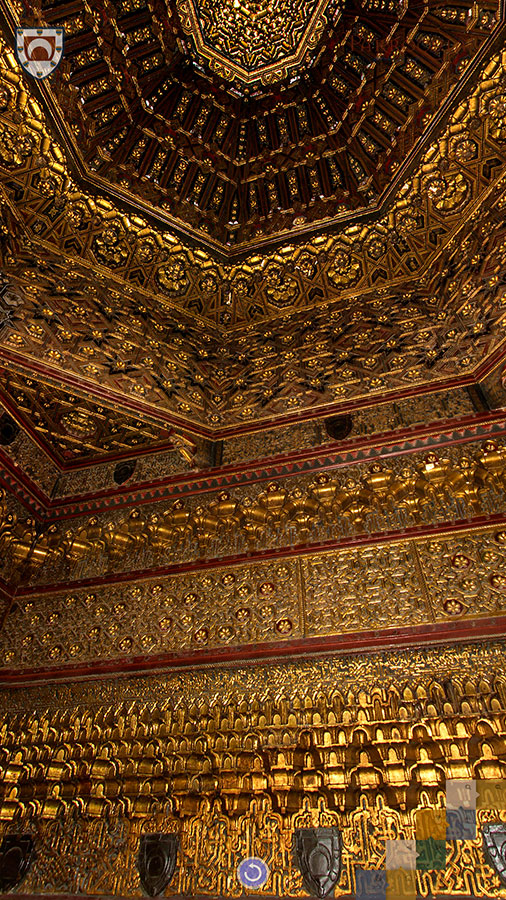
Mosques were converted into churches and some minor buildings would be lost but there was no major effort to get rid of Andalusi art. On the contrary. During the Reconquista the Muslim South was artistically and culturally superior to the Christian North and that was something the Christian rulers recognised, adopting some Andalusi styles in things like clothing, boardgames, etc and having important scholarly works translated from Arabic into Romance vernacular. As more and more of Spain was (re)conquered, many Muslim remained under Christian rule. They were skilled builders and craftsmen and there's an important body of, uhm, Moorish-looking work that was built by these Spanish Muslims for Christian rulers and prelates. My favourite example is the funerary chapel for the Archbishop of Zaragoza, Lope Fernández de Luna, at the cathedral of that city, said cathedral itself being a former mosque, by the way. [That's] (https://upload.wikimedia.org/wikipedia/commons/3/36/Fachada_de_la_Parroquieta.jpg) what it looks like from the outside (and [here's] (http://gozarte.net/wp-content/uploads/2013/12/parroquieta-ventana.jpg) a closer look). Now, this was built - rebuilt, actually, as the Archbishop was not satisfied with the first wall that he thought was too plain - in 1378. That is, a full 260 years after the Christian conquest of Zaragoza (1118) and 130 years after the conquest of Seville (1248), the city that the two masters that did the wall came from. The ceiling over the Archbishop's tomb inside contains a lot of Arabic calligraphy - some of it just vaguely Arabic-looking squiggles added for effect and some featuring actual verses from the Quran.
Christian builders and artists in Spain were heavily influenced by Moorish art until, at least, well into the 16th century. Some Moorish designs like geometric patterns - most notably, the eight-pointed star - are very prominent in Christian Gothic art in Spain all the way to the so-called Isabelline Gothic, the latest form of that artistic style. This was the style in the Crown of Castile in the late 15th and early 16th century, with many of its major works being built by Flemish and Northern German masters (hence it is often called Hispano-Flemish Gothic). So you have accomplished masters who were not even Spaniards moving to work to Castile and adding Andalusi-influenced designs to their repertoire. In Burgos, the Castilian capital, you can see the Moorish eight-pointed star, for example, in the [Constables' chapel] (https://upload.wikimedia.org/wikipedia/commons/e/ea/Cupula_de_la_capilla_de_los_Condestables.Catedral_de_Burgos_%284952356182%29.jpg), designed in the early 1500s, in [the lantern tower] (https://upload.wikimedia.org/wikipedia/commons/e/e7/Burgos_Cathedral_Intersection.jpg), designed by Jean de Langres, a Frenchman, in 1539, both in the cathedral, and in the [double sepulchre] (https://s3.amazonaws.com/classconnection/223/flashcards/9600223/png/sepulchre_of_juan_and_isabel-1532E3946B225B2A479.png) of King Juan II and Queen Isabella, built by Gil de Siloé, who was a Fleming or a German, in the late 1400s, in the Miraflores charterhouse just outside of the city. Even when Emperor Charles had a Mannerist palace built for himself inside the Moorish palace grounds of Alhambra in Granada, the architects merely demolished a minor pavilion, conserving the rest of the palace. The artistic merits of Alhambra were definitely very much valued and appreciated no matter how 'heathen' it may have been.
On this note, a lot of traditional Spanish music seems to be in harmonic minor keys, a mode more readily associated with Islamic music. Any connection?