Most Islamic civilizations never had heraldry, and were also split into various nations. How did they distinguish who was on whose side?
Why do you think that Islamic civilizations never had heraldry?
While more conservative Muslim rulers/nobles would have been hesitant to use depictions of living things on their arms, armor, and flags, even the most conservative would value the aesthetic as well as military value of having a personal symbol made of geometric patterns, Arabic writing (usually in the form of a religious slogan), or color.
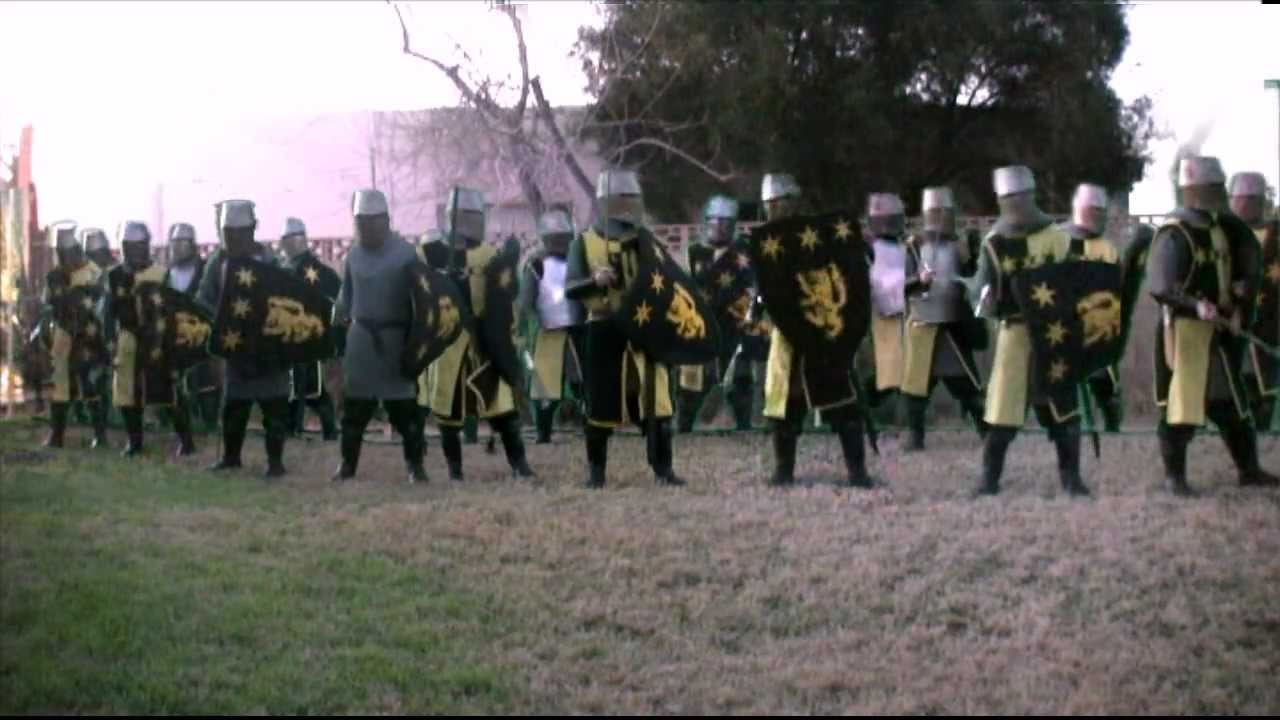
During battle, flags and instruments like horns were the main way most soldiers could signal one another as well as differentiate which group was on their side. Even in Europe, most soldiers would have a little trouble telling one another apart by only looking. Armies would generally look less like this and more like this.
In the time of massed levies, a commander would be hard pressed to supply a uniform to every single soldier. It was generally more expedient to simply have them fight as they were.
The other common ways to tell were: if they spoke another language, if they were another religion, if they spoke the same language then whether or not they spoke with a familiar accent, etc.
Back to Islamic armies. The Prophet himself often used the now-infamous black flag during battle, which has been emulated by jihadist groups in recent decades. This famous black flag had no symbols or ornaments at all, and was simply stark black fabric.
Many other Islamic commanders followed suit and used flags that were only a single, solid color with no designs but there were those who did use designs. As time went on, the designs of flags diversified and while flags that were a solid color with no designs continued to be popular because of their religious/traditional significance as a powerful symbol, they were not a mandate that forbid any heraldry or designs on flags.
Common designs included religious slogans (also emulated by many jihadist groups of today), geometric shapes, splashes of color, and indeed the famous crescent moon, though it would not become as heavily associated with Islamic kingdoms as it would be much later, once the Ottoman Empire adopted it along with European style ornaments of state and European flags. Indeed, the crescent moon and other 'heavenly bodies' like stars and the sun were just as common in European motifs for flags, heraldry, and ornaments.
Other common designs were scimitars, shields, horns, and a host of other symbols that was often connected with the owner's status, like cups, pens, and even stylized animals, which was skirting Islamic taboos against idolatry.
While I focused on heraldry here, Islamic civilizations also would have been able to tell one another apart using language/accent. While they all learned Arabic as a unifying language due to their shared religion, Arabic evolved over time like another other language despite taboos against changing the sacred tongue. I imagine it would not have been difficult for most soldiers to guess the general region someone was from by hearing them speak.
This is a very general answer and someone else could go into much more depth than I as this is outside of my usual domain.
But, let me know if you have any other questions and I can maybe point you in a enlightening direction!