Twice during Louis the 16th's minority the royal family was forced to flee Paris out of fear for their safety. At one point an angry mob broke into their home and was only pacified when they saw the young king (feigning) sleep. Later during the French Revolution, the Royal Family would be caught trying to flee their insecure homes to safer locations only to be found out by the mob.
So my question is: Why don't they live in a castle, like the British monarchs lived in Windsor castle? That way if things go poorly, you can buy time to wait it out. An angry mob isn't going to have heavy artillery to blow through the fortifications.
I suppose what you are asking is why did kings decided to live in palaces instead of strong castles (similar to the mediaeval castles) or fortresses. Am I right ?
In this case, the question is as much about why mediaeval castles lost their use in favour of fancy castles and palaces as it is about the living habits of the monarch.
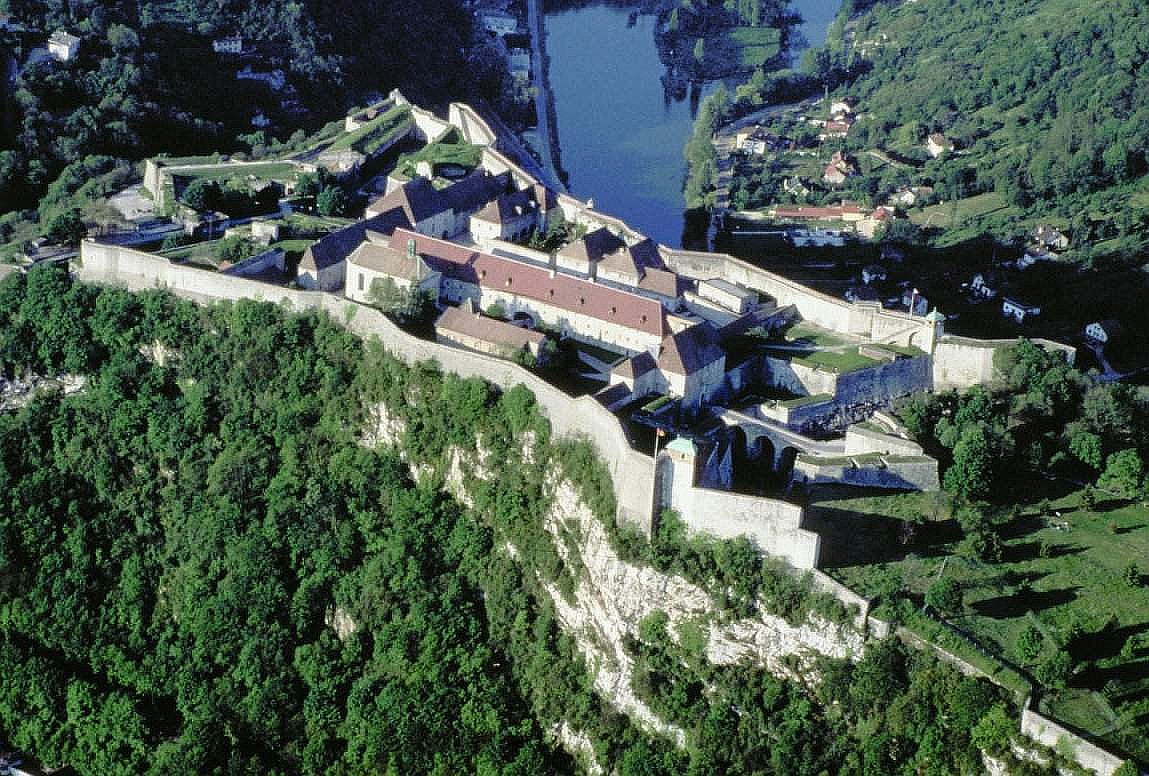
You are right that the Louvre was often perceived as insecure but it was more about its location in Paris than about the architecture. As such both Louis XIII and Louis XIV, before Versailles, moved to Saint-Germain-en-Laye which is not a castle. So the reason as to why they did not live in a castle is that those were obsolete considering the military equipment of the armies. Even Windsor would not last long if confronted to an artillery siege. As such the mediaeval castles or fortresses had lost their military use. The battles were fought on battlefield by "professional" armies. Instead fortresses and citadels were used in strategic points, like Besançon in France. The palaces like the Louvre or Versailles were much more adequate to provide a center of government and a tool to impress and of representation. Not to mention they were much more comfortable than the old mediaeval castles which the aristocracy had long deserted for palaces or hotels in cities. The evolution of castles is linked to the evolution of warfare. The castle of Fontainebleau is a good example of this evolution. If you visit the link of the website of Fontainebleau there are plans illustrating the evolution of the castle from the Middle-Ages to the 19th century. One of the main differences between Windsor and the Louvres or the Tuileries is the architecture.
Another point in your question which is very interesting is about the safety of the French royal family. The king was not someone inaccessible, even to the common man. In fact he had to be seen. Louis XIV is the perfect example. It was more difficult with Louis XV and Louis XVI due to their personality but those two were also people that could be seen by anyone quite easily. Their security of course suffered from this. Henri III was murdered in his castle of Saint-Cloud in front of the court by Jacques Clément. Simply because Clément was a monk, he not been bothered by any kind of security. Henri IV was murdered in his coach in Paris. Louis XV was stabbed by Damiens in Versailles.
In his 1787-88-89-90 Travels in France, Arthur Young wrote (this comes from the French book Au Service du Roi by Mathieu Da Vinha, as such I am translating Young's quote from translation as I don't have the original quote in English) :
I visited Versailles again. While I looked at the King's apartment which he had just left [...] it was amusing to notice all those "workers" walking freely in the palace, in and out of the King's own bedchamber. He the describes how poor many of these men looked (which is why I don't think he talked about servants but about workers and people from outside the castle) and says I was the only person surprised. It is impossible not to like this detachment and unconcern. The master of this place is well-liked and it is known that he would not be offended to see his apartment so full of people if he was to return suddenly, otherwise no one would dare to enter [...].
To ensure that the King and all those who lived around him were safe, the security and the watch was the duty of two regiments, the Swiss and the Gardes-Françaises.
I hope this answers your question. Of course, you can also ask the question about why those castles became obsolete. The French monarchy is not the only example, I am almost sure almost all the European royalty is concerned (castle of Sanssouci in Germany, the Catherine Palace in Russia, the Royal Palace of Madrid, ...etc.).