I know the STG-44 still crops up from time to time in modern conflicts (a warehouse full of them was found, and Privi Partisan still make 7.92x33 rounds to feed them!)
but what else survived the war? Where else did their weapons and vehicles end up?
Probably the most interesting stuff which survived ended up in the Middle East. Long story short (since it's not the focus of the question): Israel is created, the Arab states don't like it, they wage wars against Israel and lose time and time again[1].
Now, as a very young country, a newborn, literally, when it was fighting the War of Independence, Israel had a very diverse military. Among the staples of its air force were Czech Avia S-199 fighters. These were modified Bf 109s, built post-war by the same Czech plant which earlier manufactured Bf 109s for the Luftwaffe when the Czech territory was under German control. So, while it's not German equipment surviving per se, it's the idea and design of the piece of equipment which survived. The S-199 was nowhere near as good as the real deal (even though it was newer), but it served its purpose well in Israel in the absence of modern planes in sufficient quantities.
Speaking of Czechoslovakia, they used quite a lot of modified German equipment immediately post war. That's because they had a lot of industry which was used to support the German military, therefore they could quickly resume production of the same types of armament. For example, they used a number of Jagdpanzer 38(t) "Hetzers" (incidentally, the "t" stands for "tschechoslowakischer", or Czechoslovakian), which they called ST I, or Stíhač Tanků I. Unfortunately, I've got no idea when these were phased out.
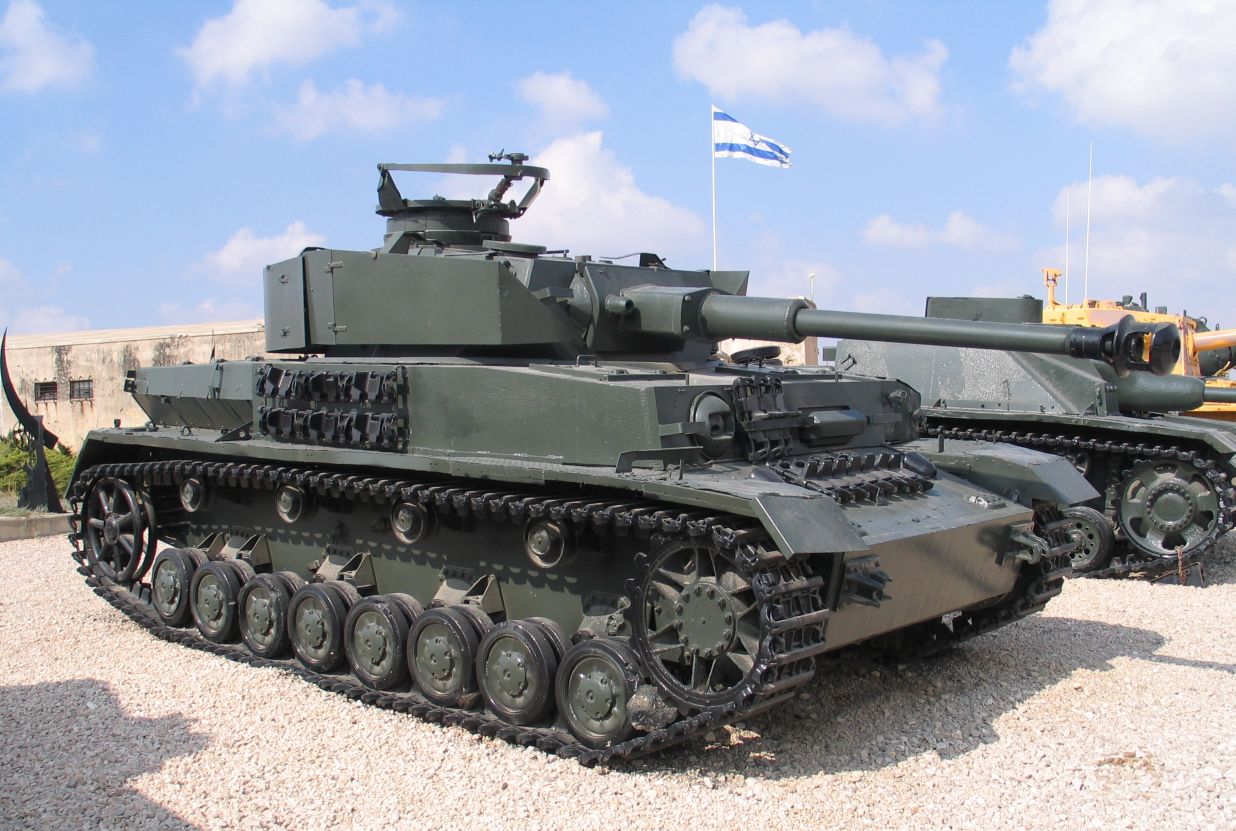
The fun starts when we get to armored vehicles in the Middle East. This is a StuG III and this is a Panzer IV. Both are in the Armored Corps Memorial Site and Museum at Latrun, Israel. But it was not Israel who used them. It was the Syrian Army. The Israelis captured a small number of ex-Nazi tanks and SP guns during the Six Day. Syria got those tanks from France (which simply had no use for them post-war), as well as Spain[2] and Czechoslovakia, which actually used them and retired them.
So, just to put things into perspective, Panzer IVs were still used in combat closer to the end of the Cold War than to the beginning of WW II. Allegedly (I've heard rumors myself at work, I've also seen them mentioned online), some of those Panzers are still in use in Syria. Or at least they were before the vicil civil war.
All in all, immediately post war a lot of German equipment was used throughout Europe (or, I should say, Eurasia). The numbers are impossible to calculate. Countries with close ties to the Third Reich, such as Spain, or Finland, bought German equipment and used it for as long as they deemed it sensible. Other countries used leftover German equipment to help rebuild their militaries post-occupation.
And as you see, even 20+ years later some of it still found use.
Also, you might want to read this little article. I assume it's reliable, since it provides its sources.
[1] There are arguments which say that the so called War of Attrition was actually a loss for Israel on the strategic level as it left the Arab states in a favorable position for the Yom Kippur war. But that's a story for another thread.
[2] The Spanish Army also used StuG IIIs well into the 1950s, but these were not sold to Syria.
In addition to the tanks mentioned by /u/tlumacz, one should not forget the small arms. The P38 for example was, and still is, used in the german Bundeswehr, called P1.
While the MG42 underwent significant changes in design before being reintroduced as MG3, the P1 is the same build as the P38, except for a change in the alloy of the grip, which makes it some 160g lighter. It is nowadays mostly replaced by the P8, but the P1 is still used on guard duty and listed on the official website of the Bundeswehr as a side weapon for machine gunners/medics.
It was/is not very well liked in the Bundeswehr, however, where it is said that it is only good for 8 warning shots and one aimed throw. (Can't give you any proper source in writing, basically everybody that served before 2012 can confirm that saying, though).
One could even argue that, since 8000 P1 werde delivered to kurdish Peshmerga fighting IS , it is still used today, although I can not find reports of them actually using it.
Source: Hogg, Ian V. and Weeks, John, Military small arms of the 20th century, New York, 1977
Edit: Formatting, links