There have been many fictional depictions of life in the Stalinist period of the USSR. Likewise, many authors have incorporated supposed aspects of life in the USSR into narratives designed to warn against totalitarianism (Orwell's 1984 springs immediately to mind). A frequent trope of these fictional depictions is of a hyper-paranoid society in which husbands denounce wives, children denounce parents and where the state presumes all of the accused are guilty.
My question is: are these depictions accurate portrayals of every day life in the USSR during the immediate pre- and post-WWII era?
It is hard for me to believe that such a society could exist without considerable unrest and dysfunction.
One of the ironies of the dystopian view of Stalinism in the West was that it had its wellsprings both in the right and the left. On the right, whether from political outliers like the John Birch society or more elevated areas like the Kremlinologists in US universities, there was a notion that Stalinism represented the core essence of the Soviet experiment. Conversely, some in the Western left contended that Stalin and his dictatorship was a perversion of the ideals of 1917 and unnatural. The Trotskyite exiles helped popularize this idea and gave it a gloss of veracity, but there were other forces on the global left that attacked Stalinism's cult of personality and excesses. Although diametrically opposed on many other political ideas, these attacks on Stalinism created some strange bedfellows in the early Cold War years. Some of the biggest boosters of Orwell's work in the US was the CIA-backed Congress for Cultural Freedom and its various offshoots, whose wider politics were very much at variance with those of Orwell's. This early picture of Stalinism and the relative inaccessibility of Soviet sources from the 1930s served to cement this portrait among the wider Western public. But as popular as the trope of totalitarian terror is in the Western public sphere, the bulk of the social history produced in the last thirty years does not really support such a dim picture.
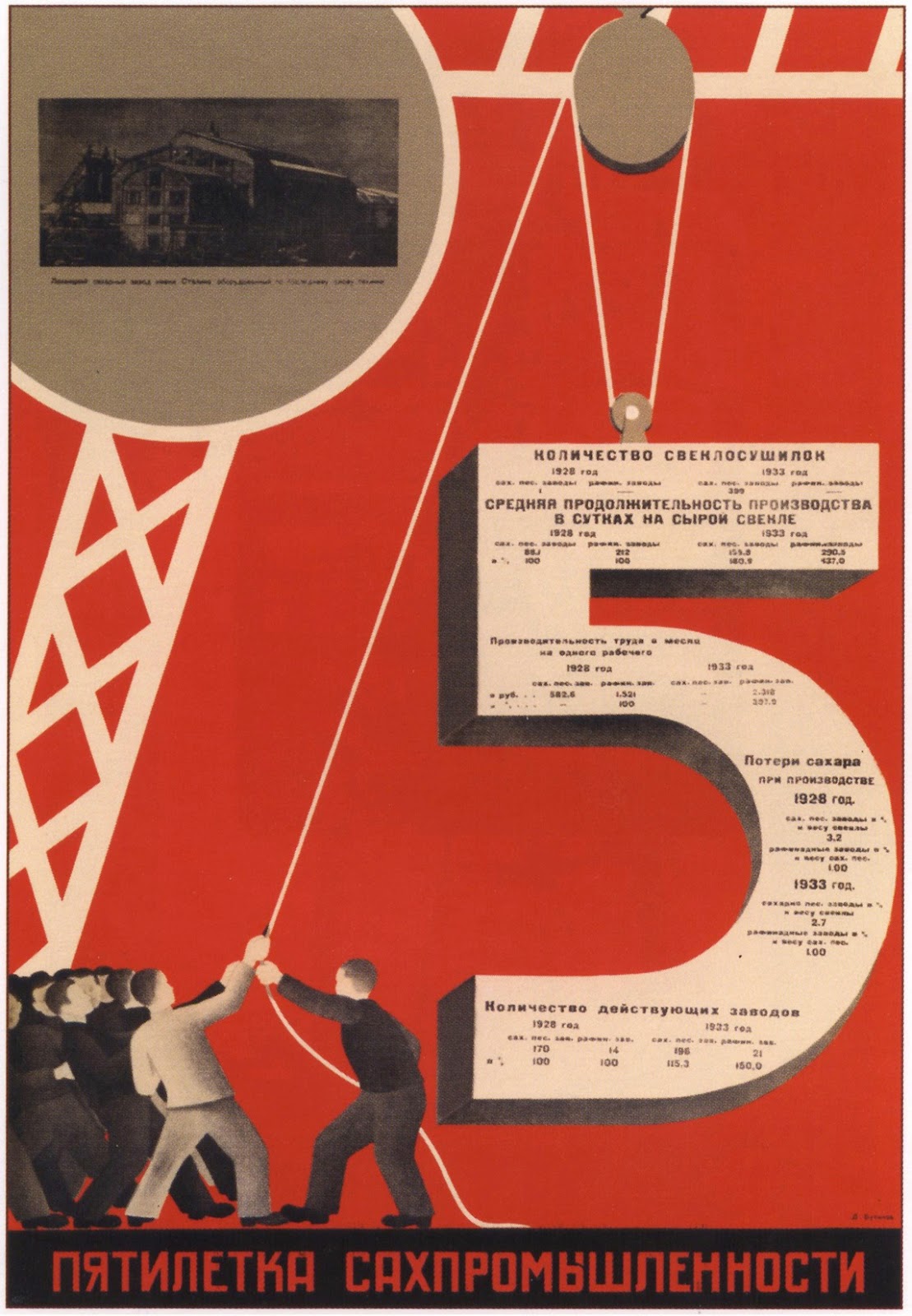
Stalinism as both a lived period of history and as a phenomenon is a complex animal. Soviet citizens confronted a new state order after the Stalin turn of the late 1920s that simultaneously threatened them, challenged them, and promised them a better world. Soviet agitprop posters provide a good window into this complex relationship between one of the hallmarks of Stalinism- full-speed industrial development - and its wider population. This dynamic GOSPLAN poster is emblematic of this process. The poster depicts a dynamic Soviet train rocketing out of a factory with various internal saboteurs and foreign powers attempting to stop it. The poster's message to its audience is clear; the Five Year Plan will succeed and the Soviet workers will triumph. But there are other, unspoken messages as well. The poster renders opposition or failure to meet production goals as part of a universal anticommunist cabal doomed to fail. Enemies of the state are not only internal and external, but there is no real difference. Moreover, the text's exhortation to meet the quotas for year four of the Five Year Plan also speaks to the growing regimentation of Soviet work life and the shopfloor under Stalin. Other posters from this period, such as this one calling for shock labor or this one, show a greater standardization of workers and subordinated their labor to state projects such as gigantic combines or even the FYP itself which often dwarf their workers building them.
The response of Soviet society towards the Stalin turn naturally varied quite a bit. In her various works on the social history of the USSR, Sheila Fitzpatrick has found that support, accommodation, adaptation, and resistance to the state were common throughout the whole fabric of society. Certain groups of course were less privileged than others under Stalinism. The Soviet peasantry and agricultural sector often bore the brunt of state distrust and regulation, and this discrimination often dovetailed with preexisting prejudices of state administrators, such as anti-Ukrainian sentiments or quasi-colonial ideas that Kazakh nomads needed to be dragged into modernity. These biases could be given full reign when Stalinist initiatives stalled or failed, such as the collectivization drive in the Ukraine or the various anti-Islamic campaigns in Central Asia. But as important as this brutalization and terror was to the whole picture, it was not the only thing going on inside the USSR during this time.
Famines and terror can overshadow the promise of the Soviet experiment under Stalin. Modern material goods like cars and airplanes had a certain cachet throughout the world in the 1930s and the USSR's pledge was that it would bring this modernity to the masses. This was one of the more popular aspects of the Soviet experiment. David Brandenberger's various works on state propaganda has shown that there was a degree of grassroots support for a new socialist-hero who was unburdened by the past and represented the march of Soviet progress. Although Brandenberger notes that the Stalinist state mucked up this grassroots hero-worship by tying it ever closer to the state, it was a powerful unifying force. Testimonial accounts, diaries, and surviving letters from this period do show more than few Soviet citizens imbibed the ideology of the state into their daily lives, albeit in often myriad ways. Jochen Hellbeck's study of Stalin-era diaries contends that diarists often framed their daily experiences through the state's ideological lens. Likewise, Stephen Kotkin's examination of the erection of the gargantuan Magnitogorsk steelworks shows that many of its workers learned to "speak Bolshevik," by aping the language of the regime to navigate the travails of daily life. Neither Kotkin nor Hellbeck's conclusions have gone completely unchallenged in the scholarship. Donald Filtzer's writings on the Stalinist shopfloor have shown that speaking Bolshevik often masked resentments of increased regimentation and control while Lewis Siegelbaum has noted that while some Soviets were initially enthusiastic about the state's promises, such faith in the Soviet experiment failed when the state came up short. But it is important to note that the the industrial drive and full employment took place in the context of the Great Depression and seemingly validated the Marxist-Leninist planned economy. Moreover, the Stalin turn also marked a departure from the NEP period. Although there were avant-garde experiments and a less regulation by the state, the NEP era also saw unemployment and a distinct class distinction between haves and have-nots among the wider population. The industrialization and collectivization drives did emanate from above, but there was also a sizable acceptance of these initiatives from the Soviet bottom and middle.
Of course only the most hardened "Tankies" would deny the existence of the Great Terror and Purges in 2016. But terror, in keeping with other aspects of Soviet society, possessed both a complicated genesis and trajectory. J. Arch Getty's landmark Origins of the Great Purges argued that the spiraling political violence of the late thirties was as often the result of mid-level CP bureaucrats who had to translate the center's directives. Although far from unchallenged in the academy, Getty's approach pioneered a number of innovative analyses to the Terror that emphasized the complex web of latent tripwires within the Soviet system, social processes like in/out group hierarchies, and Stalin's own push to regulate and control society. The historiography on the Purges and Terror is quite vast and far from settled, but purely top-down explanations for this bloody period of the USSR are not very satisfactory or persuasive explanations for this political violence. Soviet society was not only the object of terror in this period, but Soviet citizens were also active participants in political terror.
The totalitarian interpretation of the Stalin period is one that today carries very little water outside of various conservative or nationalist circles. Instead of a stark Manichean picture of society, it is more helpful to envision it as type of Chiaroscuro in which extreme darks and lights interact with each other to form a cohesive whole. Despite famines, police terror, and human wastage, Stalinist society did function in its own way. The most acid test of this cohesiveness was the Great Patriotic War. Even though the Germans' genocidal acts stiffened resolve, the Soviet population did not fall apart or turn on its leaders like it did during the last war. Contrary to the picture of Stalin's control-freak habits, Moscow actually eased up on centralized planning during the war and let its managerial elite (Team Stalin in Stephen Wheatcroft's memorable phrase) coordinate the Soviet economy. The experience of a hard-fought victorious war helped validate the sacrifices of the 1930s and added a gloss to them that was not limited to the boundaries of the USSR. Moreover, victory heightened expectations of a return to normalcy that fed into the rising hopes of the Thaw period that somehow all of these sacrifices had been worth it for the next Soviet generation. That both the leaders of the Thaw and their successors failed to meet these hopes is fairly well-established, but also a different question.