I'm under the impression that much of the current Christmas traditions became widely popular during the Victorian Era. Were there any very popular traditions from the same time that simply died out ?
There'll be parties for hosting
Marshmallows for toasting
And caroling out in the snow
There'll be scary ghost stories
And tales of the glories of the
Christmases long, long ago
--The Most Wonderful Time of the Year, Andy Williams
According to Gothic Horror Stories this actually didn't die out until midway through the 20th century.
I am not an expert, but I got curious when I sang this song with a choir several years ago, and did some looking into it.
Wassailing is a celebration apparently starting in Western England sometime in the 12th century. It was celebrated on either Twelfth Night (January 5) or Christmas Eve, and revolved around a warm drink served in a large wooden bowl. The original celebration involved blessing the apple trees in hope of a good apple harvest in the coming year.
The drink itself has dozens of variations. They are mostly based on wine or mead, and contain various spices and roasted apple pulp, called lambswool. Many modern variations resemble mulled cider, and usually contain alcohol, but not always.
The celebration would have involved going door to door and sharing your wassail with neighbors, although there are also accounts of people going door to door asking to be served.
Source: Conrad Jay Bladey has a book called "Do the Wassail" which is a pretty exhaustive history of the drink and the celebration. This website contains a lot of information from that book: http://www.cbladey.com/wassail.html
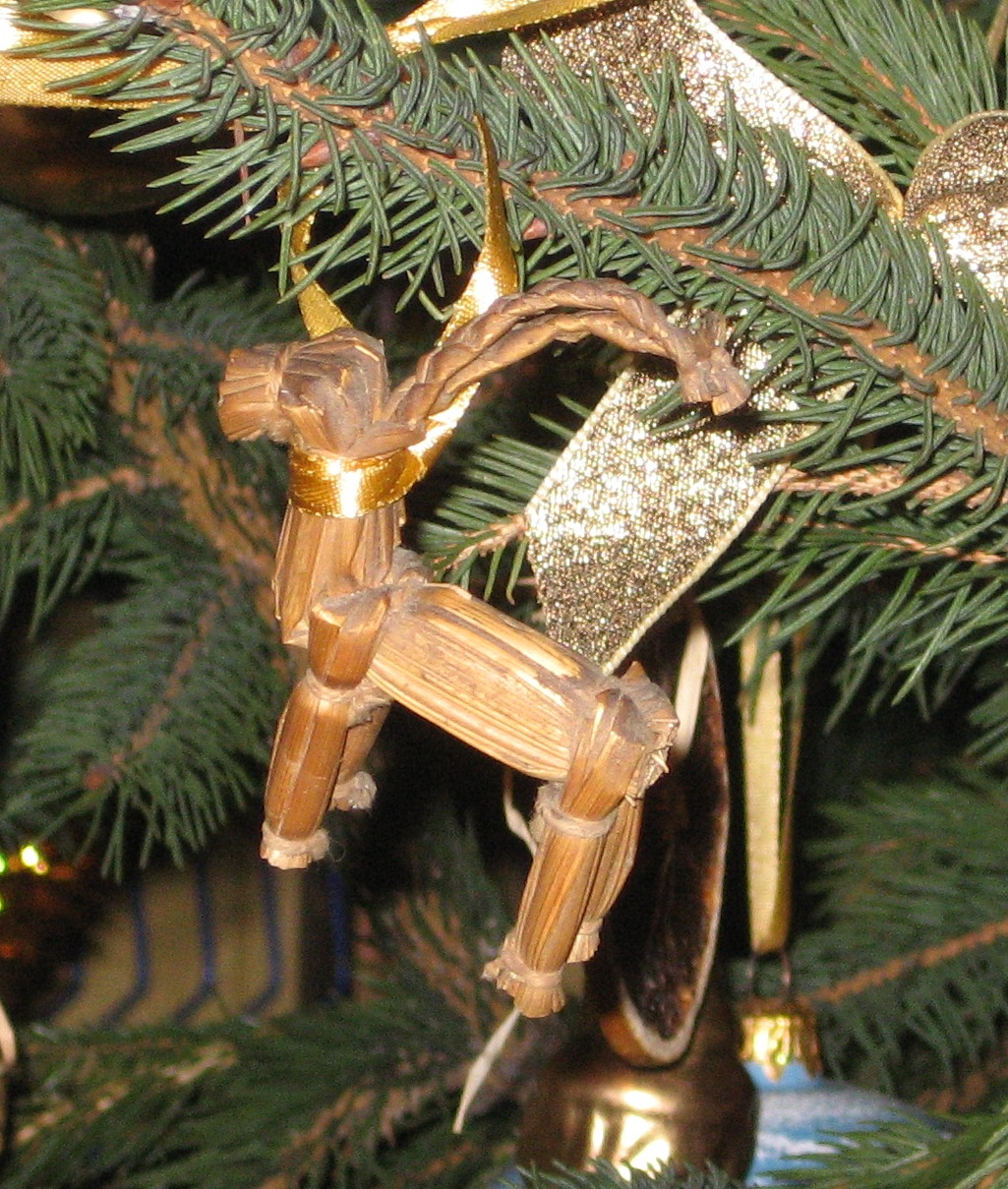
It may not be in the exact period of what you're asking but I thought you might enjoy to know a little about an old Scandinavian tradition known as The Yule Goat.
In Sweden(and in other parts of Scandinavia) it was a tradition which can be traced back to the pre-christian era and a popular theory is that it was connected to worship of the Pagan god Thor who rode a chariot drawn by two goats, but it is disputed and other say it may be related to Blot or just slaughter of a goat for a winter feast.
Its role has changed a lot over the years ranging from part of a house-visiting wassailing group and as the item of a holiday prank were you sneaked in a goat made of straw or wood in to a neighbors house(or similar) and the only way for them to get rid of it was to sneak it back in to the first household in the same fashion.
In the 19th century it was slowly transformed into a character much like the Santa Claus we have to day. A man of the family would dress up as the Yule Goat and visit the family to hand out gifts. But the wassailing tradition was known to be performed well into the 20th century. However in the mid to late 19th century the Yule Goat was replaced by Jultomten(translated, The Yule Tomte), most likely as a result of the picturing of Saint Nicholas in England and continental Europe whom in the eyes of Swedes and Scandinavians looked somewhat like the Scandinavian mythical creature tomte or nisse with his white beard.
Today the Jultomte is more or less identical in appearance with modern Santa Claus/Father Christmas but is still most oftenly a dressed up member of the family and still comes and visits the children in person to hand out his gifts. We also celebrate Christmas on Christmas Eve(Swe. Julafton) and not Christmas Day(Swe. Juldagen).
But The Yule Goat is still a part of Christmas around here in the form of a traditional Christmas Tree ornament or decoration, most notably the giant Gävle Goat which has the odd tradition of being the victim of arson every year(Tom Scott has an excellent video about it on his YouTube channel)
Merry Christmas! Or as we say it, God Jul!
Sources:
The Swedish Academy Dictionary Keyword: Jultomte
Christmas in Scandinavia Rossel, Sven H.; Elbrönd-Bek, Bo (1996).
^^^^And ^^^^a ^^^^little ^^^^bit ^^^^of ^^^^wikipedia(sorry!)
edit: I can't tell you how happy I am that so many liked my post! Posting to /r/AskHistorians has always made me really nervous. So thank you, especially to my kind gilder! You guys made my day! <3
In Newfoundland due to our English and Irish influences there are many customs that came over and have since died out, these customs range from more normal like the Yule log to the more obscure. The main focus of these customs would involve going from house to house, this would be the case when mummering or going janneying. This tradition exists in Philadelphia as well, but I'm not sure if it's exactly the same. Anyway to go Mummering you need to get rigged up in disguises, go from house to house playing music and drinking, the mummers would only leave if you could guess who they were. In order to disguise yourself you would try to change the way you walked, the way you looked (by stuffing pillows or other things in your clothes), cross dress, covering your face with cloth, and when you speak you would inhale. Most communities in NFLD were quite small so you could usually figure out who the people were. However, in the larger communities having bands of masked people wandering around lead not only to mischief but to more sinister acts such as murder. Mummering was outlawed in the late 1800's but continued in the "outport" communities where there was no police presence. Currently there is a mummers parade that happens in the capital of St. John's every year so the custom is being revived.
Another custom on St. Stephen's Day is "The Wren". Coming from England and Ireland this custom would involve young boys killing a wren and going from door to door asking people for money to bury the dead bird. In NFLD unfortunately there were no wrens so kids would make an effigy of the bird and going door to door reciting a poem to ask for money...
"The wren, the wren, The king of all birds. St. Stephen’s Day he was caught in the furze. Although he was little, His honour was great. Rise up kind lady and give us a treat. Up with the kettle, And down with the pan. Give us a penny to bury the wren. A pocketful of money, And a cellar full of cheer. And we wish you all a Merry Christmas and a Happy New Year." —as recited by Dennis Flynn
The tradition of declaring a special "Christmas peace" (Finnish: joulurauha, Swedish: julfred) was practiced in the Scandinavian / Nordic cities during the Middle Ages. Any violations of the Peace (such as drunkenness during the services) were to be punished and in general "peaceful and Christian behavior" was encouraged. As an example, a surviving piece of declaration text possibly from the 1600s [3] e.g. prohibits laying straw on the floors (which was a countryside 'Christmas decoration' tradition until modern times) to prevent fires breaking out in the city.
I'm not a medievalist or scholar of legal history myself, so maybe a professional can fill in the details how widespread such declarations were and what was their role in the legal framework of the time.
A version of a declaration of "Christmas Piece" is still read in Turku, Finland, even though it has not had any legislative effect at least for a century. The tradition is still popular (both locally and nationally; the event has been broadcast on national radio since the 1930s, later in television; the popularity being the reason it survives even if the original legal meaning has been lost) and continued with only a handful of breaks at least since 18th century (and according to the claims, before that, without much breaks since the 14th century). However, despite its survival in Turku, I think it still qualifies, because the premise is that declarations of the same sort were given more widely and the lone survivor is not widely known outside Finland.
Sources:
[1] City of Turku description of the event (mainly a info dump for tourists, but at least it's in English; apparently nobody has bothered to write about this much in English or I'm looking at wrong places..) https://www.turku.fi/en/christmas-city/declaration-christmas-peace
[2] Kunttu, Soikkanen, Laaksonen. Joulurauha Suomen Turusta. Otava. Helsinki 2015.
[3] Matti Rapola. Suomenkielinen joulurauhan julistus 1600-luvulta (Finnish Declaration of Christmas Peace from the 17th century), in Historiallisia tutkimuksia, Turun Historiallinen Yhdistys (Publications of Turku History Society) 1924. Text available online
Additionally (stretching the current events rule, but at least I can attest to the event's popularity with videographic evidence):
[4] Public Broadcaster Yle record of the declaration on Dec 12, 2016: http://areena.yle.fi/1-3259926
Hiya!
So, this this technically falls on the wrong side of our Example Seeking rule, but we're going to okay it anyway, because I'm the only moderator around and I like it it's suitably festive and an interesting question!