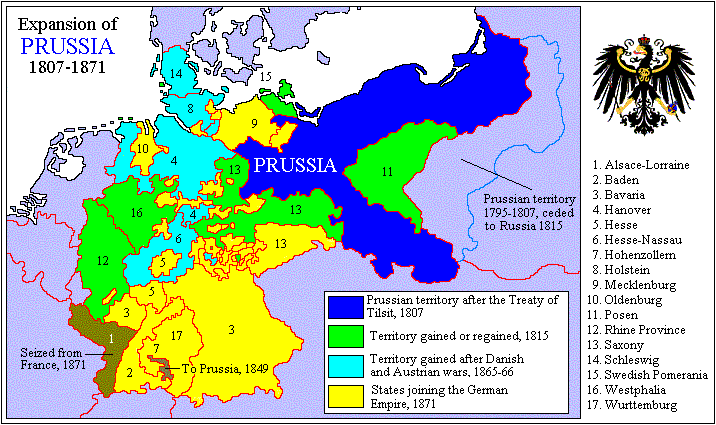
Although Prussia was easily the largest and strongest state when Germany formed,were other grand dukes, kings, counts, and so forth, given positions of power once Germany formed? Did they keep their titles? Continue ruling over their lands? Or were they forced to abdicate their lands and positions?
The long and the short of it was that German rulers and principalities kept their titles and positions after the declaration of the German Empire in 1871. The Kaiserreich was a federal system, as seen in this map with the various German polities as states within this federal system. Prussia did annex some some German states in the aftermath of the Austro-Prussian War, as seen in this (ugly) map in light blue. These polities had largely backed the losing side in the war and some, such as Frankfurt am Main, had a strong tradition of liberalism that was at odds with both Bismarck and Wilhelm I's archconservative tendencies. But the elites of these regions did not go away completely and were often amalgamated with Prussian administration, albeit with a good deal of tensions, over the course of 1866-1918. For the German polities that joined the empire in 1871, their participation in this federal union meant subordinating themselves to Prussian suzerainty. The King of Prussia was also the German Emperor- a subtle distinction- and was in this constitutional order a first among equals. The Kaiser was commander in chief of the German armies in wartime and the German entities were to subordinate themselves to Prussian institutions like the General Staff. The monarchs and rulers sent deputies to the Bundesrat, a federal council with neofeudal trappings that in theory the constitution invested with great powers, but in practice was relatively toothless. The federal states maintained their own restricted form of sovereignty; the larger states had their own armies and local parliamentary bodies. The various monarchs adapted to this restricted political power with some degree of alacrity. Many of them took on the trappings of what historians term "bourgeois monarchy" in which the monarch was not some remote figure out of time, but rather a cultured individual of the people. These monarchs would preside over festivals and cultural patronage that enhanced the local distinctiveness of the region. Some German monarchs such as the later Wittelsbach rulers and the Saxon kings were arguably more popular in their domains than the Kaisers. Although the German Revolution meant an end to monarchy in Germany, more than a few non-Prussian monarchs remained in their territories. They may have abdicated their political power, but they retained a sheen of cultural power that was quite lasting. The same could not be said of the Hohenzollerns, which outside of a few circles of Prussian-dominated institutions like the military, were persona non grata in the Weimar Republic.