So, the First Sino-Japanese War took place at a really interesting time in global history because it was, in some since at least akin to the Russo-Japanese War a decade after it, the “testing phase” of about a century of “armed peace” at the end of the 19th century. There had been a long period of post-Napoleonic… not exactly “peace” per se, but the shying away of Great Powers from engaging in largescale warfare with one another. What this meant in practical terms was that, though everyone had their pet theories and doctrines regarding warfare as it would be at the tail end of the 19th century and the early 20th century, given the rapid technological change in the 19th century it was all pretty much up in the air. That is to say, without actually facing off, who could really say whether China or Japan would emerge victorious? No one, really, there was just historical precedent to go off of… which was a few thousand years of Japan being a vassal satellite state to mighty China and, prior to the First Sino-Japanese War, the Qing government viewed as little more than an upjumped band of marauding pirates.
This combined with the fact that both Japan and China had undergone significant internal modernization campaigns - at great expense, of course – respectively, Japan’s Meiji Restoration in the late 1860s, and China’s Self-Strengthening Movement from the 1860s through the early 1890s. Both had been rather abruptly burst out of their respective “Closed Door” phases by Western powers only to find that, Lo and behold, the rest of the world had suddenly passed them by technologically. So both had been using the latter half of the 1800s to desperately play catch-up with the Western powers, and this was the first time these two renovated states and militaries were to face off – and one of the first times since the Napoleonic Wars that two powers would really get into a true slogging match with one another, apart from say the Franco-Prussian Wars, rather than skirmishes over colonial holdings and the like. Suffice it to say, a lot had changed since 1815, or even 1870.
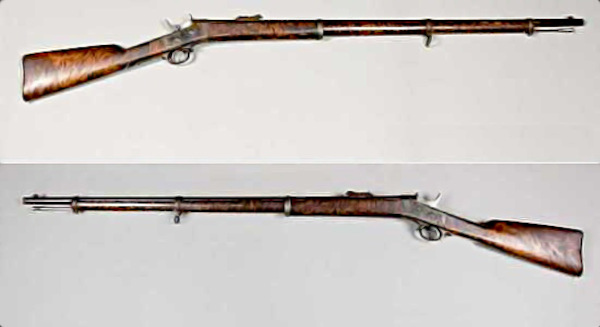
So what would the Qing Dynasty’s military have looked like in 1894? Well, that’s a bit of a complicated question. Certainly, military modernization had been at the forefront of the first phase of the Self-Strengthening Movement, for rather self-evident reasons. Since the early 1860s the Qing had been employing French advisors to assist them in constructing a number of modernized arsenals at cities like Shanghai, Nanjing, Ningbo, and Jiangnan, as well as shipyards in cities like Fuzhou. These programs, however, suffered tremendously because of the Qing Dynasty’s gross inefficiency and nepotism, saddled as it was with a late-life dynasty’s excessive baggage and historical precedents to cling to. As such, even though the Chinese arsenals had been endeavoring to produce a homemade version of the then-popular Remington Rolling Block rifle – a single-shot, breech-loaded rifle that was so effective that it would see widespread use from its initial rollout in 1867 until the conclusion of the First World War in 1918. Nevertheless, the Chinese attempts to replicate the Remington proved to be slower and more costly than simply purchasing the real deal outright. To wit, in the 2 years since the Qing Dynasty had begun producing its fake-Remingtons in 1871, by the end of 1873 it had successfully produced less than 4,200 rifles, or roughly just enough for a brigade-and-a-half… and all at significantly inflated costs versus what they could have just bought outright. Not exactly spectacular… In terms of mechanized weaponry, the Qing had outfitted itself with French-made grapeshot repeating cannons, specifically the montigny mitrailleuse crank operated machine-gun. In terms of heavier artillery, the Qing primarily used Krupp howitzer pieces.
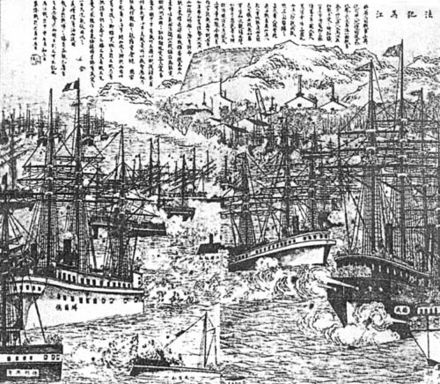
In spite of that initial drive toward military strength, the brakes had been applied following the Taiping Rebellion (1850-1864), and the quasi-“national” army of the Qing had subsequently been ethnically segregated and then further subdivided into regional and district commands. This led to no small amount of rivalries, infighting, backbiting, and ignoring imperial pleas for help is, let’s say, the Japanese start a shooting war. By the time of the First Sino-Japanese War, the most modernized and best-prepared force within the Qing Dynasty was undoubtedly the Beiyang Army and Navy (its name meaning “North Ocean” and referring to the northeast of China surrounding Beijing, Tianjin, and Hebei). The Beiyang force had grown out of the Taiping Era’s Huai Army. Though it initially used a combination of traditional weapons like swords and polearms in combination with modern firearms, over the 1880s its commander Li Hongzhang had shunted tax levies into more adequately equipping both army and navy. By the outbreak of hostilities with Japan, the Beiyang Navy had two pre-Dreadnought class battleships (whereas prior to this acquisition the pride and joy of the Qing Navy had been the Yangwu, a 58m-long steam-powered wooden corvette that had been blown to smithereens just 26 seconds into its first naval engagement in 1884 against the French navy at the Battle of Fuzhou ). In the end, though, it would prove little use, though undoubtedly the strongest, best equipped and trained force within China, the Beiyang Army and Navy both would prove no match for Meiji Japan’s German-trained forced, which were better trained, faster, and more competently led… to say nothing of the fact that it was essentially the Beiyang forces all by themselves facing off against Japan, since very few other regional military warlords could be bothered with answering the imperial summons to war. Definitely not China’s finest hour by a long shot.
In spite of this historic thumping, the Beiyang Army would nevertheless remain the preeminent military force of the late Qing, bing reorganized in 1895 as one of the brand new type of army the Chinese were building to attempt to make up for the now-inescapably-obvious military inferiority, and reform into a fully modern, Western-style fighting force. Conveniently, this new type of army was collectively know as the New Armies (新軍). Newly renovated, the Beiyang Army would come under the command of General Yuan Shikai, who would use it to catapult himself into the Presidency of the Republic of China and then (briefly) the emperor of a “restored” “Great Chinese Empire” from 1915-16 (for all of 83 days).
Fairbank, John King (1978). The Cambridge History of China: Late Chʻing, 1800-1911, pt. 2.
Paine, S. C. M. (2005). The Sino-Japanese War of 1894-1895: Perceptions, Power, and Primacy.