I've bene looking into the Napoleonic wars, and given Napoleon was such a genius, how was it that Wellington was able to beat him in Spain?
From what I understand, the French had a larger and better army (with officers promoted due to merit), and had better cannon and cavalry.
The only advantage the British had was rifles and because they ended up having Spanish partisans on side, and they had Wellington.
Was Wellington the deciding factor?
Mny thks for any info
Well first off, Wellington never beat Napoleon directly in Spain. Napoleon was only in Spain from October/November 1808 to January 1809. The commander of British forces in Spain at this time was Sir John Moore; Wellington was serving as one of the commanders of British forces in Portugal. Napoleon's Spanish campaign managed to reverse the collapse of French power and fortunes in Spain the previous year and Moore led his troops in a grueling rearguard campaign where they were evacuated by sea.
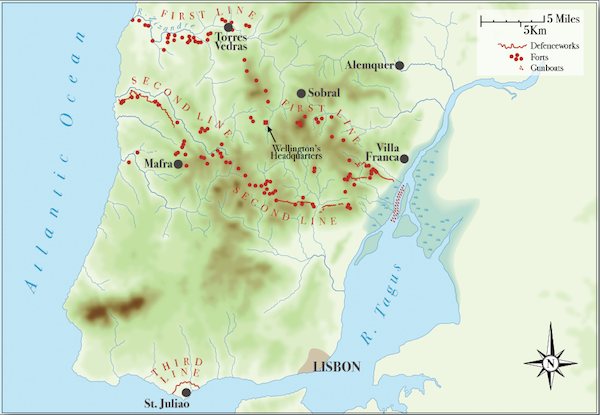
British fortunes in the Peninsula seemed to be in tatters at the close of 1808, but there were some key strengths that enabled the British to remain in the Peninsula. The British possessed a strong position within Portugal. Wellington's victory in Vimiero and the evacuation of French troops from the country allowed the British to construct a large defensive line known as the Lines of Torres Vedras around Lisbon. This gave the British a long-term strategic advantage in that they had a secure redoubt that could be resupplied by sea and could retreat to if a campaign in Spain went bad. British naval superiority ensured that the British troops in Portugal were well-supplied and had a secure logistical base. British naval superiority also guaranteed continuing existence of the de facto Bourbon government in Spain, the Cortes in the souther Spanish port city of Cadiz (the Bourbon King and his heir being unceremoniously deposed by Napoleon and kept in France) . The defeats of 1808 in Spain had underscored the need for training and discipline, and Wellington did manage to train the Anglo-Portuguese army to a very high proficiency. These forces also possessed a unity of command both on the battlefield and in a larger geo-strategic sense. Although Wellington's relationship with the Cortes was never harmonious, the British-led forces were not beholden to the Cortes's orders. They could retreat from invading Spain if the situation warranted, as they did in the 1811 campaign and later in 1812 after Wellington achieved a crushing victory at Salamanca but could not hold central Spain. Additionally, Wellington's brothers were in key positions inside the British government. This meant that he had a degree of political cover for setbacks or a seemingly cautious strategy, but also a vested interest in British government in making the Peninsular campaign a success.
The French position in the Iberian Peninsula was the inverse of that of the British in many ways. Although Napoleon's brother Joseph I was nominally the King of Spain, the Emperor micromanaged his elder sibling from afar. Adding to the problems of Joseph I, the Marshals Napoleon had left in command of French forces in the Peninsula seldom paid Madrid much heed. The internal rivalries and squabbles of the Marshallate came to the fore in Spain as some of these men resented being relegated to a distant sideshow while others saw Spanish service as an opportunity to carve out their own fiefdom. Some of these Marshals were of very high caliber- Soult, Massena, Suchet- and some were of middling ability such as Jourdan and Marmont, but the important thing is that French arms were not coordinated towards a common purpose. French counterinsurgency tactics added more problems for Joseph. The Marshals tended to react to news of guerillas with fire and sword, which deepened elements of insurgency that had started in 1808. The guerillas were never an existential threat to the French in Spain, but they prevented a normalization of Bonapartist rule within Spain. Joseph found that with little control over military matters and an alternative Spanish government in Cadiz he really could not have local elites rally towards his side. This was a marked departure from earlier precedents of French satellite states where the Enlightenment-infused rationalization coupled with French military hegemony created enough stability to allow for a native cadre of collaborators to emerge. French rule in Spain was anything but stable.
Adding to the French problems were both logistics and geography. One mantra for Spanish military history is that in Spain small armies are defeated while large armies starve. French practices of living off the land on campaign and their already ramshackle logistical tail proved quite problematic in the Iberian Peninsula. Foraging parties, even in relatively quiet areas, destabilized the Spanish hinterland. Agricultural land lay fallow as Spanish peasants fled to unoccupied areas and the shortages of grain and other foodstuffs destroyed what little was left of the Spanish economy. The food shortages hindered military operations as well. Convoys of provisions had to be escorted, denuding the French of much-needed troops. Consequently, French military operations were nowhere near as fast as they were in other, more productive, areas of Europe or were sometimes rushed so that they could return to the search for food. Adding to French problems, the declining quality of French conscripts sent to Spain meant that there was little time or resources to train them and the threat of starvation ate into morale. Iberian geography also favored the British-led forces allowing them to maintain initiative even when on the defensive. Wellington's use of Spain's hilly country, reverse slopes, and skirmishing negated French advantages in maneuverability and attack.
Britain's ultimate success was much more than Wellington's skill as a commander or the superiority of the British Baker rifle. While both of these have entered into popular memory of the campaign as the cornerstones of British victory, they were symptoms of the reasons why the British prevailed, not their cause. Wellington enjoyed privileges of command that neither his French counterparts nor Joseph enjoyed. The Duke had political cover that could protect him from undue scrutiny so he could learn from mistakes or not over-expose his army to undue danger. British logistics in Portugal and central Spain also meant that the troops could receive items like the Bakers, but also food. As they moved into the Spanish hinterland in 1814, some of the same problems of operating a large army overland in an agriculturally poor area started to bedevil the British as they had the French earlier in the war.
Sources
Arnold, James. "A Reappraisal of Column Versus Line in the Peninsular War." http://www.napoleon-series.org/military/organization/maida/c_maida3.html
Esdaile, Charles J. The Peninsular War: A New History. New York: Palgrave MacMillan, 2003.
Morgan, John. "War Feeding War?: The Impact of Logistics on the Napoleonic Occupation of Catalonia." The Journal of Military History 73, no. 1 (2009): 83-116.
Severn, John Kenneth. Architects of Empire: The Duke of Wellington and His Brothers. Norman: University of Oklahoma Press, 2007.