The decadent label is partly a function of the inevitable comparison between the tsarist state and its Bolshevik successor. The extreme disparities between these two ideologies and state systems invite a conclusion that the Romanov order was living on borrowed time and it frittered away its twilight years on frivolities. Both the novel and film versions of Dr. Zhivago spend a great deal of time in their earlier half focusing on balls and social elites' hypocrisies which form a strong contrast to the earnest and checked idealists who wanted to change the system. The Bolsheviks also helped cultivate this image of an irrelevant and morally corrupt old order being swept away by a progressive ideology. The trope of decadence had a certain logic to it as it justified a thorough restructuring of society.
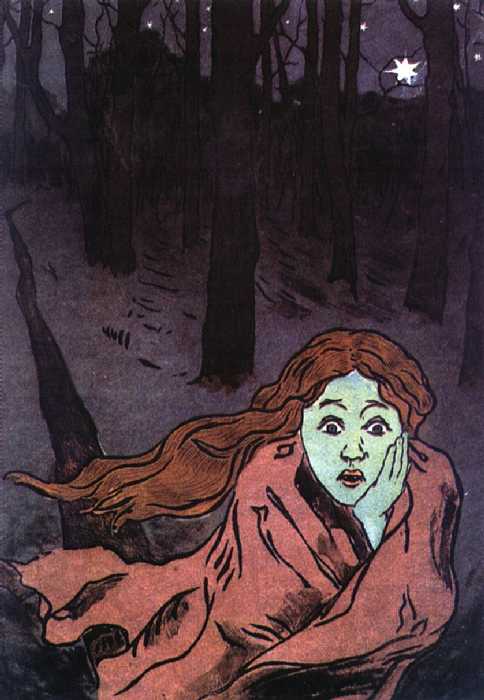
But the Bolsheviks did not invent the decadence charge out of whole cloth. Concerns over the decadence and moral decay of society permeated Silver Age Russian letters and discourse. The Realist authors of the early- and mid-nineteenth century had laid the foundation for Russian arts to tackle the modern condition and its various shortcomings. But more than a few Russian artists of the Fin de Siècle embraced decadence as an alternative form of artistic expression. The avant garde Symbolist movement tended to use decadent as a badge of honor as it stood it in contradistinction with formalist art. These artists often reversed or subverted the moral order- heroes are alienated and cynical rather than reformist and idealist- and focused on emotions that did not fit easily into conservative social norms. Maria Yakunchikova's print Fear encapsulates a lot of what these Fin de Siècle artists tried to accomplish. Her choices in contrasting color scheme, atypical composition, and active female protagonist were at odds with the conventional aesthetic norms of the day. Even though the color scheme is garish and the print's narrative is unclear, Yakunchikova's print conveys a raw immediacy and emotionality. Other Fin de Siècle Russian artists focused in on the erotic and sensual as a way to break out of stiff formalism and make a statement about the age.
Russian Silver Age artists were far from alone in this endeavor to both shock and stimulate. This was the era of Oscar Wilde, Toulouse-Lautrec, and the Ashcan School. European arts in the turn of the century did not operate in a bubble and were aware of other artists and movements. The Russian art magazine Mir iskusstva promoted the French art noveau movement and championed artistic freedom and there is evidence that Yakunchikova likely saw Munch's The Scream before she made Fear. There were also conservative guardians of artistic propriety in Europe and the Americas as well, and the conditions of emerging mass society were an ever-present fact for art to digest.
Yet Russian artistic concerns with decadence had two salient features that stood it apart from its contemporaries. One, the relatively unique nature of the Romanov state apparatus tended to quarantine or sideline intellectuals. The Romanovs' relationship to both artists and authors was strained at the best of times and the state tended to look at all intellectuals as dangerous and subversive individuals. This reflexive rejection of intellectuals as well as the Romanovs' strained relationship with modernity (in short, the state wanted its benefits without altering society- an impossible task) meant that Russian arts evolved in a very charged atmosphere. There was little opportunity the rebels of one era to become the establishment of the next; Tolstoy remained a heterodox thinker for much of his very long and fruitful career. One of the words banded about in Russian arts during the Silver Age was sovremenost (contemporality) which not only conveyed a modernity, but also the extreme fractiousness of the era.
The other aspect of Silver Age arts that set it apart from its contemporaries was that there was that the political context of their work ensured it had a very short lifespan in Russian arts. The Silver Age's focus on melancholia, despair, and eroticism helped to paint late tsarist society as dancing at the edge of the volcano. This picture of tsardom in decline was useful for the Bolsheviks and other political rebels, but they had relatively little use for the avant-garde in their own plans for the arts. The moderns' focus on the individual and darker emotions had little place in a Soviet society predicated on utopian hopes and dreams. Outside of a brief period in the 1920s where Soviet arts experimented with the avant-garde, the aesthetic norms of the Soviet state tended to be socially conservative and even more prudish than that of the Romanovs.
The result of both the Bolsheviks' disinterest in Silver Age aesthetics and the often oppositional nature of the Russian Fin de Siècle arts scene is that it conveys a picture of an especially decadent and doomed society. The Bolsheviks themselves helped perpetuate this image by holding that arts reflect the dominant ruling class's mores, so they portrayed the Silver Age's flight into the sensual as a sign of a ruling order that knew its days were numbered. Yet late-Russian society was arguably no more decadent or debased than any other European or American polity at this time. Comparative studies of contemporary newspapers and other sources of news shows a pan-European focus on scandals and frivolities. Decadence may have had sharper claws as a political critique in Russia, but focusing on the visceral was something a number of artists did during this time.
Sources
Härmänmaa, Marja, and Christopher Nissen. Decadence, Degeneration, and the End: Studies in the European Fin De Siècle. New York: Palgrave, 2014.
Matich, Olga. Erotic Utopia: The Decadent Imagination in Russia's Fin-De-Siècle. Madison, Wis: University of Wisconsin Press, 2005.
Steinberg, Mark D. Petersburg Fin De Siècle. New Haven: Yale University Press, 2011.