Sorry if this is more of an /r/askscience question, but I figured this sub would have more data on bombings.
Were the atomic bombs so powerful that they made up a large percentage of explosive power used in WWII? Or did we drop so many other bombs that the total contributions of the atomic bombs aren't very much?
The general figure used for "all explosive firepower in World War II" is usually around 2-4 million tons of TNT equivalent. So let's say 3,000 kilotons. Hiroshima and Nagasaki make up 35 kilotons of that together. So their raw energy makes up on the order of 1/100th of the explosives dropped in World War II by all sides.
This isn't a very good way to think about them. Usually this figure is used to talk about modern nuclear weapons, e.g., an Ohio class submarine can carry up to 24 Trident II missiles, each of which can be loaded with 12 W88 warheads, each of which is 475 kilotons, so each submarine could in theory carry 136.8 megatons worth of explosives, i.e. 46 World War IIs. The Sun deposits the equivalent of 117,000 Hiroshima bombs a minute on to the Earth, but because it is spread out over space (and attenuated by the atmosphere, etc.) it feels like a nice warmth on your face and doesn't destroy cities. Releasing 20,000 tons of TNT in one instant has a different effect than dropping 20,000 tons of TNT in smaller bombs over many weeks.
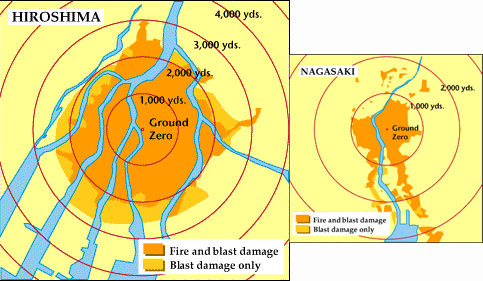
The Little Boy bomb completely incapacitated the city of Hiroshima and killed something like 50% of the population there. It would have taken some 500 B-29s to accomplish the same ends in terms of area destroyed, but if it had been a firebombing raid the number of dead would have been several times lower. The Fat Man bomb knocked about half of the city of Nagasaki out of commission, but the remainder still functioned. These differences were geographical in nature (Hiroshima was a flat bowl of a city, Nagasaki was a long snake of a city with different parts between different hills, and the Nagasaki aiming point was off).
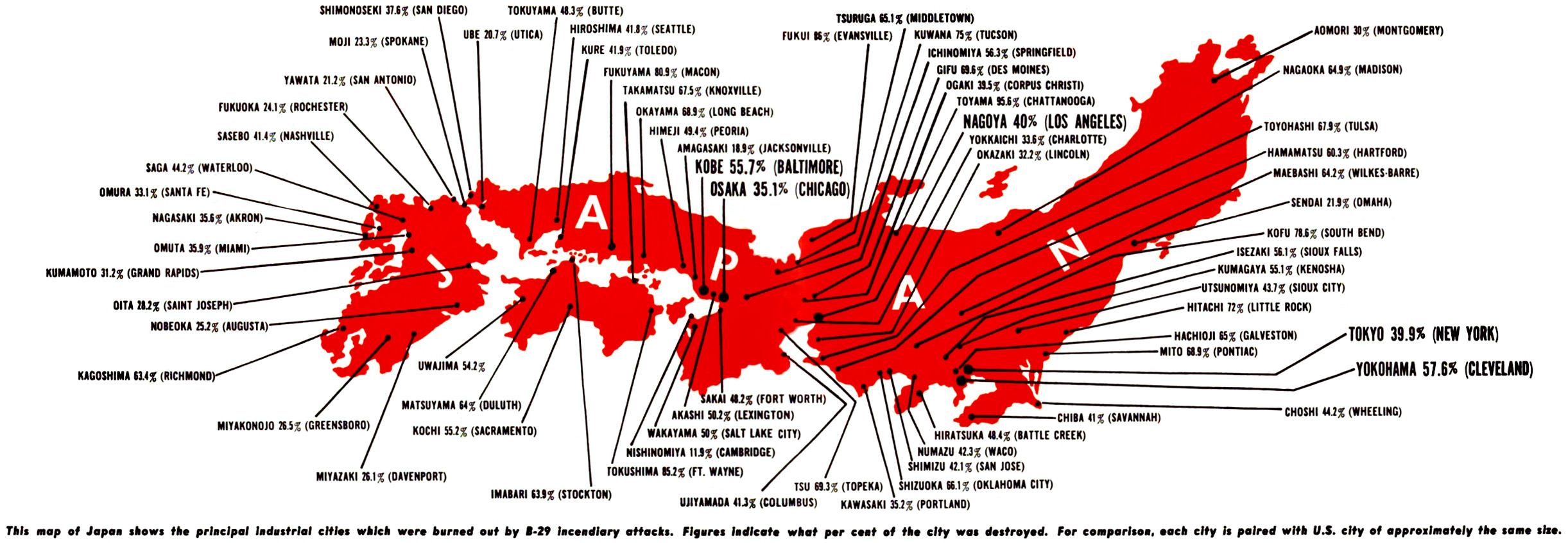
The mortality rates at Hiroshima and Nagasaki were around 15,000-20,000 people dead per square mile destroyed; the firebombing of Tokyo was around 5,300 dead per square mile; the average of other conventional bombing was only 1,000 dead per square mile. You can see that the mortality rate of the atomic bombs was several times higher than that of firebombing. There are reasons for that, in part related to the length of time the attacks took (you could flee a firebombing raid, especially if you heard it coming, which was not impossible — 500 B-29s make a lot of noise). Tokyo was in many ways an anomaly, both because it was the first such major firebombing attack (and thus the populace had not learned what to do or to flee), and also because Tokyo was a city of many millions of people, so killing even a small percentage means a lot of deaths. To kill 3% of modern-day New York City (255,000 out of 8.5 million) would kill more people than 100% of the people in modern-day Akron, Ohio (198,000), for example, though the latter would be, from a mortality perspective, a much more devastating attack.
But it is true that we should see the atomic bombings in the context of area bombing in general, from a moral and ethical standpoint. The US destroyed dozens of Japanese cities using aerial bombing in World War II, and Hiroshima and Nagasaki are easy to lose in the mix. Many people tend to invoke this as a way of "normalizing" the bombings, but I tend to think it reflects even more horrifically on US conduct during World War II, where Hiroshima-like destruction against civilians had become "the norm." But this is certainly an area for rational disagreement.
But one should not consider them to be physically equivalent to firebombing, either — they were considerably more deadly as far as attacks went. There were also radiation effects that lingered for many years, though I would be the first to note that the long-term health effects for surviving firebombing (burns, etc.) were substantial as well.
The US Strategic Bombing Survey Summary Reports state that 2.7 million tons of bombs were dropped in the European theater. And additional 656 thousand tons were dropped in the Pacific theaters.
Little Boy (Hiroshima) is generally rated as around a 15 kiloton equivalent. Fat Man is generally rated as around 20 kilotons. So the atomic bombs accounted for around 0.1% of the explosive power of bombs dropped by the allies. I think, "we dropped so many other bombs that the total contributions of the atomic bombs aren't very much," is a very good summary of the allied bombing campaigns.
In terms of raw explosive power, the atomic bombings were the two biggest single raids of the war. But most of the big bombing missions were in the multi-kiloton range. And several destroyed more buildings or killed more people than the atomic bombs. If Hiroshima and Nagasaki had been conventional raids, they'd be remembered as significant, but they'd be overshadowed by Hamburg, Dresden, Tokyo, and other bombing raids.