Edit: I should clarify. I mean was there a stage or film performance that was disseminated enough to create some type of agreement on what the monster looked like? I know film would have been in it's infancy prior to this, but is there anything out there that people saw?
Fun question!
The original 1818 edition, to my knowledge, had no illustrations, nor did its 1823 reprint; I can't find a digitized version of the 1821 French translation. That leaves the first trackable depiction of Frankenstein's creature to an 1823 play. Shelley did not like the play overall, but praised T. P. Cooke's performance as the creature (or ----- as his role was printed). She described him in the role as "unearthly & monstrous."
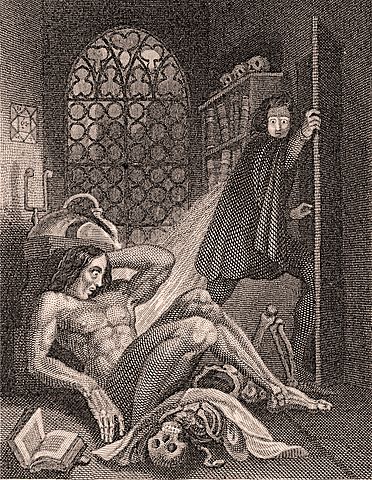
I can find two renditions from the 1823 play, the cover of a play print and this lithograph. If either of those is accurate, we can imagine Shelley's praise had more to do with Cooke's acting than the depiction. Nevertheless, the impression created by the semi-bare chest in both, by the wild hair in Wageman's engraving, and the torn clothing on the cover illustration is of the creature as wild man.
The 1831 edition did receive an illustration, and the bare-chested (....possibly more than just the chest), unkempt-haired creature maintains wild man status.
In all three of these, Herr Doktor Frankenstein himself is contrasted to the monster (and to our modern, post-Einstein/Strangelove mad scientist stereotype) in his own nice clothing and well-groomed-ness.
The monster and the contrast continues when Hollyweed gets its hands on The Modern Prometheus--and oh, it does, almost from the beginning. In this clip from the 1910 (!) edition, you can see the contrast between the refined Frankstein and his wildman monster even more clearly. Here's a still of the creature.
The other interesting thing about this particular rendition is that this seems to be the first, maybe only, time (in illustration, at least--who knows what the stage acting looked like) that the creature as hunched/twisted/deformed enters the visual iconography. This is interesting because, of course, after a couple of now-lost film versions (including a 1920 Italian production where baldness is the marker of monstrosity), Frankenstein's physically-twisted assistant will enter the legend and its extended universe. Frankenstein's creature becomes the sewn-together corpse we know and love, but by way of linking evil to disability, we get Fritz in 1931, Ygor in 1939, Daniel in 1944.