In this video, currently on the front page, the speaker mentions that a popular and compelling theory for the success of Eurasian people over other parts of the world is that they were more able to expand east to west versus people in other areas like Central America.
How does this theory stand up to scrutiny? Some of the major questions I have are:
Of the empires listed, both the Chinese and the Mongol empires were not vertically challenged. There is a huge climate difference between the Asian Steppe and Southeast Asia.
Most of the countries we see as "dominating", and the ones mentioned in the video, were not particularly large vertically horizontally. At no point did Spain control anything even close to an empire as horizontally extensive as the Umayyads on their home continent, yet they managed to spread all over the world. They weren't in cahoots with the French or the British, so doesn't this work against the theory?
Wendover released a video on this junk too? God, that's annoying.
Lots of people have discussed the issues with environmental determinism (particularly as stated by Jared Diamond) before (sluyter 2003, Jarosz 2003, Blaut 1999, Cowell 2003, etc...), so I won't reiterate most of their arguments in this post. I've been writing a larger discussion about that that may appear in the future.
There are a few foundational ideas here that I'll break out individually.
First premise:
Climate tends to change when you go north and south rather than east and west as a nature of how the Earth rotates around the sun.
Second premise:
Much of the success of early civilizations had to do with the domestication of plants, animals, and technology. Access to each of these is improved by controlling more land and being able to use that land.
Third premise:
As a result of these climatic advantages, European countries became the dominant colonial empires.
It's critically important to note that in arguing this third premise, Wendover has implicitly shifted from talking about Eurasia to talking about Europe, without justifying this logical leap.
It's my personal opinion that environmental determinism is a very attractive (and often useful) model. The primary issue for me is that each one of these premises breaks down, and taken together remain insufficient to demonstrate the conclusion Wendover is drawing about the rise of colonial empires.
Let's start with the first premise, which Wendover helpfully demonstrates by drawing an axis across Eurasia from France to... somewhere north of Vladivostok. A simple comparison on Google images will show just how drastic these differences can be.
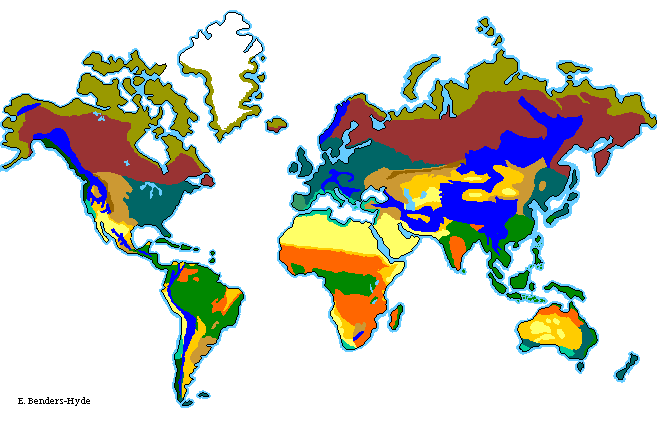
That's not the only issue with the Axes theory, mind you. But we can start off by using a more accurate biomes map that begins to illustrate the issues, despite classifying Stockholm and Barcelona in the same biome. Note that there are latitude-based biomes, particularly in the Northern Hemispheres, but these are largely uninhabitable. The largest habitable east-west axis is actually the Sahel in Africa. In Europe most of the theoretical east-west axes except for the steppe belt are broken by mountain ranges.
This brings us to the second premise, that "success" depends large swathes of similar climate. Looking at modern countries, this claim is immediately suspect. The United States and China, currently the world's two largest economies, both have extremely diverse climates. Indeed, Easterly and Levine (2003) found that climate does not correlate with what they term geographic endowments, beyond institutional factors.
However, people like Jared Diamond (and presumably Wendover) do in fact argue that climatic factors lead to institutional factors. These institutional factors then become the foundation for later colonial success (Premise 3). The argument typically goes something like this. First, people realize that local microenvironments can have dramatically different conditions at any given time. People in one area might be starving from famine while a people a few miles away have all the food they can eat. Cooperative networks develop across larger regions to smooth out these differences and help everyone to get enough food over long periods of time. Consequently, overall population rises and political institutions develop from the cooperative networks to manage these new people.
This isn't an argument we can reject out of hand and it has been made by some very prominent scholars. But it's come under increasing fire as an oversimplistic perspective. Case in point: The Hohokam of the American Southwest. The Southwest is a highly mountainous area with high climatic diversity, but overall it closely resembles North Africa and the Fertile Crescent. The Salt and Gila river valleys the Hohokam resided in very nearly resemble Egypt along the Nile, and consequently the region developed some of the most elaborate irrigation networks in the world, as well as one of the highest population densities north of Mexico. Despite this climatic similarity and the development of large scale cooperative institutions, no overarching political institutions ever developed. Indeed, we should have serious doubts that political institutions can effectively manage ecological vulnerabilities as academics like Dr. Hassan argue. Recent scholarship in the Southwest has become increasingly critical of this idea, in particular Andries (2006), Nelson et al. (2012), and Schoon et al. (2011). What seems to happen is instead that institutional complexity introduces vulnerability tradeoffs, mitigating certain types of vulnerability at the expense of making the group vulnerable to others.
What this then means is that political development is a choice rather than an inevitable reaction to climate. And the long-term consequences of those choices are neither obvious from the beginning, nor necessarily intended by the people making them.
We can argue environmental determinism back and forth all day, but what it comes down to is that history is more complicated than a simple model like environmental determinism can explain. It's most definitely a factor in where humans live and what they're able to with their environment, but it's not remotely sufficient to determine the long term evolution of human societies.
Alizadeh, A. (2010). The rise of the highland Elamite state in southwestern Iran. Current Anthropology, 51(3), 353-383.
Anderies, J. M. (2006). Robustness, institutions, and large-scale change in social-ecological systems: the Hohokam of the Phoenix Basin. Journal of institutional economics, 2(02), 133-155.
Blaut, J. M. (1999). Environmentalism and eurocentrism. Geographical Review, 89(3), 391-408.
Cowell, M. (2003). Geographic isolation: Origins of the guns, germs, and steel model. Antipode, 35(4), 807-812.
Easterly, W., & Levine, R. (2003). Tropics, germs, and crops: how endowments influence economic development. Journal of monetary economics, 50(1), 3-39.
Frachetti, M. D. (2012). Multiregional emergence of mobile pastoralism and nonuniform institutional complexity across Eurasia. Current Anthropology, 53(1), 2-38.
Jarosz, L. (2003). A human geographer's response to Guns, germs, and steel: The case of agrarian development and change in Madagascar. Antipode, 35(4), 823-828.
Nelson, M. C., Hegmon, M., Kintigh, K. W., Kinzig, A. P., Nelson, B. A., Anderies, J. M., ... & Kulow, S. (2012). Long-term vulnerability and resilience: Three examples from archaeological study in the southwestern United States and northern Mexico. Surviving Sudden Environmental Change: Understanding Hazards, Mitigating Impacts, Avoiding Disasters, University Press of Colorado, Boulder, 197-220.
Joyce, R. A. (2004). Unintended consequences? Monumentality as a novel experience in Formative Mesoamerica. Journal of archaeological method and theory, 11(1), 5-29.
Schoon, M., Fabricius, C., Anderies, J. M., & Nelson, M. (2011). Synthesis: vulnerability, traps, and transformations—long-term perspectives from archaeology. Ecology and Society, 16(2), 24.
Sluyter, A. (2003). Neo‐Environmental Determinism, Intellectual Damage Control, and Nature/Society Science. Antipode, 35(4), 813-817.