We know that many American aircraft did not have enough range to fly to Europe from America. So how did the aircraft get to the British airfields?
The United States and United Kingdom, throughout 1942, had worked on plans for a full-scale invasion of Europe sometime in late 1942 or early 1943, variously codenamed;
Operation Sledgehammer, an urgent invasion in late 1942 in the case that either the Soviet Union or Germany were struggling badly
Operation Roundup, a full-scale invasion tentatively scheduled for before April 1943
Operation Roundhammer, a full-scale invasion scheduled in May 1943 at the Trident Conference which was supposed to be undertaken in May 1944; this plan would eventually evolve into Operation Overlord
Operation Sledgehammer was cancelled and Roundup postponed in July 1942 (thankfully, as the plans appeared relatively half-baked when compared to German strength in the West) in favor of Winston Churchill's Operation Gymnast, (later to be called Torch) an invasion of North Africa. Almost immediately after, the Dieppe Raid failed badly, and a chance at success during a lofty European operation seemed out of the Allies' grasp for the time being. To accomplish the aircraft and ground troop movements necessary for a suitable buildup of forces in the United Kingdom beginning in May 1942, called Operation Bolero, two principal and one alternate air route, broken up into shorter sections, were used;
By the end of August 1942, 386 aircraft (164 P-38s, 119 B-17s, and 103 C-47s) had made the journey across the Atlantic successfully, the vast majority flown by the crews who would eventually take them into combat; the ground echelons followed on troopships. With the cancellation and postponement of Sledgehammer and Roundup in July 1942, most of the Bolero forces were diverted to the invasion of North Africa. By January 1, 1943, 882 out of 920 planes that had attempted the crossing by air reached their destinations, a loss rate of only 5.2 percent (versus the 10 percent that was expected) Other units moved to the United Kingdom entirely by ship, their aircraft coming behind them often partially disassembled.
Sources:
The Army Air Forces in World War II: Plans and Early Operations January 1939 to August 1942, chapter XVII Establishment of the Eighth Air Force in the United Kingdom, edited by W.F. Craven and J.L. Cate
U.S. Army in World War II: European Theater of Operations (Logistical Support of the Armies May 1941-September 1944), chapter II The SOS and ETOUSA in 1942, by Roland G. Ruppenthal
Strategic Planning for Coalition Warfare 1943-1944, chapter VI The TRIDENT Conference - New Patterns: May 1943 by Maurice Matloff
Expanding slightly on /u/the_howling_cow 's comment, quite a large number of planes arrived in theater in crates. The Royal Navy did quite a bit of this as they prepared to bring Task Force 57 online in the Pacific, shipping aircraft to their Mobile Naval Air Bases (MONABs) to be put together by crews trained to do just that.
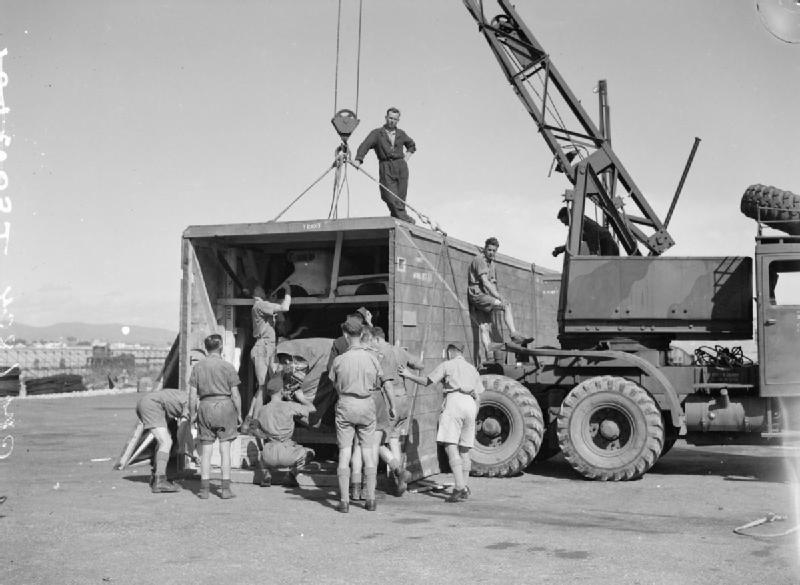
A Spitfire crated in completely knocked-down condition.
An example of a plane in partially knocked-down condition.
If time and circumstances allowed, shipping the planes in fully knocked down condition was the preferred method. It was found that the airframe would often need substantial repairs when shipped only partially disassembled. Clearly they needed to use more packing peanuts or bubblewrap.
Incidentally, you may remember the flurry of excitement when it was announced that searchers may have found a large number of Spitfires buried in Burma. Over and above the excitement of finding a huge number of late-war Spitfires, it's thought that they were crated up and covered with preservatives greases like Cosmoline. If so, and the crates have withstood being buried for 70 years, they could be pulling nearly new planes out of the ground.
Save for the bombers that flew by relay to Canada, Iceland, and England, or the occasional use of aircraft carriers in Operation Torch and Neptune, aircraft were generally carried aboard the ubiquitous Liberty Ships.
Entire cargo ships would have disassembled planes packed in the cargo hold. This potentially fragile life line to the UK survived due to the successful convoy and radar systems used against the U-boats.
This supplies a very good reason for why it took so long for the Anglo-Americans to gain air supremacy needed for Torch and D-Day. This is not to say that aircraft carriers did not make an appearance in the Atlantic, albeit in smaller models than the Yorktown or Essex class used in the Pacific. In fact, escort carriers performed vital roles in protecting the convoy system itself, and eliminating the U-boat threat.