As an orchestral musician, I've always wondered about this.
Humans have made great advances in the performing arts in the past few years. When you watch a film from the 1930's for example, if you compare the technical skill of the performers, directors, editors, etc to something today, they pale in comparison. Not that their contributions aren't meaningful and beautiful, but we have learned and improved so much in that short amount of time.
I am under the impression that advances in the past centuries must have all led to today's orchestras sounding the best they ever have. I would expect that our performers today are more skilled, generally more talented (larger pool of musicians overall), and have more technology at their disposal. I would also expect that those improvements lead to a better sound, better interpretation of the music, and a more pleasurable concert experience for the average orchestra patron.
Am I way off base? Do we have any examples, reviews, or other writings to compare before the era of recording?
Well, we don't have recordings of an orchestra in Prague c. 1808 to compare with one there in 2008, so your basic question is hard to answer. But fun to think about.
When you think of just the "sound", for example, you also have to consider the instruments in that 1808 orchestra. There was development and change. Fortepianos were being made longer scale, strung heavier,...everything was getting more dynamic range and becoming more chromatic. And the orchestras were getting bigger, audiences and halls were getting bigger. It wasn't at the point of being the full Romantic orchestra of 1850, but it was getting a bigger sound than the Classical one. With all this change, you would expect a lot of excitement, but, yes, there would have been a lot of musicians figuring things out- I mean, think of the clarinet. It has a pretty fussy technique, and in 1808 it had only really made its appearance in orchestral music a few decades before, was still under development. What kind of pedagogy was around, to train a clarinetist? What kind of things did a composer imagine a clarinet could do? The early 18h c. seems to have thought it to be a quieter trumpet substitute. And when somebody like Beethoven came in and started changing music, how much do the musicians understand it? I mean, if you'd been a violinist playing Hayden and Benda and you sat down in front of your part for the brand-new 9th Symphony ( later than 1808 of course) , is it likely you'd get it?
On the other hand, you would have been playing a smaller repertoire than an orchestral musician nowadays, who has to cope with Benda and with Bartok and Cage...you would have a musical home and perhaps the same group of musicians to play with- there could have been some very tight ensembles, where the players could hear each other think, and could and would think for themselves and not need the conductor to tell them...the orchestral equivalent of the Count Basie band circa 1934.
That's just speculation. Still, there is some real evidence that the recording industry has changed performance, making players rather careful. Jim Swejda's radio show The Record Shelf has played recordings of operas that range from the early days of Caruso to the recent ones of Domingo. As the opera repertoire still has Verdi, Puccini, etc. it's possible to compare a tenor doing an aria circa 1920 ( when recording was quite new, and musicians were used to singing in halls) to one singing the same thing, circa 1995, by which time recordings had become extremely important. Swejda's played plenty of examples showing that the early artists would take risks to get expression, virtuosity. In doing so, they would sometimes blow a phrase, drop a note- a small mistake would not be noticed in concert, but greater expression would be- especially without a microphone and a recording engineer to highlight something quieter. The later artists tend to sing very cleanly and clearly, and ( assuming they're not multi-tracking and so fixing the performance in the recording process) avoiding mistakes. This is something you would expect- as the recording is played over and over again, the mistakes become more and more obvious.
In 1808 instruments were still very much in the Baroque era more than the modern.
Oboe - a classical oboe would only have 1-2 keys, and as such would have difficulties playing in lots of different keys, chromaticisms, etc. Whereas a romantic oboe would have many more keys, and be very similar to a modern equivalent.
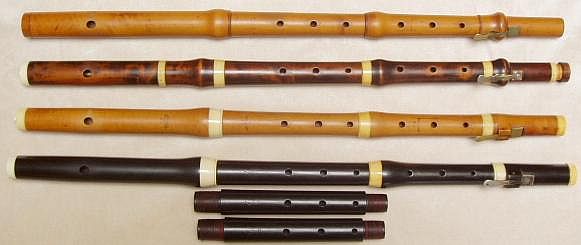
Flute - the classical flute was still using essentially a Baroque flute with a single key, and would have all the same problems, vs. the Boehm flute which came out in the 1830s which are virtually the same as today.
Strings - while there were some amazing violin makers at the time, all these instruments would still be using gut strings, which would be quieter, have a very different sound than metal, and have a harder time keeping tune. However, the modern Tourte bow would have been invented, so would have given greater flexibility for bowings and dynamics.
Trumpet - the valve trumpet didn't really exist, except in experimental prototypes, so any trumpets would be natural trumpets until the first valve trumpets came out ~20 years later.
The other things that would be different would be instrumentation. Things like the piccolo, trombone, and a lot of standard percussion would not have typically been in use in a standard orchestra. And the bass instruments would have been quieter which, in a period orchestra, gives a lighter sound to the whole ensemble.