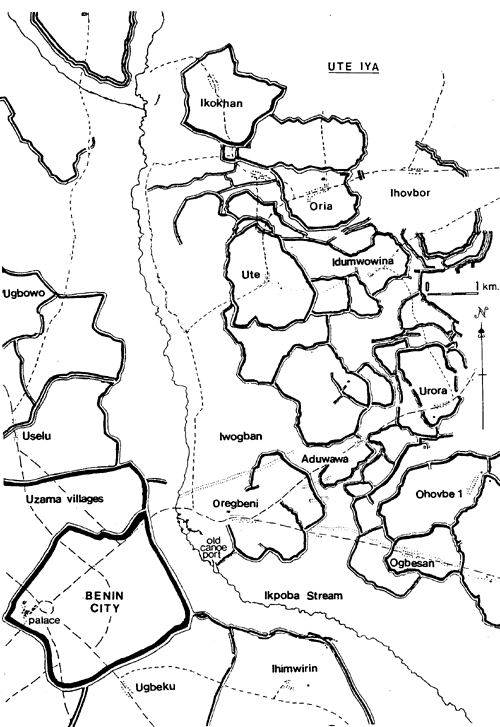
I saw on Wikipedia that they were partially destroyed by the British in the 19th century, but why was such an extensive defensive fortification already in place?
The wikipedia article mentions this, but I want to stress that the vast majority of the extensive system of walls surrounding old Benin city were not built as defensive measures, but were instead boundary markers dividing up the agricultural land of the villages in the hinterland around Benin city/Edo.*
When he did his archaeological digs in the late 1960s, Graham Connah found evidence of these agricultural enclosure walls inside and predating the urban fortifications (the thicker line in that map). That indicates that there was a process of political centralization where these earlier villages combined together and formed an urban site at Benin/Edo by the 13th century, and construction of the city walls was complete when Portuguese explorers arrived in the 15th century.
I can't say what specific group were perceived to be a threat at the time when these walls were originally constructed. However, oral traditions do recount an attack on Benin by their eastern Igala neighbors in 1517^1
However, the sustained commercial contact between Benin and European powers provided Benin with much wealth**, and Benin became a major regional power, with her navy and marines controlling the coast from Calabar to Accra in the mid-16th century.^2 However, her fortunes turned for the worse and the borders retreated back to the Niger delta coast and hinterland.
Out of Benin's fall, the yoruba state of Oyo became the next expansionist regional power. Oyo's power was built upon the exchange of slaves for horses from Borno, creating a powerful cavalry arm. European observers do not mention conflict between Oyo and Benin. Rather, they frequently remark on the mutual hostility of both these powers towards the kingdom of Allada or Ardra^3.
Perhaps that is over-explaining, but I hope it gives some sense of how unsettled the situation was in Atlantic West Africa in the centuries after European contact. Thus, the walls of Benin would have been to protect the people from Igala neighbors, or protect them from Oyo, or Allada, or later Dahomey, or perhaps another neighbor.
Also, we should note that Benin was not exceptional for having earthwork fortifications in this era. The Yoruba cities of Ife and Oyo also featured fortifications, as did Kumasi. Dahomey relied heavily on firearms and fortifications to resist Oyo invasion in the 1720s, though ultimately unsuccessfully. Rather, Benin is unusual for the extent of the boundary walls surrounding the city.
1 "Archaeology and the Study of Early Urban Centres in Nigeria" by A. I. Okpoko in African Study Monographs 19(1) May 1998, pp40
2 Warfare in Atlantic Africa by John Thornton, pp 76.
3 "Contemporary Source Material for the History of the Old Oyo Empire, 1627-1824" edited by Robin Law for the York/UNESCO Nigerian Hinterland Project, 2001. pp 9
*It is Graham Connah's judgement that these walls represent boundary markers, though Edo oral history disagrees and recounts them as defensive structures for the villages.
** In this early phase of commerce (~1450-1650) between Europeans and Benin, trade goods tended to consist of fine fabrics, ivory, gold, and other items of "legitimate commerce". In the 17th, 18th and early 19th centuries, commerce increasingly turned towards the trade in slaves, which had an effect of increasing West African states capacity to wage war, and increasing incentives to make war for slaves.