There are several main conflicts between Saudi Arabia and Iran. To put it very simply, Saudi-Iranian relations are defined by 3 aspects: religion, power blocs, and regional leadership. It's important to note that for a long time Saudi-Iranian relations were actually quite cordial, mostly due to the efforts of the United States in its "Twin Pillars" strategy. The United States worked for years to ease tension between the states, arbitrating disputes and forcing Iran to give up its claims on Bahrain. Both countries were key US allies in the region, and although Saudi Arabia was a very religious state, (the house of Saud, though not incredibly religious itself, maintained power through a fragile alliance with the clergy.) Iran was secular and not especially interested in spreading Shia Islam throughout the region. After the Iranian Revolution however, relations worsened rapidly.
Iran became a Shia theocracy, putting it directly at odds with Saudi Arabia, which adheres to a particularly radical branch of Sunni Islam, Wahhabism. Saudi Arabia and Iran were and are the two most powerful nations in the Middle East, so tension over leadership of the region was natural when their alliance broke down. Finally, the new Iranian state was formed in direct opposition to the United States, putting it at odds with the US-allied Saudi state.
I would also like to note that Saudi-American relations were born out of necessity and a shared opposition to Communism. This did not prevent the Saudis from opposing the US on the issue of Israel, as shown by the Suadi-backed OAPEC embargo of oil against the American power bloc.
To expand on what is mentioned by /u/philospherfujin, there are 3 important events from 1979 that are worth mentioning:
The first is the event that precipitated much of the conflict between Iran and Saudi Arabia. As most people know, in 1979 there was the Shia Islamic Revolution in Iran. This revolution instituted a wilyat al-faqih, or Guardianship of the Islamic Jurists. Simply put, this form of government is what puts a man like Ayatollah Khameini in the ultimate position of power. This is obviously worrying to a kingdom like Saudi Arabia. As /u/philosopherfujin mentioned, the Sauds are not particularly religious and kept power through an alliance with conservative clerics. A nation being run successfully by clerics, even if they were Shia, encroached at their power.
The second event is slightly less well known but also pivotal in the development of the Saudi antagonism. Also in 1979, shortly after the Iranian Revolution, Sunni extremists in Saudi Arabia under the leadership of Juhayman al-Otaybi, who had declared his brother-in-law Mohammad Abdullah al-Qahtani the mahdi, an Islamic figure who will return at the end of days, seized the Grand Mosque in Mecca. For 2 weeks, these extremists held control of one of the holiest sights in Islam and kept hundreds of worshippers hostage. The situation only ended after French commandos stormed the mosque (after nominally converting to Islam), resulting in over 300 dead in total. This was obviously a huge blow to Saudi power, as it showed the ability of a small group of religious extremists to possibly start a revolution. The Saudi family reacted to this not by cracking down on religious fanactics, but rather by embracing them. The solution, in the eyes of the House of al-Saud, was more religion, not less. This resulted in Saudi Arabia falling under even more sway of the conservative clerical elite. Many of these clerics held the belief that Shia are not true Muslims. From here it can be evident that the Shia led nation of Iran would be a prime enemy.
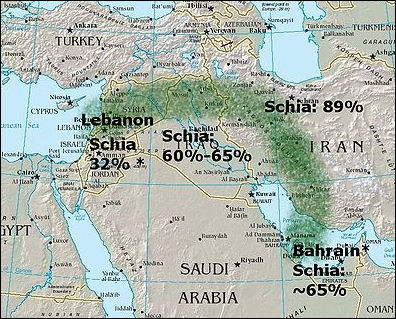
The final thing I want to mention is the so-called Shia Crescent. Although the term was formally coined in 2004 (so within the 20 years rule and I can't talk about it), it represents the thought of the Sunni heads of state that Iran and other Shia elements were trying to extend their sphere of influence.
These fears were warranted, as 1979 showed for a 3rd time. Saudi Arabia, although largely Sunni, is home to ~1.5 - 2 million Shia, largely concentrated in the South-East near Bahrain (the only Shia majority country in the Arabian Gulf, yet ruled by a Sunni monarchy). In addition to the seizure of the Grand Mosque by Sunni extremists, Saudi Shia dissidents protested against unfair treatment within the nation. Following the success of the 1979 Iranian Revolution, many Shia Saudis hungered for more radical change. This desire manifested itself in a serious of protests in November 1979, when tens of thousands of young Shia demonstrated (and at times rioted) against Sunni persecution of Shia beliefs and practices. The group that emerged at the head of these protests was the military minded “Organization for the Islamic Revolution in the Arabian Peninsula”, dedicated to the overthrow of the Saudi monarchy. Shia then represented not only a theoretical threat to the regime, but also an immediate, practical threat.
Sources
Matthiesen, Toby. "Hizbullah Al-Hijaz: A History of The Most Radical Saudi Shi'a Opposition Group." The Middle East Journal Middle East J 64.2 (2010): 179-97. Web. 02 May 2016.
Munson, Henry. Islam and Revolution in the Middle East. New Haven: Yale UP, 1988. Print.
Edit: Forgot to write this last time, but I would heavily recommend the book Transnational Shia Politics by Laurence Louër if you're interested more about the impact of Shiism in the Arabian Gulf. In particular, it goes into more depth about the relationship between Iran and Saudi Arabia.