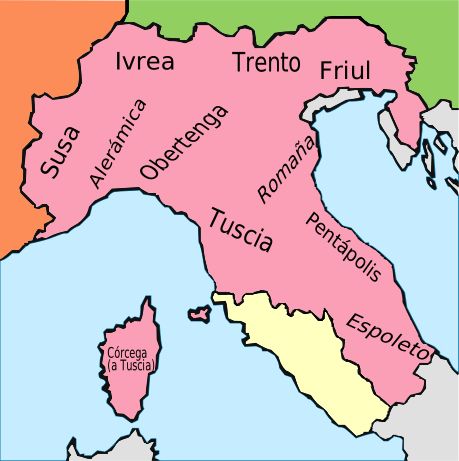
In what measure did medieval Italians (the people, the patricians and the aristocracy) see themselves as Romans, or much like the Byzantine Empire and HRE see themselves as the direct continuation of the Roman Empire? Did this feelings vary between different groups of Italians such as those from Urbino, Roma and Venezia?
In the immediate aftermath of the transition from Odoacer's consulship to Theodoric's proclamation as Rex Italiae, a "Roman" was any member of society who spoke Latin as a first language.
There certainly were associations tied to speaking Latin and middle/upper class urban lifestyle, while "Goths" or other "Non-Romans" would have been expected to have arrived in Italy from other parts of the Empire to perform manual labor or serve in the army. Theodoric himself would astutely comment, "A poor Roman plays the Goth, a rich Goth the Roman."
The forcible absorption of the Regnum Italiae into the Eastern Empire in 554 sparked a long confrontation between the Lombardo/Italic aristocracy in Italy and the Greek-Speaking Byzantine Empire, which divided Italy among regional lines. The conflict, lasting from 568 to 774, pitted the Lombards (calling themselves Italians) against the Greeks (who called themselves Romans). This significantly weakened the connotations of "Roman" identity, associating it with an Empire whose power base had shifted from Italy to Greece.
So are there any areas if Italy where ordinary people still identified as Roman citizens? There are multiple candidates: the "Romagna" or coastal strongholds held by Byzantium around the delta of the River Po ruled by the Exarch in Ravenna; the Duchy of Rome, in theory ruled by the Roman Senate but in practice dysfunctional without the Exarch; and he deep south of Italy, whose inhabitants were predominantly Greek-speaking but would also consider themselves "Romans" being citizens of the empire.
Beginning of the end of the connotation that "Some people in Italy are Romans" occurred in 781, when King Desiderious (d. 786) got very close to finally kicking the Byzantines out of Italy. A successful offensive saw the encirclement of the Romagna, which allowed Desiderious to march south against Rome unopposed. The utility of identifying oneself as a "Roman" citizen was rapidly disappearing.
Fearing a loss of independence for the bishop of Rome who had been pretty much guaranteed a free hand to rule the modern Lazio in exchange for Byzantine military access, Pope Adrian cried "Uncle", excommunicated Desiderius, and asked Charlemagne to come to his aid. Charlemagne, even though he was busy conquering what would later become Germany, was immediately flattered and marched for Italy.
Charlemagne's "Regnum Italiae," given his third son Pepin denoted the lands he conquered in the north of Italy. However, a Lombardo-Latin rump state continued to exist in southern Italy.
Any pretext of Roman identity disappeared, and medieval Italians used the word "Lombard" to denote anything indigenously Italian in both north and south. The earliest examples of what can be called written Italian appear in Benevento in the ninth century, while the nearby city of Salerno would become a major Mediterranean entrepôt and come to house a renowned University. Encroachments by the Carolingians were successfully repealed, either by force of arms or diplomacy. However, instability would be a hallmark of the principality; until the Muslim Conquests, the Byzantine Empire would always hold the regions of Calabria and Puglia, while dynastic infighting would split the kingdom three ways by the mid 9th century; the Duchy of Benevento, the Duchy of Salerno, and the Republic of Amalfi.
In northern Italy, after Pepin's untimely death and the wars of succession following Charlemagne's death, the Kingdom of Italy was given to Lothair (a grandson of Charlemagne) in 795. The relatively stable transitions between emperors in the "Crownsharing" deal under the Carolingian dynasty would end in 887, after the deposition of Charles the Fat. Charles was the last Emperor to simultaneously hold the title of King of Italy, France, and Germany, and had even been elevated to the Imperial Throne from the position of King of Italy. However, Charles possessed no direct heirs, and the fight between innumerable female-line descendants was on.
The Marquis of Ivrea managed to get crowned King Berengar II in the late ninth century, however it wouldn't be long before the German Kaiser Otto decided to take the crown for himself.
The Ottonian Emperors Otto I, Otto II, Otto III, and Henry II would all travel to Italy to be crowned King of Italy by an Italian Bishop. Absurdly, the Ottonians came to rely on Italian revenues to contrast the unruly vassals in Flanders, Bavaria and Luxembourg. With the Italian lords having fought themselves into irrelevance in the early tenth century, Italy came to be one of the most centralized parts of the Empire. With the Ottonian revival of the old Roman cities (and decline of the landed nobility) one of the wealthiest too. Until, alas, Henry II died without issue in 1024. And here it gets interesting, because although Conrad is elected emperor with minimum fuss in Germany, in Italy his ascension is not entirely recognized.
The Ottonians understood Italy, especially thanks to Otto II's marriage to the Byzantine princess Theophanu but the same could not be said about the Salians. Almost as soon as Conrad II was elevated to the throne, his legitimacy in Italy was contested. Conrad condemned the Italians in court, but no punitive action was taken: the lack of a strong landed aristocracy meant that Conrad had no military means to counter Italian cities doing as they pleased without transporting knights over the Alps. After Conrad convened a synod in Pavia to hear out the complaints, he got so infuriated by the dissidence of the Italian leaders he ordered the arrest of the bishop of Milan Aribert of Intimiano. However, imperial influence in Italy had almost completely eroded: Aribert fled back to Milan unhindered. Conrad tried to forcefully enter the city to seize him, but couldn't round up enough support. It would seem, then, that the Kingdom of Italy was ungovernable.
In between the eleventh and fourteenth centuries, when the Italian cities established themselves as self-governing but didn't yet evolve into states with jurisdictions beyond their city walls, identity was most definitely tied to one's city or region. One of my favorite quotes from the Divine Comedy reads as follows:
Non omo, omo già fui, e li parenti miei furon lombardi, Mantoani per patria ambedui
This is Virgil introducing himself to Dante. Virgil says, "Man I am not but man I once was, my parents were Lombards, Mantuans by homeland both."
Dante commits an anachronism, as there were no Lombards in Mantua at the time of Virgil's birth. But what's interesting here is the meaning of the word "Lombard" nonetheless: Dante calls "Lombards" the inhabitants of Northern Italy.
But specifying "Lombard" isn't enough, Dante finds it necessary to affirm that Virgil's parents are both that a "Mantuans" lest we incorrectly assume they're from Milan or from Bergamo.
So here we have a demonstration as to how identity on the peninsula is mostly tied to the urban communities. However, the concept Italy never disappears as a geographic construct (at least among the intelligentsia). In the second decade of the fourteenth century, for example, Boccacio would write that Canagrande Della Scala (Lord of Verona) was "One of the most notable and magnificent lords known in Italy since the Emperor Frederick" while the poet Niccolò de' Rossi affirmed that Canagrande "Will be king of Italy by next year" (Canagrande would drop dead at forty and do no such thing, but that's not important).
Fast forward to the Battle of Fornovo in 1495, when the Italian states chased the already retreating Charles the VIII of France from Italy. Duke Lodovico Sforza of Milan and Pope Alexander had asked Charles to conquer the Kingdom of Naples, but then freaked out when he actually did conquer the Kingdom of Naples. They then set up a league to stop him (long story). After the battle, Milan made a hasy separate peace at Vercelli; "Treachery!" cried the other members of the League, who then snubbed Milan (who had born the brunt of the fighting) and proclaimed the Republic of Venice "Liberator of Italy" after Charles was forced to hand the Kingdom of Naples back over to King Alfonso after his Alfonso's son Ferrante landed in Calabria at the head of an army courtesy of his Spanish cousins.
Again, fast forward to the negotiations of the Peace of Utreicht after the War of Spanish succession in 1713, when the Venetian Ambassador Carlo Ruzzini reported that the Republic of Venice was seen as "La Principale Potenza e Protettrice d'Italia" or "Principal Power and Protector of Italy." Clearly, the notion of "Italy" doesn't seem to have mutated in the two hundred years since the solidification of the half dozen independent polities on the peninsula.