I'm not sure if this is the right place for this question, but I recently finished Inside the Third Reich by Speer and it caused me to look more into Speer's work as an architect. I have found that many of his designs have been called garish and oversized. However, I wonder if this has more to do with his work being identified with Nazism rather than from an objective standpoint and I do think there is something to the idea of "ruin value" in architecture. Obviously, I'm not a Nazi, nor am I defending Speer's use of slave labor in his role as Minister of Armaments I'm just curious if there are any objective critiques of his work and if there are any defenders for it.
Evaluating contemporary responses to Speer's architectural output is deeply problematic as these critiques often mixed contemporary politics and Speer only had a good five years of peacetime to build (ca. 1934-39) before the war finally outstripped aesthetic principles. The response among Germany architects towards Speer's magnum opus, the Chancellery, illustrates this problem. There was a good deal of praise for the building in Germany's architectural journals, but this praise was infused with the ideological principles of National Socialism and various right-wing völkisch ideals. Herbert Hoffmann in Moderne Bauformen praised the how the building expressed the "unified will" of all Germany. Other commentary in German architectural journals highlighted the use of native German materials from throughout the Reich and its symmetry and strength. One element singled out for praise was the Chancellery's large and over-stuffed furniture. The sculptor Arno Breker, who contributed statues to the building, outlined how the stolid furniture was in line with the Prussian sensibilities of eighteenth-century Hohenzollerns in an anthology celebrating the new headquarters for the Reich's head of state, Die neue Reichskanzlei. Other writers emphasized how the buildings furnishings and palatial nature fell in line and exceeded its Renaissance-inspired predecessors.
This praise for the Chancellery and its decorations is notable for its absences and evasions. The luxurious furniture, for example, was quite at odds with the styles then being advocated in German design journals. Even though the Werkbund's style of conservative functionalism had an unsavory connection to Bauhaus modernism, it was touted in the mid-thirties as the true national Germanic style that fused modern technology and traditional spartan forms to reflect German sobriety. The Chancellery's over-stuffed and gilt furnishings were a throwback to the Biedermeyer kitsch of the nineteenth century. Praising the traditional and symmetrical lines of the Chancellery said more about the remaining architects inside the Third Reich after the regime had purged out many of the progressive modernists out of Germany's architectural design teams and the Nazi press excoriated the Bauhaus and other experiments in design as Judeo-Bolshevik abominations sans true Kultur. The architects who remained in Germany tended to be either culturally conservative or able to adjust to the new realities of the confused aesthetics of National Socialism. The jumble of overstuffed luxury and neoclassicism in the Chancellery was a safe and conservative design that did not push the envelope for architecture and that in itself earned it praise within the Third Reich.
Also conspicuously absent from the trade discussions of the Chancellery was any real discussion of the building's future as a ruin. Indeed, Hermann Giesler's entry to Die neue Reichskanzlei stressed the building's timelessness and power. This is not a coincidence as Speer formulated his "ruin value" theory while in prison in Spandau postwar. At best, this was an idea percolating in his mind and works while working for Hitler. The ruin theory itself was not very novel. Speer built upon older precepts of nineteenth century Romanticism affair antiquities' ruins that were quite common in the middle-class German milieu. There was a strong Central European sub-genre of nineteenth-century century landscapes featuring towering ruins populated by miniature human figures in the foreground.
Speer himself was a rather second-rate architect and his aesthetics were neither very coherent or well-thought out. His designs often compare poorly to his predecessor as Hitler's favorite architect, Paul Troost. His designs like the Haus der Kunst were of a more stable fusion of neoclassicism and modern materials and forms than what Speer produced. Speer's son contends that it was not his father who came up with his designs, but his teams. In Speer's defense, an architect is often only as good as their client, and Hitler's preferences for buildings favored a certain type of brash neoclassical style. Moreover, Hitler demanded that his buildings be produced cheaply and quickly. Whatever Speer's aesthetic failings, he was quite adept at managing a team and using materials to accomplish this goal. Reinforced concrete faced with stone was likely not in service of ruin theory, but rather as a budgetary expedient to create buildings suitable for the new era in the allotted time. A number of Speer's team did become major architects for West Germany in the postwar period and their modernist designs were much more balanced (of course, 1950s and 60s West German architecture has also not aged well in the public eye either!).
The other aspect in defense of Speer's designs was that monumentality and the ferro-concrete grandeur of his buildings served an immediate purpose that is not readily apparent in 2017. These were buildings designed to be used in mass rallies and other forms of mass mobilization. The Nuremberg party rally grounds may dwarf individuals with their stark size, but that was their intent. His designs for party buildings and rally grounds were to convey an impression that the sum of its participants was greater than its parts. The panache of these rallies, as well as the novelty of innovations like Speer's Cathedral of Light was to create a spectacle. The fact that images of the Nuremberg rallies have become indelibly associated in the world's mind with the Nazi dictatorship do show Speer succeeded on this front (with help from people like Riefenstahl).
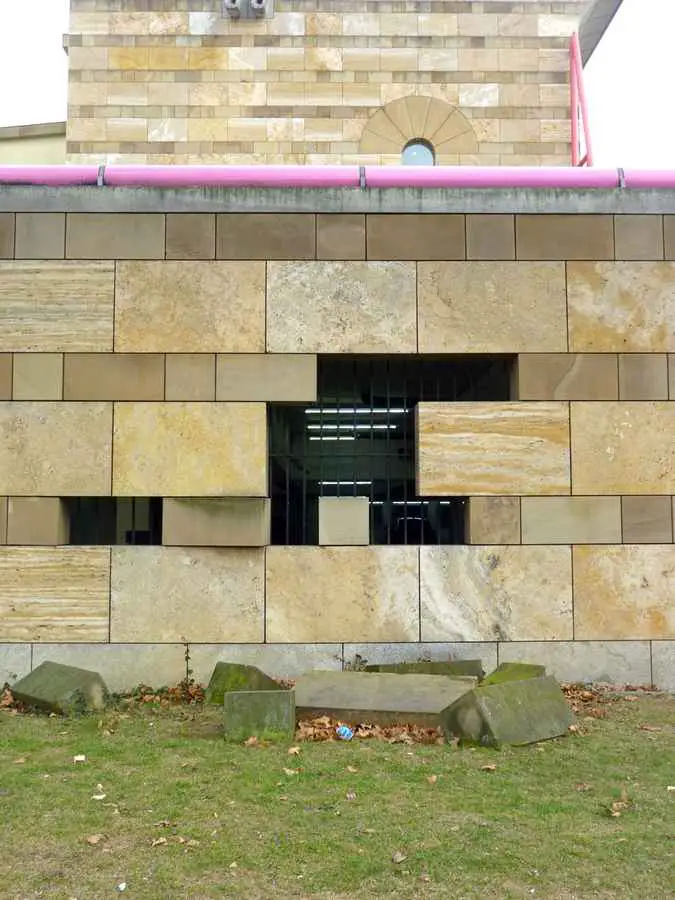
But success with spectacle does not necessarily carry over into other fields and aesthetics. The architectural precepts of the Third Reich were often quite dim and dull; even though he was himself something of a German cultural conservative, the emigre art historian Nikolaus Pevsner wrote in 1943 of the buildings of National Socialism, "the less said, the better." A number of postwar architects would create a much more fruitful and intellectually stimulating experiments with the materials and forms used by Speer. The Brutalists, for example, were much more experimental in their use of ferro-concrete and stark forms than Speer and his contemporaries. Even though Brutalism largely failed as an aesthetic movement and produced buildings that were quite ugly and aged badly, the Brutalists had a much more coherent rationale behind their building forms. Some postmodernist architects also intersected with ideas behind ruin theory, but within a more subversive fashion. Stuttgart's Neue Staatsgalerie designed by James Stirling's team has a section of crumbling masonry as an intrinsic part of the design. But this was a more playful and direct way of conveying to the public the idea of impermanence.
In the end, there are very few defenders of Speer's architectural designs is because there is very little to defend. Léon Krier does defend Speer in his book Albert Speer: Architecture 1932–1942, but the reviews of the book tended to note Krier did not really succeed in his case and note this defense was more contrarian than principled. His greatest successes involved embellishing the image of a dictatorial regime whose aesthetic principles were poorly thought-out and often contradictory. The ruin-theory had little weight within the architectural community because those who engaged in ti postwar were doing so for different reasons than Speer. Postmodern ruin theory- if it can be termed as such- is about stressing the folly of man thinking things last while Speer's ruin theory was a ex post facto attempt to divorce his gargantuan buildings from the political cause they supported.
Sources
Düwel, Jörn, and Niels Gutschow. A Blessing in Disguise: War and Town Planning in Europe, 1940-1945. Berlin: DOM Publishers, 2013.
Kitchen, Martin. Speer: Hitler's architect. New Haven: Yale University Press, 2015.
Taylor, Robert R. The Word in Stone; The Role of Architecture in the National Socialist Ideology. Berkeley: University of California Press, 1974.