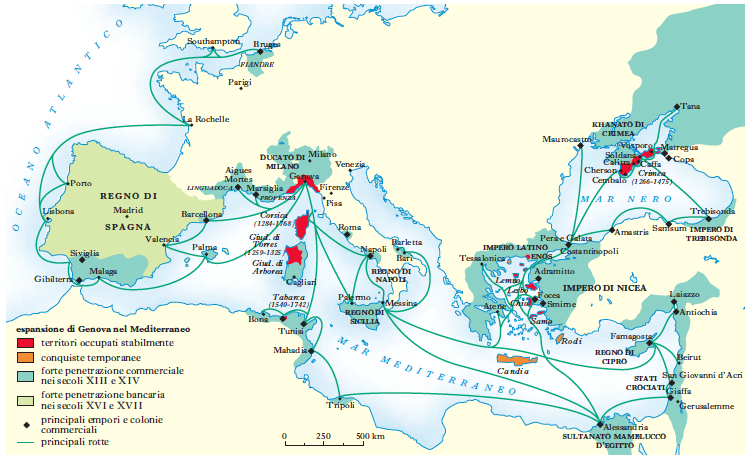
The Italians did, just not in the New World. The Republic of Venice had an extensive colonial empire in the eastern Mediterranean, encompassing all of Istria and Dalmatia as well as the islands of Crete, Corfu, Negropont, and Cyprus, as did the Republic of Genoa. However, Italian colonies were used as bases from which to protect trade in areas of interest; and the Atlantic Ocean was much less up their alley. Plus, the Venetians and the Genoese were already expending lots of money and resources to defend these colonies from the Ottoman Empire as well as from each other! The Italian states had to first contest the crowded Mediterranean waters before they could even think of crossing the Atlantic, made all the more difficult by the fact that the Italian states were almost continuously at war between 1494 (four years after Columbus' voyage) and 1559. They not only missed out on the entire early colonization process, but by the second half of the 16th century, the Italian states were exhausted and in no position to start founding colonies anywhere. In fact, they entered a long period of economic and political stagnation.
It's worth noting that there was peripheral involvement by Italians beyond the early navigators, albeit never at the state level. Columbus' first voyage was partially financed by Genoese bankers, and after King Francis ceded the Duchy of Milan to Charles V of Spain (and Austria) the Republic of Genoa, which had been a Milanese Client-State for much of the fifteenth century, became an important client of the Spanish Empire; not only was the Genoa-Milan-Burgundy axis and important supply line for the Spanish Netherlands, but Genoese investors and merchants played an important role in financing Spanish expansion in the Americas.
After unification they did. Italy had some holdings in East Africa and Libya. The German empire controlled large areas of africa and parts of the far east. Both countries lost their lands as a result of the world wars