How long would have it taken a farmer who lives away from the city to receive the news in 1865?
Fantastic question. It would depend on where in rural America you lived, and how far from a telegraph line.
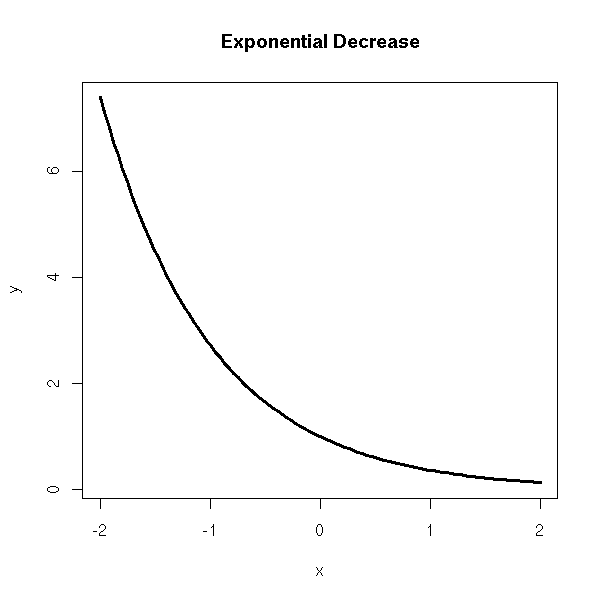
Generally, the proportion of uninformed Americans would follow a curve that looks somewhat like this. I'll argue that a huge proportion of Americans would be informed within 24 hours. Within 48 hours, most Americans would know. Within a week, it'd be 90 percent. Within a month, 99.9 percent.
The first factor to consider is the telegraph. By 1865, the telegraph was a mature technology, in use around the world and across the United States. This wonderful map, dating from 1867, illustrates the spread of telegraph lines in 1863. Telegraph lines generally (but not always) paralleled railroad tracks because the right-of-way was cleared, and maintenance access was easy. Navigable rivers were used as telegraph routes for the same reasons. In places where a long-distance telegraph line did not parallel a railroad or a river, as with the transcontinental telegraph line, the line operators had to operate a string of maintenance and relay stations ─ an expensive proposition, which is why telegraph lines usually accompanied the spread of railroads.
Railroads were frequent telegraph customers, but so were newspapers, which spent enormous sums to be the first with access to the limited numbers of telegraph wires available. In 1865, the multiplexer had not yet been invented, so the number of signals was defined by the number of wires. A newspaper with the earliest access to news by telegraph would have a huge advantage in attracting readership (and thus advertisers).
Lincoln was shot in the late hours of April 14, and he died in the early hours of April 15. Despite the short turnaround time (and the huge difficulties involved with typesetting news on a short deadline), morning newspapers in major cities across the country carried reports that Lincoln was shot. The Cleveland (Ohio) Morning Leader proclaimed on the morning of April 15 that Lincoln had been shot, and the wound was likely mortal. Other big-city newspapers did the same, and as word came in that Lincoln had died, many published "extra" editions that updated the story. The Nashville Union was one example, spreading word to middle Tennessee that Lincoln had been killed by "rebel fiends."
By the time the evening newspapers were setting their type, the news of Lincoln's death had spread across the country, to virtually every telegraph station connected to the nationwide network. In Burlington, Vermont, the editors of the Burlington Free Press wrote on April 21, "The shock which reached the hearts of millions Saturday morning, when told that [Friday] evening ABRAHAM LINCOLN, the President of the United States, was assassinated in a peaceful assembly at Washington, cannot be described. It is a horror which can only be felt."
In distant Washington Territory, the Washington Standard had just finished publishing its April 15 issue when word arrived. "Last Saturday, after the regular edition of our paper had been issued," the editors of the Standard wrote one week later, "was received the awful intelligence which has caused such a pall to fall over the nation. Our pure-minded, noble-hearted President is no more." In Sacramento, California, news spread quickly enough on the 15th that the city's leaders asked for residents to gather at the state assembly chamber at 3 p.m. "At the hour designated, a large audience had assembled, and very soon the numbers became so great that many could not gain admission to the hall," the paper wrote.
In Grand Haven, Michigan, the westernmost terminus of the D&M Railroad and the westernmost Michigan town connected by telegraph, the Grand Haven News received word on Saturday but didn't publish an issue until April 19. When it did, it shared an account from the Washington Times. In the 19th century, newspapers (and people in general) shared content with all the frequency and ease given to us by Facebook and Twitter. Copyright on news items was enforced on a scattered basis, and while people themselves couldn't post news links on Facebook, they frequently shared old issues of newspapers with each other.
In rural communities away from the telegraph lines, this sharing ─ as well as word of mouth ─ had a huge impact. So did the U.S. Mail, which tended to use the fastest-available transportation to carry newspapers and letters. Jeff Pasley's The Tyranny of Printers discusses how interested rural residents would sometimes gather at the post office to get the latest issues of telegraph-connected newspapers as they arrived. Journalists in those small towns would be among the group as well, picking up information for their own dispatches. A horse might travel 20-50 miles per day from a telegraph station, and you might consider that news would spread in a circle at that pace outward. Steamboats and ships at sea would travel much faster.
In 1865, St. Cloud, Minnesota was a small town on the Mississippi River northwest of St. Paul, the state capital. St. Paul wasn't connected to the nationwide railroad network (though it had a small railroad of its own). St. Paul was connected to the telegraph network, even if St. Cloud wasn't. News of Lincoln's assassination reached St. Cloud on April 17, and it was published in the St. Cloud Democrat on April 20. "HE IS DEAD!" the paper mourned. "Oh, God! What precious blood dost Thou require with which to place Thy seal upon the new born liberty of the Republic! Thousands created in Thine image had yielded up their lives for that of the nation, and by Thy favor, after years of suffering, we were made to cry with joy, that our brightest hopes were being consummated. But now, Oh God! Thou hast stricken the light from our eyes ─ Thou has taken our great, good and mighty ruler, our wise counsellor. ABRAHAM LINCOLN IS DEAD!"
In Oskaloosa, Kansas, the news of Lincoln's death arrived in time for the issue of April 22. In Brownville, Nebraska Territory, it didn't arrive in time for the issue of April 20, but it did appear in the issue of April 27. In Virginia City, Montana Territory, the news reached the gold rush town on the morning of April 29. "Intelligence the most painful has flashed along the telegraphic wires to us this morning [ed. the first telegraph line into Montana Territory didn't come until 1866] ─ news that is so fraught with horror that we can scarcely persuade ourselves but that we are the victims of some hideous dream," the paper's editor wrote.
In distant Santa Fe, New Mexico, which was hundreds of miles from a railroad or telegraph line, news of the president's assassination didn't arrive until the last day of April,, more than two weeks after Lincoln's death. "The heart of this community was grief-stricken on Saturday last upon the receipt from the States of the sad intelligence of the assassination of President Lincoln in Washington City on the 14th of April," the paper wrote May 6. "That which would otherwise have been a joyful day in consequence of the glad news of near approaching peace, was one of gloom and sadness."
Who would have been the last to hear about it?
Follow-up, for breaking news, was the telegraph used?
Hello everyone,
In this thread, there have been a large number of incorrect, speculative, or otherwise disallowed comments, including many asking about the deleted comments, which merely compounds the issue. As such, they were removed by the mod-team. Please, before you attempt to answer the question, keep in mind our rules concerning in-depth and comprehensive responses. Answers that do not meet the standards we ask for will be removed, and posters who break the rules of the subreddit admonished as applicable.
This thread is trending high in the subreddit, but those upvotes represent interest in the question itself, and it can often take time for a good answer to be written. We know that it can be frustrating to come in here from your front page and see only [removed] and this post, but we ask for your patience and understanding. If you are looking for some interesting content in the mean time, we hope you will check out our Twitter, the Sunday Digest, or the Monthly "Best Of" feature. It is very rare that a decent answer doesn't result in due time, so please do come check into the thread in a few hours. A Private Message to the Remind Me bot is a good way to remember.
Additionally, it is unfair to the OP to further derail this thread with off topic conversation, so if anyone has further questions or concerns, I would ask that they be directed to modmail, or a META thread. Thank you!